Table of Contents
What Is Driving the Shortage in the IC Socket Market?
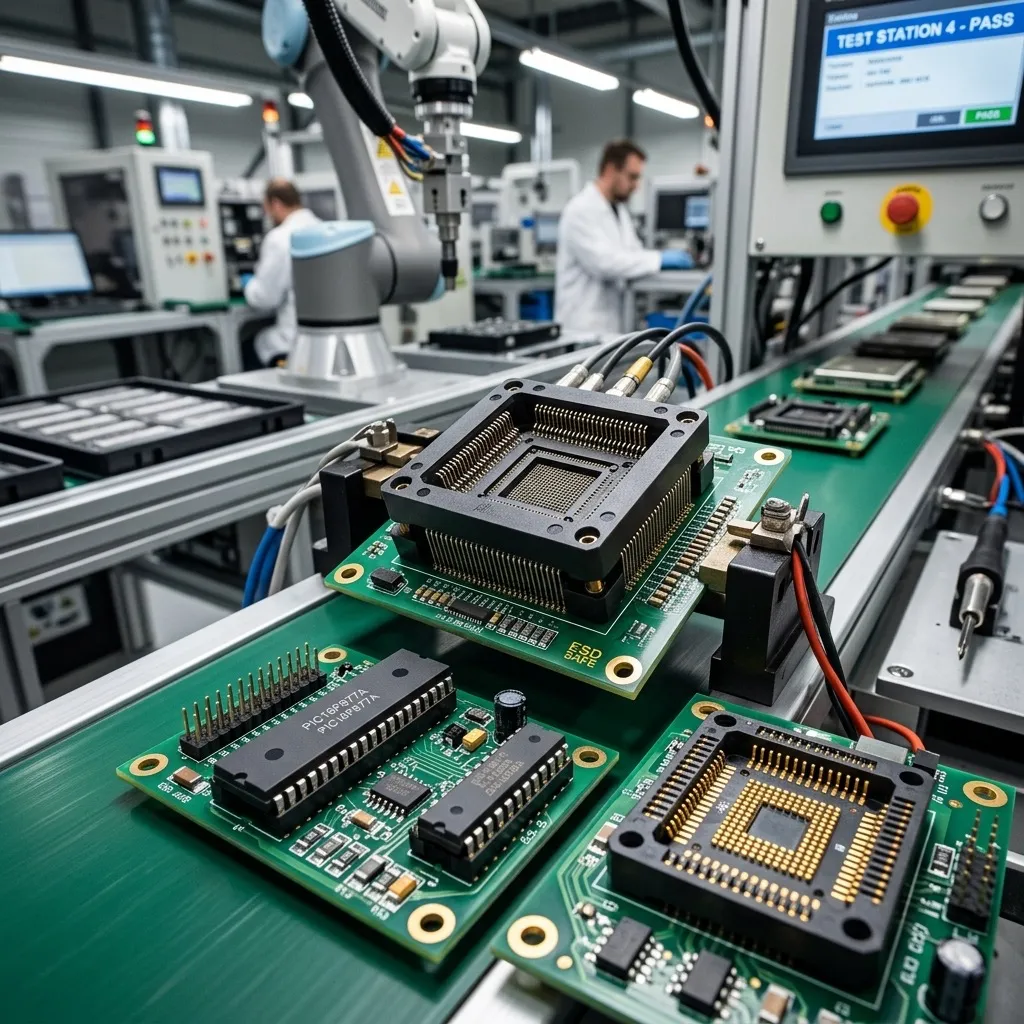
The explosion in advanced semiconductor packaging (like TSMC’s CoWoS) for AI logic chips has triggered an acute bottleneck in the global IC socket market, pushing lead times for both high-end test sockets and legacy DIP microcontroller sockets to 18-24 weeks. According to a Q2 2026 report by SEMI, the demand for precision-machined BGA test sockets used in AI GPU burn-in testing has surged by 45% year-over-year. This high-margin demand has forced major socket manufacturers to reallocate their finite CNC machining capacity and engineering-grade polymers (like Torlon and PEEK) away from standard production sockets. Consequently, procurement teams sourcing everyday dip microcontroller socket components for industrial automation or legacy systems are facing unprecedented de-commits and allocation hurdles.
As a specialized electronic components distributor, we are fielding daily panicked requests for basic interconnect devices that used to be readily available off-the-shelf. Just last week, we assisted a major industrial controller manufacturer in Europe who was completely shut down because a 40-pin DIP socket from TE Connectivity was pushed out by 20 weeks. We sourced 10,000 pieces of an exact cross-reference from a vetted independent channel within 4 days.
This article explores the structural shifts in the interconnect industry and how you can secure supply in a tightening market.
How Does Advanced Packaging Impact Legacy Socket Supply?
It might seem counterintuitive that the boom in $30,000 AI servers affects the supply of a $0.50 DIP socket. Why are they connected?
The connection lies in the raw materials and the manufacturing capacity constraint:
- Material Shortages (High-Performance Plastics): Both advanced test sockets and high-reliability production sockets rely on specialized liquid crystal polymers (LCP) and high-temp resins. The aerospace and AI sectors are consuming these materials at an unprecedented rate, creating a structural deficit.
- Tooling and CNC Constraints: Socket manufacturers have finite tooling capacity. When a top-tier fabless company orders 5,000 custom test sockets for a new AI accelerator, the socket vendor immediately reassigns their precision tooling lines, deprioritizing the production runs of standard catalog parts.
What Are the Viable Cross-Reference Strategies for IC Sockets?
Unlike active semiconductors (like MCUs or FPGAs) where a cross-reference requires firmware rewrites, IC sockets are fundamentally mechanical interconnects. How can you leverage this mechanical nature to survive allocation?
When franchised lead times fail, cross-referencing is your strongest weapon. Here is how we evaluate P2P (Pin-to-Pin) replacements for sockets:
| Critical Parameter | Evaluation Criteria | Sourcing Flexibility |
|---|---|---|
| Pitch and Pin Count | Must match exactly (e.g., 2.54mm pitch for DIP, 0.8mm for BGA). | Zero flexibility. |
| Contact Plating | Gold (Au) vs. Tin (Sn). Gold is required for high-cycle test sockets or corrosive environments. | Moderate flexibility. Can often upgrade to Gold if Tin is unavailable. |
| Current Rating | Maximum current per pin (e.g., 1A or 3A). | High flexibility. Can use a higher-rated socket. |
| Insulator Material | Temperature rating (e.g., FR4, PPS, PEEK). | Moderate flexibility. Must meet or exceed the maximum operating temperature of the original part. |
When a specific 3M or Mill-Max socket is unavailable, there are often highly capable alternatives from secondary manufacturers in Taiwan or Japan that utilize identical tooling standards.
How Can Procurement Mitigate Socket Shortages in Q3 2026?
The global IC socket market will remain constrained as long as the AI packaging bottleneck persists. What immediate actions should your purchasing department take?
- Evaluate Generic Form Factors: If your BOM explicitly calls out a premium brand for a standard dip microcontroller socket, authorize your engineering team to approve generic equivalents. The mechanical standard for a DIP socket hasn’t changed in decades; paying a premium for a specific logo is unnecessary when supply is tight.
- Consolidate Your Vendor Base: Do not try to source 5 different sockets from 5 different brokers. Partner with an independent distributor who has deep ties to the interconnect supply chain in Asia.
- Forward-Buy Critical Test Sockets: If your production relies on specific burn-in or programming sockets, these are consumable items with a finite lifespan (number of insertions). Do not wait until the socket fails to order a replacement; the 12-week lead time will paralyze your line.
Sources:
- SEMI, “2026 Global Semiconductor Packaging Materials Outlook”
- Electronic Sourcing, “Interconnect Lead Time Trends Q2 2026”
- IPC, “Standard for High-Performance IC Sockets”
- IEEE Xplore, “Thermal Management in High-Density BGA Test Sockets”
- SupplyICs Solutions, “Custom Interconnect Procurement”
[!TIP] Struggling to find standard DIP sockets or complex BGA test fixtures? Send your BOM and critical specs to our team. We maintain deep relationships with premier interconnect manufacturers and hold allocated stock. Check our Solutions page for more details.
Frequently Asked Questions (FAQ)
Why is there a shortage in the IC socket market in 2026?
The rapid transition to advanced CoWoS packaging for AI chips has consumed the vast majority of precision machining and high-grade polymer resin capacity, leaving legacy DIP microcontroller sockets and standard burn-in sockets with lead times stretching up to 24 weeks.