Table of Contents
- Why EOL Notices Are Accelerating
- The True Cost of EOL Management
- Building an EOL Risk Management Framework
- 1. BOM Health Monitoring
- 2. Strategic Inventory Planning
- 3. Alternative Sourcing Strategies
- 4. Redesign and Replacement Planning
- Counterfeit Prevention in the EOL Market
- Case Study: Managing a Legacy Defense Program BOM
- Key Takeaways for Procurement Professionals
Semiconductor manufacturers issued over 12,000 End-of-Life (EOL) notices in 2025, according to industry tracking data compiled by IHS Markit and SiliconExpert. The pace is accelerating in 2026, driven by foundry capacity reallocation toward advanced nodes, the consolidation of legacy product lines, and the sunsetting of 200mm and 150mm wafer fabs that can no longer justify their operating costs.
For procurement professionals managing products with lifecycles measured in decades—defense systems, industrial equipment, medical devices, aerospace platforms—EOL component management has moved from a periodic inconvenience to a core competency.
Why EOL Notices Are Accelerating
Several structural forces are driving the acceleration of EOL activity:
Foundry Capacity Migration. TSMC, Samsung, and GlobalFoundries are reallocating 200mm and 150mm capacity away from low-margin, low-volume legacy products toward higher-value specialty nodes (BCD, SiGe, MEMS, GaN-on-Si). A product that generated $5 million in annual revenue on a 200mm line may consume capacity that could generate $50 million for a specialty automotive or industrial process. The economics are unforgiving.
Consolidation of Product Lines. The wave of semiconductor industry consolidation (ADI-Maxim, Renesas-Dialog, Infineon-Cypress, Intel-Altera) has generated thousands of overlapping product lines. Post-merger integration invariably includes SKU rationalization, and legacy products with declining revenue are the first to go.
Substrate and Packaging Obsolescence. Many legacy components use leadframe packages, ceramic substrates, or assembly processes that are themselves approaching obsolescence. When the sole supplier of a specific ceramic PGA package discontinues production, every semiconductor product using that package becomes EOL by default.
Regulatory Pressures. The transition to lead-free (RoHS), halogen-free, and conflict-mineral-free manufacturing has forced the discontinuation of legacy products that cannot economically be re-qualified with compliant materials. The EU’s forthcoming restriction on PFAS (per- and polyfluoroalkyl substances) is expected to trigger another wave of EOL notices for components using fluoropolymer packaging materials.
The True Cost of EOL Management
The financial impact of EOL component management is often underestimated. A 2025 study by the Aerospace Industries Association (AIA) quantified the costs:
| Activity | Typical Cost |
|---|---|
| Engineering redesign for a single EOL component | $50,000 - $250,000 |
| System re-qualification (military/aerospace) | $500,000 - $5,000,000 |
| Lifetime buy inventory carrying costs (10 years) | 150-300% of component acquisition cost |
| Production line stoppage (per day) | $50,000 - $500,000 |
| Aftermarket sourcing (premium pricing) | 3-10x original component cost |
For a mid-size defense contractor managing 500 active BOMs, annual EOL-related costs routinely exceed $10 million.
Building an EOL Risk Management Framework
Effective EOL management begins long before a PCN (Product Change Notification) arrives. A proactive framework has four pillars:
1. BOM Health Monitoring
Every component on every active BOM should be assigned an obsolescence risk score based on objective criteria:
-
Lifecycle Stage: Is the product in active production, not recommended for new design (NRND), or already EOL? Semiconductor manufacturers publish lifecycle status data through IHS Markit, SiliconExpert, and direct PCN notifications.
-
Supplier Concentration: Is the component single-sourced? What is the financial health of the supplier? Has the supplier announced any fab closures or product line rationalizations?
-
Technology Node: Components fabricated on 150mm or 200mm wafers at nodes above 90nm are at elevated risk. The foundry economics of these nodes are deteriorating rapidly.
-
Market Demand Trajectory: Is the end-market for the component growing or contracting? Components serving declining markets (e.g., DSL modem chipsets, 2G/3G baseband processors) face higher discontinuation risk.
-
Substitute Availability: Are there pin-compatible, drop-in replacements? Are there functional equivalents requiring minor board modifications? Is a full redesign required?
Automated BOM scrubbing tools (SiliconExpert, IHS BOM Manager, Z2Data, Accuris) can perform this analysis at scale, but they require human interpretation. A component flagged as “medium risk” by an algorithm may be critical to a $100 million program—or irrelevant to a prototype build.
2. Strategic Inventory Planning
When a component is identified as high-risk, procurement teams have several inventory strategies:
-
Lifetime Buy (LTB): Purchase the entire forecasted lifetime requirement in a single order. This is the most common approach but ties up working capital and creates storage, obsolescence, and counterfeiting risks over long time horizons. For components with 20-year program lifecycles, the LTB quantity must account for attrition, handling losses, and rework.
-
Scheduled Buy: Negotiate with the supplier for multiple scheduled deliveries over an extended period, allowing for final wafer purchases to be stored in die bank and packaged as needed. This reduces upfront cash outlay but requires supplier cooperation that may not be forthcoming for low-volume products.
-
Die Bank Agreements: Purchase wafers or bare die and arrange with an OSAT provider for packaging on demand. This is the gold standard for long-lifecycle programs but requires significant engineering resources to manage die storage conditions, bond pad metallurgy compatibility, and package qualification.
3. Alternative Sourcing Strategies
The open market for EOL and obsolete components is large—estimated at $5-7 billion annually—but navigating it requires expertise:
-
Authorized Aftermarket Suppliers: Companies like Rochester Electronics, Lansdale Semiconductor, and Flip Electronics have licensed manufacturing agreements with original component manufacturers. They produce discontinued components using original die, masks, and test programs. Parts sourced through authorized aftermarket channels carry full manufacturer warranty and traceability.
-
Independent Distributors: The independent channel provides access to excess inventory, broker stock, and factory overrun. Quality and authenticity vary dramatically. Procurement teams should maintain an Approved Vendor List (AVL) of independent distributors that have passed rigorous qualification audits including facility inspection, ESD protocol verification, and supply chain traceability review.
-
Component Remarketing: Specialized remarketing firms purchase excess inventory from OEMs and CMs and resell it with full traceability documentation. This is an increasingly important source for EOL components, particularly for defense and aerospace programs where traceability to the original component manufacturer is mandatory.
4. Redesign and Replacement Planning
When all sourcing options are exhausted, redesign is the only path forward:
-
Form/Fit/Function Replacements: Ideally, the replacement component is a drop-in substitute requiring no board changes. This is rare for EOL components but should be the first option investigated.
-
Minor Redesign: A different package or slightly different pinout may require a board re-spin but preserves the core electrical design. For through-hole to surface-mount conversions, this is often the most cost-effective approach.
-
Full Redesign: When the original component has no functional equivalent, a complete subsystem redesign is required. This should trigger a broader obsolescence review—if one component on a board has gone EOL, others are likely to follow.
Counterfeit Prevention in the EOL Market
The EOL component market is the primary vector for counterfeit semiconductors. When legitimate supply dries up and demand persists, counterfeiters fill the void. The U.S. Department of Defense has documented counterfeit components in over 1,800 separate defense supply chain incidents, with the majority involving EOL or obsolete parts.
A robust counterfeit prevention program for EOL sourcing should include:
-
Supplier Qualification: Source only from authorized distributors or independent distributors that have passed a rigorous on-site audit. Require evidence of supply chain provenance for every shipment.
-
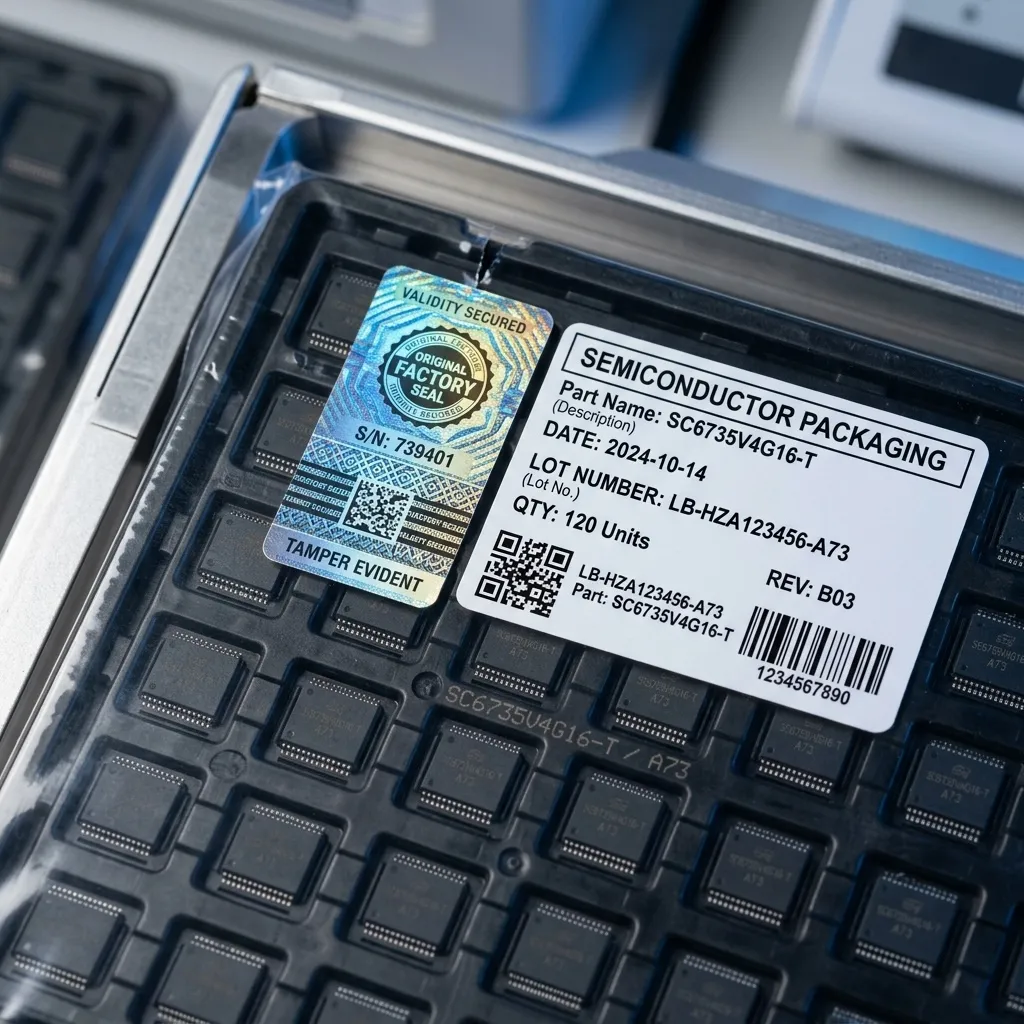
Incoming Inspection Protocol: Implement a risk-based inspection protocol aligned with SAE AS6081 (Counterfeit Electronic Parts; Avoidance, Detection, Mitigation, and Disposition) and IDEA-STD-1010 (Acceptability of Electronic Components):
- Level 1 (Low Risk): Visual inspection, documentation review, marking permanency testing
- Level 2 (Medium Risk): Level 1 plus X-ray inspection, solderability testing, and electrical verification against manufacturer data sheet parameters
- Level 3 (High Risk): Level 2 plus decapsulation/delidding with die marking verification, Scanning Acoustic Microscopy (SAM), and X-ray Fluorescence (XRF) material analysis
-
Traceability Documentation: Maintain full chain-of-custody documentation for every EOL component procurement, from the original component manufacturer through every intermediary. Gaps in traceability are the primary red flag for counterfeit infiltration.
-
Test and Screening: For high-reliability applications, consider third-party test and screening to verify authenticity and electrical performance. Labs approved to MIL-STD-883 and MIL-STD-750 can perform temperature cycling, burn-in, and hermeticity testing.
Case Study: Managing a Legacy Defense Program BOM
A notional case study illustrates the EOL management challenge:
Program: Shipboard radar system, originally designed 2005, expected service life through 2040 BOM: 847 unique line items, 312 semiconductor components EOL Challenge: 47 components (15%) went EOL between 2020 and 2025; an additional 89 components (28%) are projected to go EOL before 2030
The procurement team’s response:
- Year 1: Conducted full BOM scrub; identified 47 EOL and 89 high-risk components; executed LTBs for 22 components with irreplaceable functionality; qualified authorized aftermarket sources for 15 components
- Year 2: Completed die bank agreements for 8 high-criticality ASICs; initiated redesign for subsystems containing 10 EOL components
- Year 3: Completed redesign and qualification; established ongoing BOM monitoring program with quarterly reviews
Total cost: $4.2 million. Avoided cost of unplanned line stoppage: estimated $18 million.
Key Takeaways for Procurement Professionals
-
Start Early: EOL management begins at the design phase. New designs should, wherever possible, use components from suppliers with published lifecycle management policies and long-term support commitments.
-
Invest in Data: Automated BOM monitoring tools are not cheap, but they are far cheaper than an unplanned line stoppage. Integrate lifecycle data into your ERP and PLM systems.
-
Build Relationships: The independent distribution channel, when properly vetted, is a legitimate and essential source for EOL components. Invest time in qualifying suppliers before you need them.
-
Plan for the Worst: Every procurement team should have a documented EOL response plan that covers notification procedures, impact assessment, sourcing options, and escalation pathways.
-
Embrace Redundancy: Dual-sourcing, pin-compatible alternatives, and die bank agreements are insurance policies that pay off when EOL notices arrive.
SupplyICs specializes in sourcing EOL, obsolete, and hard-to-find electronic components with full traceability and authenticity verification. Our global network of authorized aftermarket suppliers, independent distributors, and factory-direct sources has resolved thousands of EOL sourcing challenges. Contact our obsolescence management team to discuss your specific requirements.
Frequently Asked Questions (FAQ)
What are the main sourcing challenges for this semiconductor family in 2026?
Sourcing End-of-Life (EOL) electronic components requires strict quality auditing. Procurement teams should analyze packaging configurations, perform ...