Table of Contents
- Automotive Ethernet PHY Transceivers and Zonal Networking Sourcing Guide
- Which automotive Ethernet PHYs are best suited for zonal and backbone networks in 2026?
- How do Realtek, Microchip, NXP, and Infineon PHYs compare in EMC reliability and BOM cost?
- What are the critical sourcing strategies for zonal gateway controllers?
Automotive Ethernet PHY Transceivers and Zonal Networking Sourcing Guide
Which automotive Ethernet PHYs are best suited for zonal and backbone networks in 2026?
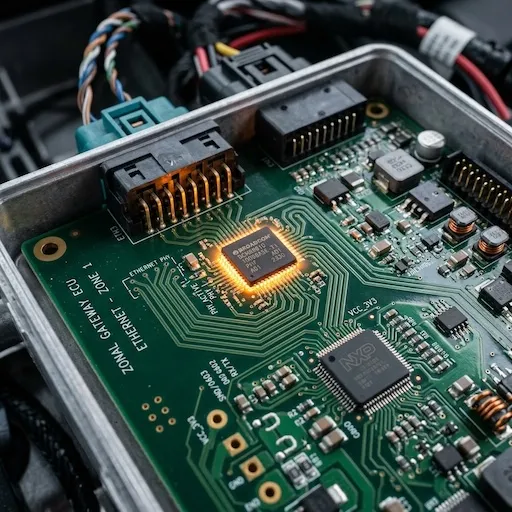
The legacy approach of connecting dozens of distributed Electronic Control Units (ECUs) via CAN or LIN buses has reached its physical limits. In 2026, modern vehicle architectures have pivoted to a “Zonal and Central Compute” topology. In this model, edge sensors (cameras, LiDAR, radar) connect to localized zonal gateways, which aggregate the data and transmit it via high-speed Ethernet backbones to a central compute unit.
This architectural shift places extreme demands on the physical layer (PHY). The ideal automotive Ethernet PHY for a zonal network must support:
- 1000BASE-T1 (1 Gbps) over a single unshielded twisted pair (UTP): Crucial for reducing wiring harness weight, which directly impacts EV battery range.
- Multi-Gigabit Support (2.5G/5G/10GBASE-T1): Required for the central backbone linking zonal gateways to the high-performance compute (HPC) domains.
- Time-Sensitive Networking (TSN): Essential for deterministic data delivery, ensuring that braking sensor data prioritizes over infotainment streaming.
Major automotive OEMs are standardizing their designs around PHYs that integrate seamlessly with TSN switches. The Realtek RTL8198D series, for example, has gained significant traction due to its robust 1000BASE-T1 performance and seamless integration capabilities in highly compact gateway modules.
How do Realtek, Microchip, NXP, and Infineon PHYs compare in EMC reliability and BOM cost?
When evaluating the automotive MCU and PHY supply chain, procurement teams face a complex matrix of trade-offs between technical compliance, cost, and availability.
- NXP and Infineon (The Reliability Leaders): These European stalwarts are deeply embedded in the automotive ecosystem. Their PHYs exceed standard AEC-Q100 requirements, offering exceptional Electro-Magnetic Compatibility (EMC) performance crucial for EVs, where high-voltage inverters generate massive electromagnetic interference. Furthermore, they provide comprehensive safety manuals to achieve ASIL-B or ASIL-D certification. The trade-off is typically a higher unit BOM cost and, historically, longer lead times during supply crunches.
- Realtek (The Integration & Cost Disruptor): Moving beyond its legacy in PC networking, Realtek has heavily penetrated the automotive sector. Chips like the RTL8198D offer aggressive pricing structures and excellent low-power modes. For OEMs focused on aggressive cost-down initiatives for mid-tier EVs, Realtek provides a highly compelling ROI, though stringent validation for harsh EMC environments remains a key step for integrators.
- Microchip (The Stability Anchor): Microchip’s automotive Ethernet portfolio (bolstered by their historic acquisition of Micrel) is renowned for interoperability and unparalleled long-term supply stability. Their “client-driven obsolescence” policy ensures that PHYs designed into a 2026 vehicle platform will remain available through the vehicle’s 15-year lifecycle.
2026 Automotive Ethernet PHY Vendor Comparison
| Vendor | Key Strengths | Optimal Use Case | Relative BOM Cost |
|---|---|---|---|
| NXP / Infineon | Elite EMC performance, ASIL-D readiness | Central compute, ADAS backbone, high-voltage zones | $$$ |
| Microchip | Longevity guarantees, strict interoperability | Commercial vehicles, industrial-auto crossovers | $$ |
| Realtek | Aggressive pricing, rapid iteration | Infotainment zones, cost-sensitive EV gateways | $ |
What are the critical sourcing strategies for zonal gateway controllers?
Securing the physical silicon for zonal gateways requires mitigating the inherent volatility of the automotive semiconductor market. Procurement must evolve from transactional purchasing to strategic lifecycle management.
- Enforce Multi-PHY Footprint Designs: Engineering teams must be mandated to design printed circuit boards (PCBs) that can accept pin-to-pin (P2P) compatible PHYs from at least two different vendors. If an NXP PHY goes on 52-week allocation, a Microchip alternative should drop in with zero hardware spin required.
- Prioritize Cable Diagnostic Capabilities: In 2026, the cost of diagnosing a faulty wire harness in a dealership far exceeds the cost of the silicon. Source PHYs that feature integrated Time Domain Reflectometry (TDR) to detect opens, shorts, and degradation in the UTP cables before they cause critical system failures.
- Audit the Full TSN Software Stack: The hardware PHY is only half the equation. Ensure that the chosen silicon vendor provides mature, AUTOSAR-compliant driver software for Time-Sensitive Networking features. A cheap PHY with an immature software stack will incur massive hidden development costs.
Frequently Asked Questions (FAQ)
Which automotive Ethernet PHYs are best suited for zonal and backbone networks in 2026?
For zonal architectures, 1000BASE-T1 and Multi-Gig PHYs from NXP, Microchip, and Realtek (like the RTL8198D) are best suited due to their low latency, strict EMC compliance, and robust cable diagnostics.
How do Realtek, Microchip, NXP, and Infineon PHYs compare in EMC reliability and BOM cost?
NXP and Infineon lead in stringent automotive EMC reliability and ASIL-B/D safety support. Realtek offers highly competitive BOM cost and strong integration, while Microchip provides exceptional long-term supply stability.