Table of Contents
- What Exactly Is an Envelope Tracking IC and Why Does It Matter?
- Which Market Segments Are Driving ET Chip Demand?
- 5G Smartphones: The Volume Driver
- 5G Base Stations: The Value Driver
- IoT and CPE: The Emerging Segment
- Supplier Landscape: Who Makes Envelope Tracking ICs?
- What Are the Key Procurement Risks for ET Chips in 2026?
- 1. Platform Lock-In
- 2. Fab Concentration
- 3. Sub-6 GHz vs. mmWave Divergence
- Envelope Tracking vs. Alternative PA Efficiency Techniques
- Procurement Playbook: Securing ET IC Supply in a Constrained Market
- 1. Qualify Both Integrated and Discrete ET Approaches
- 2. Engage the ET IC Supplier During Baseband Platform Selection
- 3. Monitor GaN PA Adoption as a Leading Indicator
In a 5G base station transmitting at 64T64R Massive MIMO configuration, the power amplifier array can consume over 2 kilowatts. Without envelope tracking, roughly 75% of that power is dissipated as heat—wasted electricity that drives up operating costs and requires expensive active cooling. With envelope tracking, efficiency jumps to 45–55%, cutting annual electricity costs by tens of thousands of dollars per site.
This is not an incremental improvement. It is a step-function change in RF power efficiency, and the semiconductor industry has taken notice. The envelope tracking chip market is growing at a double-digit CAGR, and procurement teams involved in 5G infrastructure, handset manufacturing, and IoT device production need to understand the supplier landscape—because the part you need for your next-gen design may already be on allocation.
What Exactly Is an Envelope Tracking IC and Why Does It Matter?

An Envelope Tracking Power Supply IC is an advanced power management device that dynamically modulates the supply voltage of a power amplifier (PA) in real time to match the instantaneous amplitude—the “envelope”—of the RF signal being transmitted.
The core functional blocks:
- Envelope detector: Senses the incoming RF baseband signal amplitude
- ET modulator: A high-bandwidth DC-DC converter that slews the PA supply voltage at 80–150 MHz
- Linear amplifier: Provides fine voltage correction to track the envelope with microsecond precision
- Control interface: MIPI RFFE digital bus for modem-to-ET IC communication
The key technical challenge: the ET modulator must track a 100 MHz-wide 5G NR carrier envelope with less than 1% voltage error, while switching at multi-MHz frequencies. This requires advanced BiCMOS or SOI-CMOS process technology capable of combining high-speed analog and power stages on a single die—a capability that only a handful of semiconductor fabs possess.
Which Market Segments Are Driving ET Chip Demand?
5G Smartphones: The Volume Driver
Every premium 5G smartphone shipping in 2026 contains at least one envelope tracking IC—often two, for separate sub-6 GHz and mmWave PA chains. Qualcomm’s Snapdragon X80 modem-RF system integrates ET for n77/n78/n79 bands, while Apple’s custom RF front-end (using Qorvo and Broadcom PAs) employs discrete ET ICs from Qorvo and Skyworks.
With global 5G smartphone shipments projected to exceed 750 million units in 2026 (IDC), the ET chip volume alone represents a multi-billion-dollar component market. The procurement implication: smartphone OEMs booking 10M+ unit annual volumes can negotiate direct allocation with Qualcomm and Qorvo. Mid-tier OEMs (1–5M units) are dependent on distributor allocation, which tightens when premium OEMs ramp new model production.
5G Base Stations: The Value Driver
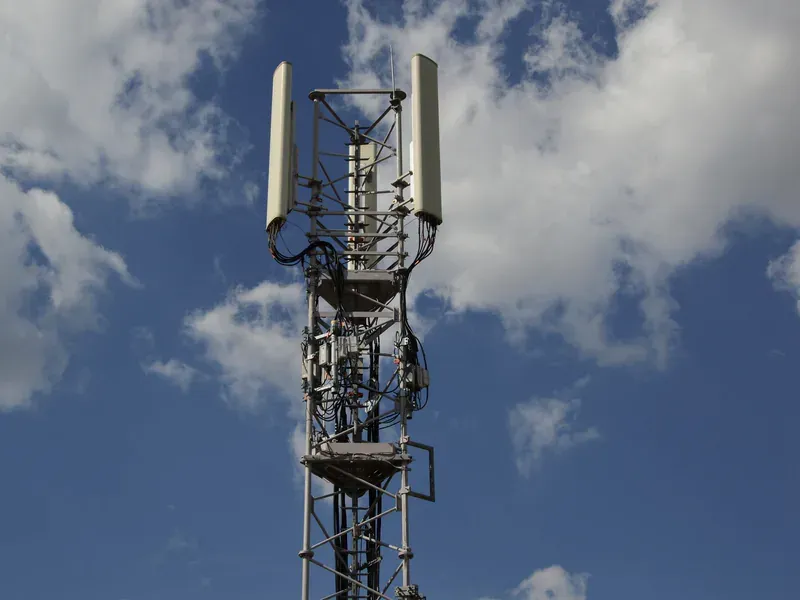
A single 64T64R Massive MIMO base station requires 64 PA chains, each with its own envelope tracking modulator. At GaN-based PA power levels (5–10W per channel), the ET IC must handle higher voltages (up to 15V supply modulation) and wider bandwidths than handset equivalents.
ADI (Maxim Integrated) and NXP Semiconductors are the primary ET modulator suppliers for infrastructure. Unlike the handset market (where ET ICs are tightly coupled to specific modem platforms), infrastructure ET modulators are more commoditized—but fabrication at the required BCD (Bipolar-CMOS-DMOS) process nodes limits the supplier base.
IoT and CPE: The Emerging Segment
Fixed wireless access (FWA) customer premises equipment, industrial IoT gateways with 5G connectivity, and private network small cells are creating a third demand tier for ET ICs. These applications require lower power (0.5–2W), smaller form factors, and wider temperature ranges than handsets—but the fundamental ET technology is identical.
Supplier Landscape: Who Makes Envelope Tracking ICs?
| Supplier | ET Product Family | Integration | Lead Time (Jul 2026) | Primary Market |
|---|---|---|---|---|
| Qualcomm | QET5100/QET6100 series | Integrated with Snapdragon X80 modem-RF | 20–30 weeks | Premium and mid-tier 5G handsets |
| Qorvo | QM78064/QM78065 family | Standalone ET IC; also integrated in RF Fusion modules | 18–26 weeks | Apple iPhone, Samsung Galaxy, Chinese OEMs |
| MediaTek | MT6305/MT6306 series | Integrated in Dimensity 9400/9500 platforms | 22–30 weeks | Chinese and Indian handset OEMs |
| Skyworks | SKY77660/SKY77661 series | Standalone and Sky5 module-integrated | 16–24 weeks | Samsung, Google Pixel, select Chinese OEMs |
| ADI (Maxim) | MAX9750 series | Standalone ET modulator for infrastructure | 24–32 weeks | 5G base station PAs |
| Samsung Semiconductor | Internal supply | Integrated in Exynos modem-RF platforms | Proprietary | Samsung Galaxy (selected models) |
Sources: Semiconductor Insight (April 2026), company product documentation, SupplyICs sourcing database (July 2026)
What Are the Key Procurement Risks for ET Chips in 2026?
1. Platform Lock-In
ET ICs are not interchangeable drop-in replacements. Qualcomm’s QET5100 communicates with the Snapdragon X80 modem via a proprietary MIPI RFFE command set. A Qorvo ET IC will not function in a Qualcomm RF front-end design without significant software and hardware rework. Once a design locks to a modem-ET platform, the procurement team inherits a single-source dependency that lasts the product’s lifecycle.
Risk mitigation: Before design freeze, evaluate whether an alternative modem-RF platform (e.g., MediaTek for cost-optimized designs, Samsung Exynos for vertical integration) provides more sourcing flexibility. The decision point is architectural, not procurement-level—which means procurement must be in the room during platform selection, not after.
2. Fab Concentration
Envelope tracking ICs require specialized BiCMOS, BCD, or RF-SOI process technology. The global fab capacity for these processes is concentrated:
- TSMC (Hsinchu, Taiwan): Primary foundry for Qualcomm, MediaTek ET ICs
- GlobalFoundries (Singapore, Dresden): RF-SOI for Qorvo, Skyworks ET ICs
- STMicroelectronics (Crolles, France): BCD for ADI infrastructure ET modulators
Any disruption at these three fabs—geopolitical, seismic, or operational—affects the majority of global ET IC supply. Procurement teams should map their ET IC supply to the specific fab and develop contingency plans for fab-specific disruptions.
3. Sub-6 GHz vs. mmWave Divergence
5G handsets increasingly require separate ET ICs for sub-6 GHz and mmWave PA chains. MmWave ET ICs operate at wider bandwidths (up to 400 MHz for 5G NR carrier aggregation) and require more advanced process nodes, further constraining supply. Procurement teams should not assume that a sub-6 GHz ET IC supplier can also provide mmWave ET ICs—the supplier landscape is different, and second-source qualification must be performed separately for each frequency band.
Envelope Tracking vs. Alternative PA Efficiency Techniques
| Technique | Efficiency Improvement | Complexity | Application |
|---|---|---|---|
| Envelope Tracking (ET) | 20–30% | High (requires ET modulator IC + digital pre-distortion) | 5G NR handsets, base station PAs |
| Average Power Tracking (APT) | 5–10% | Low (voltage DAC + simple control loop) | LTE handsets, NB-IoT, Cat-M |
| Doherty PA Architecture | 15–25% | Medium (dual-path PA design, no ET IC needed) | Base station PAs (alternative to ET) |
| Digital Pre-Distortion (DPD) | 5–10% | Medium (DPD processor/FPGA + feedback path) | Used in conjunction with ET or Doherty |
| Envelope Elimination and Restoration (EER) | 25–35% | Very High (complex polar architecture) | Niche military/aerospace applications |
For most 5G handset designs, ET is the only practical choice—the combination of high PAPR and tight power budgets makes APT insufficient and Doherty impractical at handset power levels. For base station designs, Doherty PA architectures offer a credible alternative that eliminates ET IC dependency, but at the cost of larger PCB area and narrower instantaneous bandwidth.
Procurement Playbook: Securing ET IC Supply in a Constrained Market
1. Qualify Both Integrated and Discrete ET Approaches
Integrated modem-RF platforms (Qualcomm, MediaTek) simplify design but create single-source dependency. Discrete ET ICs (Qorvo, Skyworks) offer supply flexibility but require additional integration engineering. The optimal strategy: design for the integrated platform for time-to-market but maintain a pin-compatible discrete ET IC footprint on the PCB for supply risk mitigation.
2. Engage the ET IC Supplier During Baseband Platform Selection
This is the highest-leverage intervention point. If your engineering team is evaluating three application processor/modern platforms, procurement should provide a supply risk assessment for each platform’s ET IC—covering lead time trends, fab concentration, and second-source availability. A platform that seems 5% more performant on paper but has a single-fab, single-supplier ET IC is a procurement risk that may outweigh the performance advantage.
3. Monitor GaN PA Adoption as a Leading Indicator
GaN-based power amplifiers for 5G base stations require different ET modulator specifications (higher voltage swing, wider bandwidth) than LDMOS-based PAs. As GaN adoption accelerates—driven by AI data center power demands and 5G mmWave deployments—the ET IC supply chain for infrastructure will tighten further. Procurement teams with base station BOMs should track GaN PA design wins as a leading indicator of future ET IC demand pressure.
Struggling with envelope tracking chip allocation for your 5G design? SupplyICs sources RF front-end components—including ET ICs, PAs, LNAs, and RF switches—from qualified global suppliers with full traceability. Upload your BOM or submit an RFQ for a response within 24 hours.
Frequently Asked Questions (FAQ)
How does envelope tracking technology improve 5G power amplifier efficiency?
Envelope tracking (ET) dynamically adjusts the power amplifier's supply voltage in real time to track the envelope of the transmitted RF signal. Instead of running the PA at a fixed voltage (wasting power as heat during low-amplitude signal periods), ET supplies only the voltage needed at each instant. For 5G signals with high peak-to-average power ratios (PAPR) of 8–12 dB, ET improves PA efficiency from roughly 25% (fixed-supply) to 45–55%, cutting heat dissipation by 40% and extending battery life in handsets by 15–25%. In base station PAs, the efficiency gain directly reduces cooling costs and electricity consumption.
Who are the leading envelope tracking chip suppliers and what are their lead times?
The ET chip market is concentrated among four primary suppliers: Qualcomm (integrated with Snapdragon X80 modem-RF systems, lead times 20–30 weeks), Qorvo (standalone ET ICs used by Samsung and Apple, 18–26 weeks), MediaTek (integrated in Dimensity platforms, 22–30 weeks), and Skyworks (standalone and module-integrated, 16–24 weeks). Samsung Semiconductor supplies ET ICs for its own Exynos platforms and select OEM partners. Secondary sources include Maxim Integrated (now ADI) for infrastructure ET modulators and efficient power conversion for base station applications.
What is the difference between envelope tracking and average power tracking for RF PAs?
Average Power Tracking (APT) adjusts the PA supply voltage based on the average output power over a frame or slot—it's slower, simpler, and adds ~5–10% efficiency improvement. Envelope Tracking adjusts the supply voltage on a microsecond timescale to match the instantaneous RF envelope—it is more complex, requires a high-bandwidth ET modulator IC, and adds ~20–30% efficiency improvement. ET is mandatory for 5G NR handsets operating in n77/n78/n79 bands where PAPR exceeds 10 dB. APT is sufficient for LTE-only and narrowband IoT applications where the efficiency gap is narrower.