Table of Contents
- HBM and DRAM Supply Chain Dynamics Amid the 2026 AI Bubble Correction
- How does the AI semiconductor bubble correction affect HBM and DRAM supply in Q2 2026?
- What percentage of global DRAM wafer capacity is shifting to HBM production?
- How can procurement managers navigate HBM supply shortages through 2027?
HBM and DRAM Supply Chain Dynamics Amid the 2026 AI Bubble Correction
How does the AI semiconductor bubble correction affect HBM and DRAM supply in Q2 2026?
Throughout 2024 and 2025, the narrative dominating the memory semiconductor cycle was one of infinite demand. The explosive rollout of large language models (LLMs) mandated massive arrays of GPUs, each heavily reliant on High Bandwidth Memory (HBM). This hyper-demand led to aggressive capital expenditure and capacity shifts away from standard DRAM.
Entering Q2 2026, the market is experiencing a necessary “bubble correction.” As enterprises evaluate the actual ROI of their initial generative AI deployments, the speculative ordering of mid-tier AI accelerators has cooled. This correction does not mean AI development has halted; rather, the procurement cycle has matured from panic-buying to strategic, forecast-driven sourcing.
For the DRAM market, this correction has immediate effects:
- Capacity Repatriation: Foundries are slightly easing the aggressive transition of advanced node (1-alpha and 1-beta) capacity exclusively toward HBM, freeing up marginal wafer volume for standard DDR5 production.
- Pricing Stabilization: The frantic quarter-over-quarter price hikes seen in late 2025 have plateaued. Contract prices for DDR5 64GB RDIMMs are showing signs of stabilization, offering procurement teams a much-needed window to lock in long-term agreements (LTAs).
What percentage of global DRAM wafer capacity is shifting to HBM production?
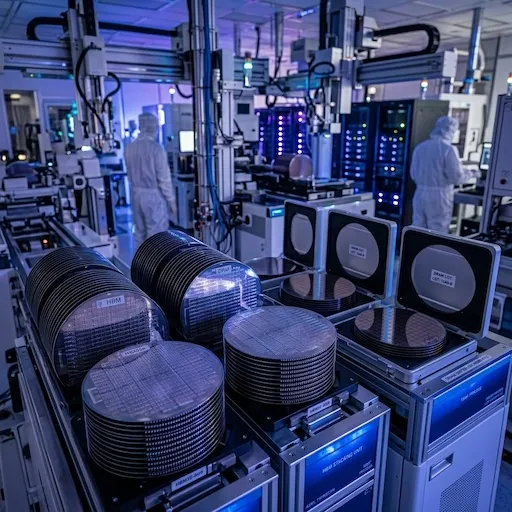
Understanding the HBM percentage of DRAM wafer capacity is critical because HBM manufacturing is highly inefficient compared to standard memory. The die size of an HBM3E stack is significantly larger, and the complex TSV (Through-Silicon Via) packaging process results in substantially lower overall yields.
Industry data confirms that in 2026, producing a single gigabyte of HBM requires roughly 2.5 to 3 times the wafer area of a standard DDR5 chip. Consequently, while HBM only represents about 8-10% of total memory bit shipments, it consumes nearly 22% of global DRAM wafer capacity.
This structural reality means that every wafer dedicated to a GPU’s memory stack is a wafer stolen from the PC, mobile, and standard server markets. Buyers sourcing for legacy systems, such as consumer electronics requiring legacy eMCP or eMMC components, will face continued margin compression and shrinking vendor options as fabs prioritize high-margin HBM contracts.
How can procurement managers navigate HBM supply shortages through 2027?
Even with the temporary market cooling, HBM remains structurally supply-constrained. For hardware integrators and enterprise buyers, navigating this environment requires a departure from traditional memory purchasing models:
- Monitor Advanced Packaging Bottlenecks: The limitation for HBM output is often not the memory die itself, but the CoWoS (Chip-on-Wafer-on-Substrate) packaging capacity. Tracking TSMC’s CoWoS expansion plans provides a more accurate forecast of HBM availability than memory fab capacity alone.
- Diversify Supplier Base: While SK Hynix currently dominates the HBM3E landscape, validating Micron and Samsung as qualified alternatives is mandatory for supply chain resilience in late 2026 and 2027.
- Forecast Holistic BOM Impact: Recognize that a shortage in HBM will inevitably trigger tightness in broad-market DDR5. Adjust safety stock parameters for standard memory modules whenever AI hardware demand forecasts are revised upward.
Frequently Asked Questions (FAQ)
How does the AI semiconductor bubble correction affect HBM and DRAM supply in Q2 2026?
The Q2 2026 AI semiconductor bubble correction has cooled speculative demand for mid-tier AI accelerators, freeing up roughly 5% of global DRAM wafer capacity and temporarily stabilizing pricing for DDR5.
What percentage of global DRAM wafer capacity is shifting to HBM production?
In 2026, HBM production consumes approximately 22% of total global DRAM wafer capacity, significantly constraining the output of standard DDR4 and DDR5 memory modules.