Table of Contents
- What Do Micron’s Q3 FY2026 Numbers Actually Mean for Buyers?
- The $100 Billion Backlog
- Revenue Growth That Reflects Structural Demand, Not Cyclical Recovery
- Gross Margin Expansion That Signals Pricing Power
- DRAM Bit Growth vs. Revenue Growth: The HBM Multiplier
- Why Is the HBM Shortage Worse in Its Second Year?
- Lenovo’s 2028 Warning: Should Procurement Teams Believe It?
- Where Can Non-Hyperscaler Buyers Actually Find Memory?
- Option 1: 12-Month Blanket Orders with Scheduled Deliveries
- Option 2: Tier-Two Memory Suppliers for Legacy DRAM
- Option 3: Strategic Independent Distribution
- The Data Center Structural Shift: Why 70% Changes Everything
- Q3 2026 DRAM and NAND Price Outlook by Category
Micron Technology reported earnings on June 25, 2026. The numbers weren’t just good—they were structural. $41.5 billion in quarterly revenue. $100 billion in contracted backlog stretching into 2028. Gross margins above 60%. Every single HBM3E wafer spoken for through Q4 2027.
This is not a cyclical memory upturn. This is the semiconductor industry’s largest-capacity product category being fundamentally re-priced by AI demand. And procurement teams that treat it as a temporary spike will find themselves without memory allocation by Q4.
📌 Direct Answer: DRAM prices will rise an estimated 50% in Q3 2026 because HBM production now consumes 23% of all DRAM wafer starts—up from 8% in 2023—and each HBM3E gigabyte requires 2.5-3x more silicon wafer area than standard DDR5. The three major DRAM manufacturers (SK Hynix, Samsung, Micron) cannot expand total DRAM wafer capacity fast enough to meet combined AI + enterprise demand: new fabs in Boise (Micron), Clay NY (Micron), and Taylor Texas (Samsung Phase 2) won't reach volume output until late 2027 at the earliest. Meanwhile, data centers now consume 70% of all memory chips produced globally, according to Tech-Insider's April 2026 supply chain analysis, up from 45% in 2023. This structural shift means that even if PC and smartphone demand remains flat, DRAM supply will stay tight through 2028.
Related Reading: For the underlying HBM supply chain dynamics and how AI accelerator demand reshaped memory markets in early 2026, see our earlier analyses: 2026 HBM and DRAM Supply Chain Analysis: Navigating AI-Driven Memory Shortages and HBM DRAM Supply Chain Dynamics: AI Impact on Memory Markets Q2 2026. This article focuses on the Q3 2026 price trajectory and immediate procurement actions.
What Do Micron’s Q3 FY2026 Numbers Actually Mean for Buyers?
Micron’s earnings are the most detailed public window into the memory market’s supply-demand balance, and the Q3 FY2026 release (covering the quarter ending May 29, 2026) revealed four data points that procurement teams need to understand:
The $100 Billion Backlog
Micron disclosed $100 billion in contracted backlog—a figure that represents multi-year, take-or-pay agreements primarily with hyperscale cloud providers (Microsoft Azure, Amazon AWS, Google Cloud) and AI hardware companies (NVIDIA, AMD). This backlog is not speculative; it represents legally binding volume commitments with pricing collars.
For non-hyperscaler memory buyers, the backlog means that any wafer capacity that can be allocated to HBM already has a named customer and a contracted price. There is no “excess HBM capacity” that might flow back to standard DRAM if AI demand softens—the contracts guarantee the capacity allocation regardless of short-term demand fluctuations.
Revenue Growth That Reflects Structural Demand, Not Cyclical Recovery
Micron’s $41.5 billion quarterly revenue represents roughly 4x the revenue from the same quarter in FY2025. This is not a recovery from a downturn; the industry’s previous revenue peak was approximately $160 billion annually across all memory manufacturers, and Micron alone is now running at a $166 billion annualized rate. The memory market has structurally doubled in revenue terms since 2023, driven entirely by AI workload demand.
Gross Margin Expansion That Signals Pricing Power
Micron’s gross margins above 60% reflect the pricing power that memory manufacturers now hold. In the previous cyclical peak (2018), Micron’s peak gross margin was approximately 61% before the cycle turned. The difference in 2026: the demand driving pricing is concentrated in the highest-value, highest-complexity products (HBM3E, HBM4 development), rather than cyclical PC and smartphone demand that historically reversed when inventory accumulated. Hyperscaler AI infrastructure investment has multi-year visibility that consumer electronics demand never provided.
DRAM Bit Growth vs. Revenue Growth: The HBM Multiplier
Micron reported DRAM bit shipment growth of approximately 8% year-over-year, while DRAM revenue grew approximately 200%. The dramatic difference between bit growth and revenue growth is entirely explained by product mix: HBM3E sells for roughly 5-7x the revenue per gigabyte of standard DDR5, and HBM’s share of Micron’s DRAM revenue has risen from approximately 5% in 2023 to over 40% in Q3 FY2026.
For procurement, this means that even modest improvements in DRAM wafer supply will be directed toward the highest-revenue products (HBM), not toward alleviating standard DRAM tightness.
Why Is the HBM Shortage Worse in Its Second Year?
The conventional expectation was that HBM supply would improve as manufacturers added capacity and improved yields. Instead, the shortage has intensified because demand grew faster than the capacity additions.
| Factor | 2025 (Year 1 of Shortage) | 2026 (Year 2) | Why It’s Worse Now |
|---|---|---|---|
| HBM share of DRAM wafer starts | ~15% | ~23% | More capacity reallocation = less standard DRAM supply |
| AI GPU units shipped (NVIDIA equivalent) | ~3.5M units | ~5.5M units (est.) | Each GPU needs 6-8 HBM stacks, up from 4-6 in prior gen |
| HBM stack height (layers) | 8Hi (HBM3E) | 12Hi entering volume | 12Hi stacks consume 50% more wafer area per stack |
| Advanced packaging capacity (CoWoS wpm) | ~80K wpm | ~120K-140K wpm | Capacity grew but demand grew faster |
| HBM lead time for new customers | 40-52 weeks | 52+ weeks or allocation closed | New entrants cannot access supply at any price |
The fundamental problem: each successive generation of AI GPU uses more HBM stacks, with more DRAM layers per stack, fabricated on processes that consume more wafer area per gigabyte. The volume growth in AI GPU shipments—still running at 40%+ year-over-year—compounds the per-GPU memory content growth to produce demand that simply outstrips the industry’s ability to add wafer capacity.
Lenovo’s 2028 Warning: Should Procurement Teams Believe It?
At ISC 2026 (June 2026, Hamburg), Lenovo CTO Dr. Yong Rui stated during a keynote panel: “We do not see meaningful price relief in the memory market returning before 2028. The structural drivers are too strong, and the capacity response timeline is too long.”
This type of public statement from a major customer—Lenovo is one of the world’s largest memory consumers through its server (ThinkSystem) and PC businesses—is unusual. Publicly-traded memory manufacturers are typically careful not to signal excessive optimism about pricing, and customers are typically reluctant to validate supplier pricing power. That a customer of Lenovo’s scale is publicly endorsing a “no relief before 2028” thesis suggests the supply-demand imbalance is genuinely severe.
The timeline makes physical sense: semiconductor fabs take 3-4 years from groundbreaking to volume production. The capacity expansion wave that began in response to 2023 AI demand signals will not reach volume output until late 2026 (the earliest projects, primarily TSMC CoWoS expansions) through 2028-2029 (new greenfield DRAM fabs). Between now and then, the industry must supply growing AI memory demand from a capacity base that grows incrementally through node transitions and debottlenecking, not through new fab shells.
Where Can Non-Hyperscaler Buyers Actually Find Memory?
The sourcing playbook has changed. Buying standard DDR4 or DDR5 DRAM components on the spot market at competitive prices is effectively suspended for the foreseeable future. The buyers who will maintain supply continuity are those who adapt their procurement model now.
For a dated September 4 update that separates current spot indicators from negotiated supply, see the DRAM spot versus contract price procurement guide.
Option 1: 12-Month Blanket Orders with Scheduled Deliveries
This is the most reliable path but requires commitment. Memory manufacturers and their franchised distributors are prioritizing customers who provide rolling 12-month forecasts with firm POs. The commitment signals that you are a “sticky” customer rather than a spot-buyer who will disappear when the cycle turns.
Practical approach: Consolidate your DRAM requirements across product lines into a single 12-month blanket order. Accept that pricing will reset quarterly (upward, in the current environment). The trade-off is price predictability (you will pay more each quarter) versus supply assurance (you will actually receive product).
Option 2: Tier-Two Memory Suppliers for Legacy DRAM
For DDR3, DDR4, and low-density LPDDR4 requirements, the Big Three memory IDMs have effectively deprioritized production. Their mature-node DRAM capacity has been converted to HBM or leading-edge DDR5 lines, and what remains is being wound down.
The tier-two memory suppliers have stepped into this gap:
- Nanya Technology (Taiwan): Focused on DDR4 and specialty DRAM for industrial and automotive applications. Lead times of 14-20 weeks, pricing 10-15% below equivalent Samsung/SK Hynix DDR4.
- Winbond (Taiwan): Strong in low-density specialty DRAM (128Mb-2Gb) and mobile DRAM for IoT and industrial. Reliable supplier with increasingly competitive quality.
- CXMT (China): Focused on DDR4 and LPDDR4 for domestic Chinese market but expanding internationally. Price-competitive but politically sensitive for Western buyers subject to entity list or government procurement restrictions.
Option 3: Strategic Independent Distribution
When allocation is closed and franchised lead times exceed 26 weeks, hybrid independent distribution becomes the primary source of short-lead-time memory. Our memory procurement desk at SupplyICs aggregates excess inventory from EMS providers, OEM overstock, and cancelled orders globally—currently maintaining an active memory inventory pool sourced from over 200 suppliers across 15 countries. Every module undergoes full electrical testing, X-ray inspection for counterfeits, and date code/lot code traceability verification before release.
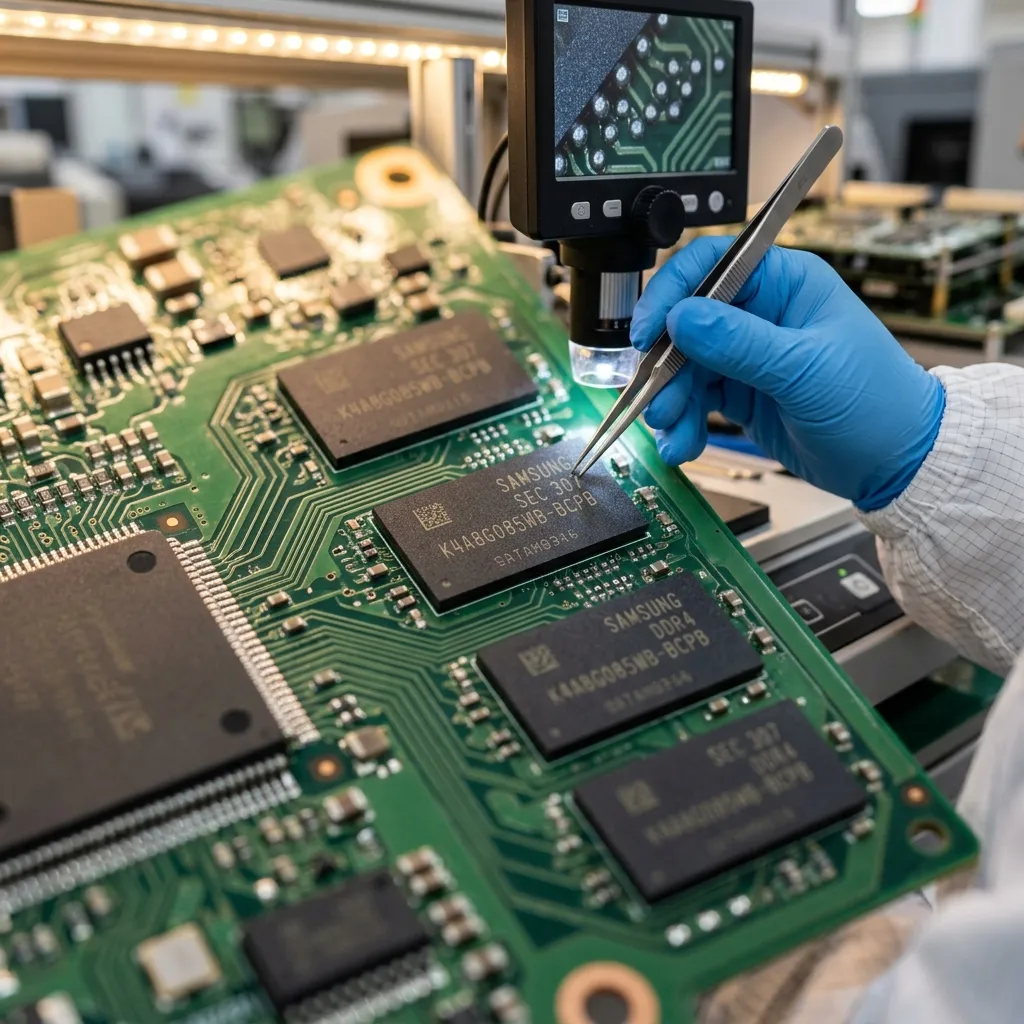 Functional testing and lot-code authentication of memory modules. SupplyICs tests every memory component through our ISO 9001-certified quality assurance lab before shipment.
The Data Center Structural Shift: Why 70% Changes Everything
Tech-Insider’s April 2026 supply chain analysis documented a threshold crossing: data centers now consume 70% of all memory chips produced globally, up from 45% in 2023. This is not a temporary spike; it reflects the permanent installation of AI infrastructure at a scale that has no precedent in the history of the semiconductor industry.
The implications for non-data-center memory buyers are uncomfortable:
- Your purchasing power relative to the market has shrunk. In 2023, enterprise/industrial/automotive memory buyers collectively represented roughly 55% of demand. In 2026, that figure is 30%. When you negotiate with memory suppliers, you are competing with hyperscalers who buy more memory in a single quarter than your company will buy in its entire existence.
- Product mix is driven by hyperscaler requirements. The memory products being developed and manufactured are optimized for data center workloads: high bandwidth, high capacity, managed thermals. Legacy DRAM configurations (x8 organization, specific temperature grades, long-lifecycle commitments) are treated as nuisance business by the major IDMs—low volume, technically demanding, and requiring manufacturing line time that could be allocated to higher-revenue HBM or DDR5.
- Price volatility flows from data center demand signals. If hyperscalers accelerate AI infrastructure deployment (as they have consistently done), DRAM prices rise regardless of what is happening in automotive, industrial, or consumer electronics markets. Procurement teams in non-data-center industries have lost the ability to forecast memory costs based on their own demand visibility—the market is now driven by AI capex decisions made in Seattle, Mountain View, and Richmond.
Q3 2026 DRAM and NAND Price Outlook by Category
| Memory Category | Q2 2026 Price | Q3 2026 Forecast | QoQ Change | Supply Risk | Lead Time |
|---|---|---|---|---|---|
| DDR5 RDIMM 64GB (enterprise) | $240-260 | $360-390 | +50% | 🔴 Critical | 26-40 wks |
| DDR5 UDIMM 32GB (workstation) | $95-110 | $140-155 | +45% | 🔴 Critical | 20-30 wks |
| DDR4 RDIMM 32GB (industrial) | $65-75 | $90-105 | +35% | 🟠 High | 18-26 wks |
| DDR4 SODIMM 16GB (embedded) | $30-35 | $40-48 | +30% | 🟠 High | 16-22 wks |
| DDR3 4Gb x8 (legacy industrial) | $2.80-3.20 | $3.50-4.00 | +25% | 🟡 Medium | 14-20 wks |
| HBM3E 8Hi 24GB stack | $2,200-2,500 | $2,500-2,800 | +12% | 🔴 Critical | 52+ wks (sold out) |
| Enterprise SSD 7.68TB PCIe 5.0 | $680-720 | $700-740 | +3% | 🟢 Low | 8-12 wks |
| Enterprise SSD 15.36TB PCIe 5.0 | $1,300-1,400 | $1,320-1,420 | +2% | 🟢 Low | 8-12 wks |
Sources: 247WallSt (July 1, 2026), Suntsu Q2 2026 Memory Monitor, Tech-Insider supply chain analysis, SupplyICs proprietary lead time tracking. NAND/SSD pricing is stable; the shortage is concentrated in DRAM, not NAND flash.
Note: NAND flash and enterprise SSD pricing remains stable—the shortage is confined to DRAM. This divergence creates opportunities for procurement teams to strategically shift budget toward NAND-based storage while navigating DRAM constraints.
SupplyICs provides real-time memory market intelligence and maintains one of the industry’s largest independent DRAM and NAND inventory pools. Our memory procurement desk tracks pricing, lead times, and allocation availability across all major manufacturers—contact us for same-day pricing on specific DDR4, DDR5, HBM, or enterprise SSD requirements.
Frequently Asked Questions (FAQ)
Why is DRAM pricing surging in Q3 2026 when PC and smartphone demand is flat?
The DRAM price surge is driven by HBM (High-Bandwidth Memory) production consuming an ever-larger share of global DRAM wafer capacity. Each gigabyte of HBM3E requires roughly 2.5-3x more silicon wafer area than standard DDR5, and major manufacturers—SK Hynix, Samsung, and Micron—have allocated 23% of total DRAM wafer starts to HBM production. With AI accelerator demand still growing 40%+ year-over-year, standard DRAM supply is being structurally squeezed regardless of consumer electronics demand.
When will memory prices come back down?
Lenovo's CTO warned at ISC 2026 that 'meaningful price relief' in the memory market will not return before 2028. This timeline is driven by: (1) HBM4 production ramping in 2027, which will consume even more wafer capacity per gigabyte than HBM3E; (2) new DRAM fab capacity from Micron (Boise, Clay NY) and Samsung (Taylor Phase 2) not reaching volume production until late 2027/2028; and (3) data center memory demand continuing to grow as AI inference workloads shift from training-dominated to inference-dominated, requiring more total memory per deployed GPU.
What should industrial and automotive buyers do about DRAM shortages?
Industrial and automotive buyers who compete with hyperscalers for DRAM capacity have three practical options: (1) lock in 12-month blanket orders with scheduled deliveries now—spot buying DDR4/DDR5 at favorable prices is effectively suspended through at least Q2 2027; (2) qualify tier-two memory suppliers including Nanya Technology, Winbond, and CXMT for industrial-grade DDR3/DDR4 requirements where the major IDMs have deprioritized mature-node DRAM production; (3) work with independent distributors who aggregate excess OEM and EMS inventory globally—this is currently the most reliable source for shorter-lead-time memory procurement outside of direct allocation.