Table of Contents
What is Causing the Bottleneck in the Power Discrete Module Market?
The global automotive industry’s aggressive shift towards 800V electric vehicle (EV) architectures in 2026 has triggered an acute shortage in the power integrated module market. High-voltage Silicon Carbide (SiC) modules and advanced IGBTs from Infineon, onsemi, and STMicroelectronics are currently facing extreme allocation, with lead times stretching beyond 40 weeks. According to Yole Intelligence, the automotive SiC market is growing at a staggering 34% CAGR. While raw SiC boule production has improved, the true bottleneck lies in the specialized, high-yield packaging facilities required to assemble these complex Power Integrated Modules (PIMs) reliably. For automotive Tier-1s building traction inverters and onboard chargers (OBCs), traditional just-in-time procurement has completely collapsed.
As an independent distributor specialized in power electronics, we recently intervened for a European Tier-1 supplier whose EV traction inverter production line was days away from halting due to a delayed shipment of onsemi EliteSiC power modules. By leveraging our established channels with global excess inventory, we secured 500 fully-traceable modules, preventing millions in OEM penalties.
This technical analysis explores the dynamics of the power discrete module market and how procurement teams can navigate the 2026 shortage.
Why Are SiC and IGBT PIMs So Difficult to Manufacture?
To understand the shortage, we must look at the manufacturing complexity. Why can’t suppliers simply build more PIMs?
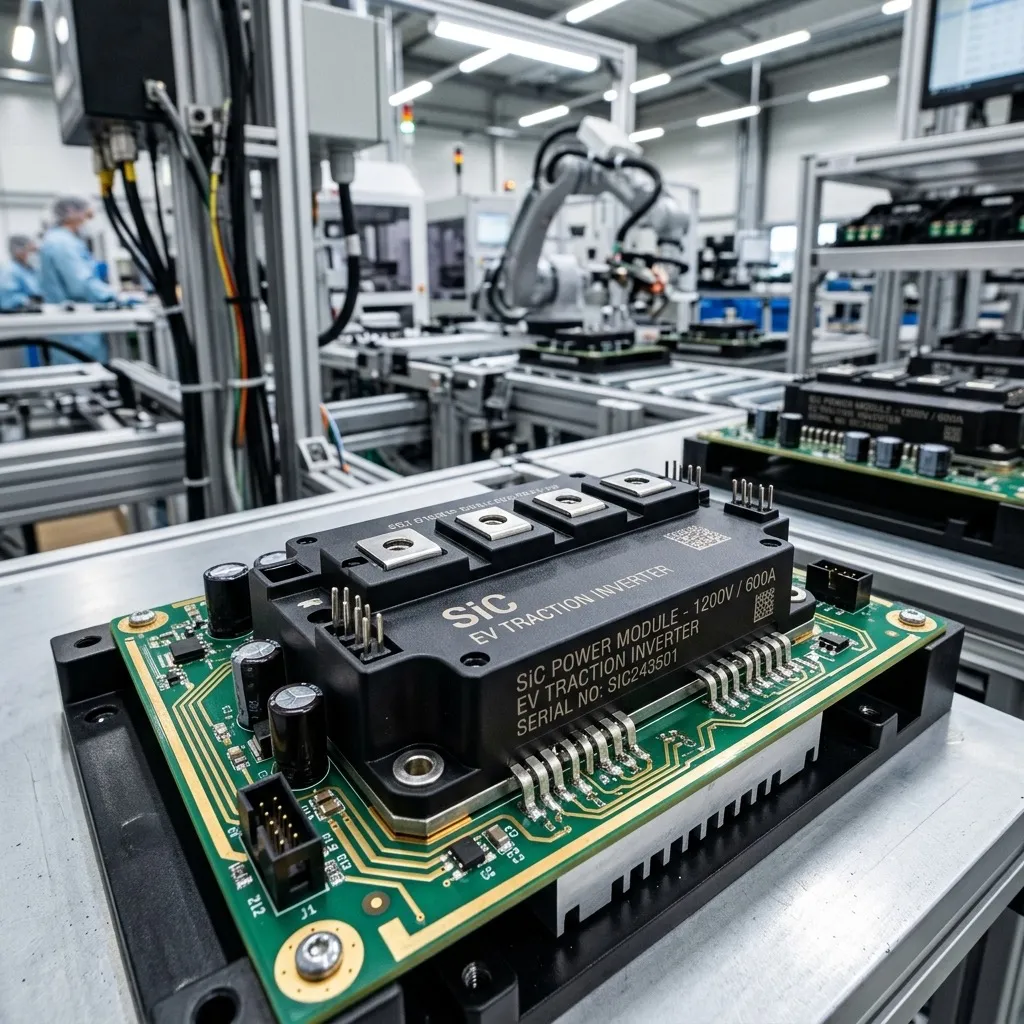
Unlike a standard discrete MOSFET packaged in a TO-247, a Power Integrated Module is a complex subsystem. A typical traction inverter PIM contains multiple bare die (IGBTs or SiC MOSFETs alongside anti-parallel diodes), directly bonded to a Direct Bonded Copper (DBC) or Active Metal Brazed (AMB) ceramic substrate, all encapsulated in a high-temperature resistant housing.
- SiC Wafer Yields: Silicon Carbide is notoriously difficult to grow. Defect densities (like basal plane dislocations) in 150mm and 200mm SiC wafers remain higher than traditional silicon, limiting the number of known-good-die (KGD) available for module assembly.
- Packaging Bottlenecks: The 800V EV architectures require advanced cooling technologies (like double-sided cooling or pin-fin baseplates). The specialized bonding techniques (sintering vs. traditional soldering) required for SiC PIMs are capacity-constrained globally.
How Do the Major Suppliers Compare in 2026?
Based on our market intelligence, here is the current landscape for the dominant players in the power integrated module market:
| Manufacturer | Core Focus in 2026 | Lead Time Outlook |
|---|---|---|
| Infineon | HybridPACK Drive (IGBT/SiC), CoolSiC | 38 - 52 weeks (Allocation) |
| onsemi | EliteSiC modules, VE-Trac | 30 - 45 weeks (Tight) |
| STMicroelectronics | ACEPACK, SiC MOSFET modules | 36 - 48 weeks (Allocation) |
| Wolfspeed | WolfPACK SiC modules | 26 - 36 weeks (Improving) |
| Fuji Electric / Mitsubishi | Industrial & Automotive IGBTs | 24 - 32 weeks (Stable) |
What Are the Procurement Strategies for PIMs?
When a franchised supplier quotes 52 weeks for a critical traction inverter module, engineering and procurement must align to find solutions. How can you mitigate this risk?
- Evaluate Discrete vs. Module Architectures: In extreme shortage scenarios, some automotive engineering teams are redesigning traction inverters to use paralleled discrete SiC MOSFETs (e.g., TO-247-4L packages) instead of a single integrated PIM. While this increases PCB complexity and manufacturing time, discrete components generally have shorter lead times (18-24 weeks) and more dual-sourcing options.
- Qualify Alternate PIM Footprints: Standardize around industry-standard module footprints (e.g., EconoPACK or 62mm packages) wherever possible. This allows procurement to pivot between Infineon, Fuji Electric, and Semikron Danfoss if one supplier falters.
- Tap into Global Excess Networks: Contract manufacturers globally are constantly adjusting their production forecasts, creating pockets of excess PIM inventory. Partner with a rigorously vetted independent distributor who can actively scan these global pools and verify authenticity before purchase.
Sources:
- Yole Intelligence, “Power SiC 2026 Market Update”
- EE Times, “Automotive 800V Architecture Supply Chain Dynamics”
- Infineon Automotive, “HybridPACK Drive Specifications”
- AEC Council, “AEC-Q101 Stress Test Qualification for Discrete Semiconductors”
- SupplyICs Linecard, “Automotive Power Solutions”
[!TIP] Is a SiC module shortage threatening your EV production ramp? Send your critical shortage list to SupplyICs. We specialize in sourcing highly allocated automotive power modules with full traceability and testing. Contact our procurement desk via our Solutions page.
Frequently Asked Questions (FAQ)
Why are Power Integrated Modules (PIMs) facing allocation in 2026?
The rapid transition of the global EV market from 400V to 800V architectures has massively spiked demand for high-voltage Silicon Carbide (SiC) Power Integrated Modules (PIMs), outstripping the raw SiC wafer supply and complex packaging capacity of dominant suppliers like Infineon and onsemi, resulting in lead times over 40 weeks.