Table of Contents
eMMC combines NAND flash with an internal controller that manages error correction, bad blocks, wear, and the host protocol. That abstraction simplifies the host design, but it does not make every device of the same capacity interchangeable.
A safe replacement review starts with a working unit’s identity and configuration, then follows the product through blank-device programming, first boot, field update, power interruption, and data recovery.
What should you record before qualifying an eMMC replacement?
Record the original eMMC’s full ordering code, revision, capacity, package and ball map, bus widths, I/O voltage, timing modes, and temperature grade. Save its CID, CSD, and complete extended CSD (EXT_CSD) register image before changing configuration so the candidate can be compared with both the device capabilities and the programmed state.
The register capture provides a machine-readable baseline. It can reveal sector count, partition support, boot size, reliable-write capabilities, cache behavior, command-queue support, and device-life indicators. Compare decoded fields by meaning; register availability and interpretation depend on the eMMC revision.
How do you prove an eMMC alternate will boot from a blank device?
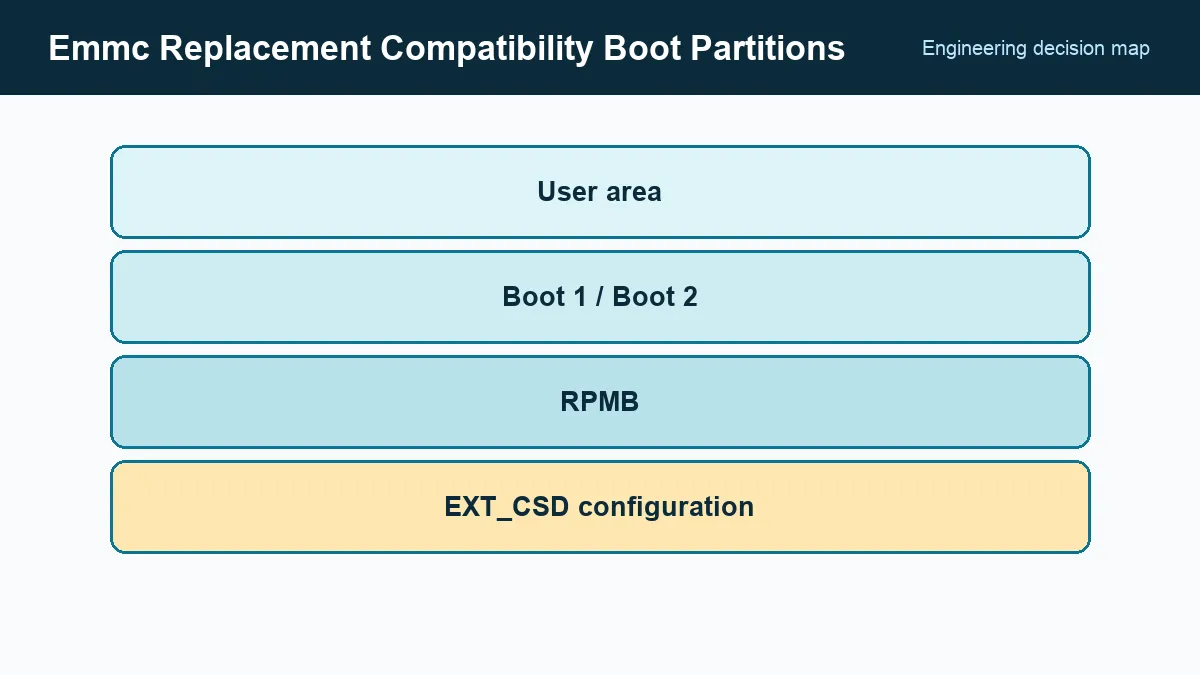
Program a blank candidate with the production recipe, including the selected boot region and required configuration, then power-cycle it through the product’s ROM and bootloader path. First identify whether boot uses the user area, boot partition 1, or boot partition 2; record boot-bus width, reset, acknowledgement, partition access, enhanced areas, and any replay-protected memory block (RPMB) use.
Texas Instruments’ U-Boot memory guide, accessed September 24, 2026, illustrates how bootloader commands expose and configure eMMC partitions. The command names are platform-specific, but the lesson is general: programming the user image alone may omit boot-area and configuration state.
Build the production recipe from a truly blank candidate. Program all required regions, apply only intended configuration fields, power-cycle, and boot through the same ROM and bootloader path used in the product. A candidate that works after cloning an already configured sample may still fail on the factory line.
Qualify timing modes and board margin
Confirm that the host controller and PCB support the candidate’s required signaling mode. Test initialization from the slow identification clock through the selected high-speed mode. For HS200 or HS400 designs, run host tuning across voltage and temperature and retain margin data rather than only a boot pass.
Device output timing, input sampling, drive strength, strobe behavior, and package parasitics differ. A faster speed grade can normally advertise lower modes, but the actual host/device combination still needs validation. Check whether firmware selects a vendor-specific drive or enhanced-strobe setting.
Include rapid power cycling, slow ramps, brownout, reset during write, and warm reset. The power rails and reset pin must follow the device’s sequencing requirements.
Why can equal-capacity eMMC devices have different endurance and latency?
Equal-capacity eMMC devices can use different NAND technology, spare-area policies, controller firmware, and wear-management behavior. Compare endurance and retention conditions for the exact ordering code and workload; supported health and lifetime fields are useful indicators, but coarse life estimates are not precision wear meters.
If the application relies on cache, reliable write, sanitize, secure trim, RPMB, or hardware partitions, verify command semantics and failure recovery. Measure sustained and tail latency under a representative filled-state workload; a short sequential benchmark on an empty device says little about worst-case logging performance.
Release the alternate with reproducible artifacts
The approval package should contain register dumps, decoded differences, bootloader and kernel logs, partition table, production-programming transcript, image hashes, timing-mode test results, endurance comparison, and recovery tests. Include the exact firmware and fixture versions.
Procurement should control manufacturer, ordering code, package, temperature grade, revision constraints, lifecycle status checked on the sourcing date, and any firmware dependency. The replacement is approved when a blank unit can be built, booted, stressed, interrupted, and recovered under the documented process—not when a reworked board happens to recognize the same capacity.
Frequently Asked Questions (FAQ)
Is matching eMMC capacity and package enough for replacement?
No. The host must support the device revision, bus modes, geometry, boot behavior, partition configuration, voltage, timing, and initialization sequence. Endurance and production-programming behavior also need comparison.
Why should EXT_CSD be captured before approving an eMMC alternate?
EXT_CSD exposes device capabilities and configured state, including revision, sector count, partition information, timing modes, life estimates, and other fields used by boot and operating software.
Can an eMMC boot partition configuration be changed repeatedly?
Some configuration fields are one-time or have restricted programming behavior. The exact JEDEC revision and device documentation must be checked before changing production commands.