Table of Contents
- How do you estimate an MLCC’s effective capacitance in circuit?
- Why can two X7R capacitors lose different amounts of capacitance?
- Which capacitance or impedance limit should an MLCC alternate meet?
- Include mechanical and surge risks
- Verify ripple, surge, and acoustic behavior
- Release a value at conditions, not a catalog label
The capacitance printed in an MLCC ordering code is measured under defined test conditions. In a powered circuit, a Class II ceramic capacitor may deliver substantially less because DC bias, temperature, aging, and AC amplitude act on the dielectric.
A defensible replacement comparison starts with the minimum capacitance or impedance the circuit needs at its operating point. Nominal microfarads, case size, and voltage rating are screening fields, not the final result.
How do you estimate an MLCC’s effective capacitance in circuit?
Estimate effective capacitance from the exact MLCC’s nominal value, purchased tolerance, DC-bias data at the terminal voltage, temperature characteristic, and aging interval. Keep the manufacturer’s test conditions with each contribution and use combined-condition data where available; nominal microfarads alone do not establish the minimum delivered value.
Murata’s ceramic-capacitor FAQ, accessed September 24, 2026, explains that capacitance changes with applied DC voltage for high-permittivity ceramic dielectrics. The exact loss depends on construction, so a curve from a similar value or package is only a preliminary estimate.
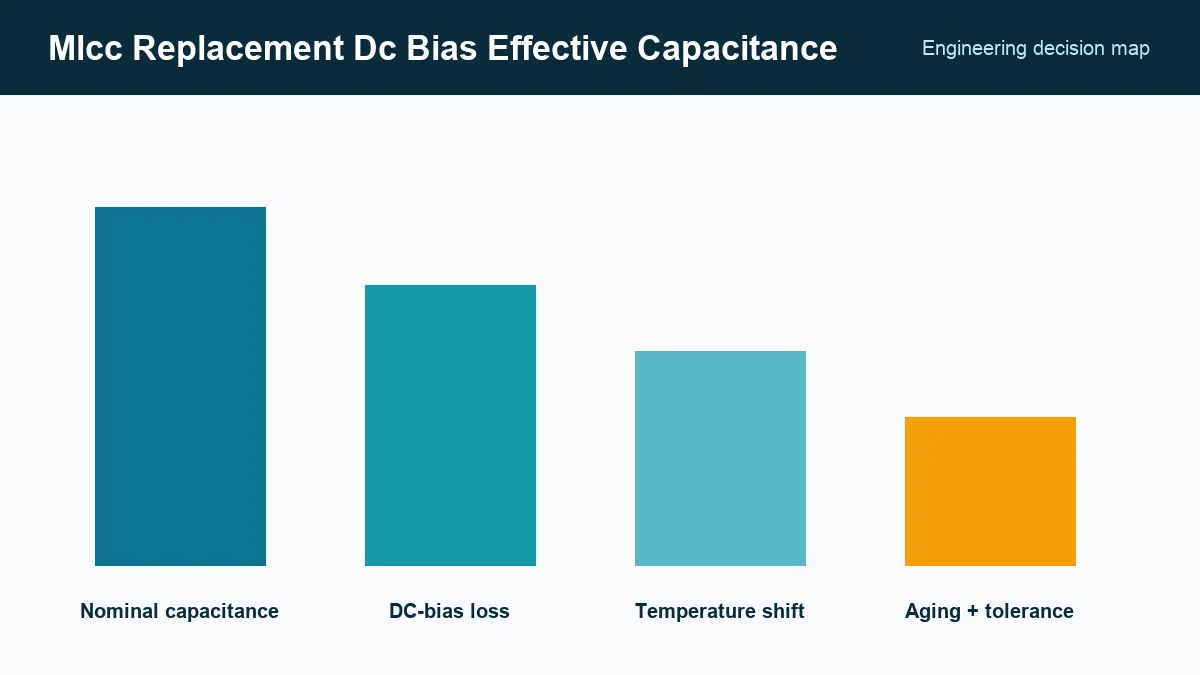
For an input or output capacitor, use the maximum normal DC voltage, including tolerance and steady offset. For a coupling or resonant application, include the AC waveform and bias together. Temperature extremes can either increase or decrease value within the dielectric’s characteristic envelope.
Why can two X7R capacitors lose different amounts of capacitance?
X7R specifies a temperature characteristic, not a DC-bias-loss limit. Two X7R MLCCs can have different electrode counts, dielectric thicknesses, voltage ratings, capacitance densities, and packages, so a replacement needs bias data for its full ordering code. The same distinction applies to X5R parts.
Kyocera AVX’s DC-bias technical note, accessed September 24, 2026, describes the ferroelectric mechanism and how construction changes bias response. Obtain simulation or characterization data for the complete ordering code when the minimum value matters.
Bias can also change resonance and impedance. For power integrity, compare impedance versus frequency under bias, including mounting inductance and the parallel capacitor network—not just effective capacitance at a low test frequency.
Which capacitance or impedance limit should an MLCC alternate meet?
The acceptance limit comes from the circuit function: regulator stability may require minimum effective capacitance and an ESR range, a reservoir needs acceptable transient droop, and a decoupling network needs sufficiently low impedance over its noise band. Coupling and resonant circuits also need their cutoff or distortion limits checked at the operating bias.
Translate that function into acceptance values. For example, calculate the capacitance needed from C ≥ I × Δt / ΔV for a first-order transient estimate, then verify the complete regulator response. Do not use the formula alone where control-loop dynamics dominate.
Measure finished boards at the relevant bias when practical. LCR fixtures and bias tees have voltage and frequency limits, and in-circuit measurements can include parallel paths, so document the method.
Include mechanical and surge risks
Larger case sizes and rigid board locations increase flex-crack exposure. Compare termination type, flex construction, board thickness, depanelization, screw proximity, connector insertion load, and placement orientation. A higher-capacitance substitute that cracks is not a reliability improvement.
Verify ripple, surge, and acoustic behavior
Check ripple-current heating, insulation resistance, dielectric withstand, and surge or pulse behavior. Class II MLCCs can be piezoelectric, producing audible noise or microphonic signals in sensitive circuits. The alternate’s physical construction can change that behavior.
Apply the production voltage waveform and switching frequency when checking temperature. For input filters and resonant networks, measure the complete capacitor array because parallel values can create anti-resonant peaks that no individual data sheet shows.
Release a value at conditions, not a catalog label
The approved specification should include exact part number, case, dielectric class, rated voltage, tolerance, minimum effective capacitance at stated DC voltage and temperature, aging interval, impedance requirement, termination type, temperature range, and board-process controls.
Keep the manufacturer curve or exported model with its access date and revision. If the circuit relies on a minimum capacitor value, include a system test at the limiting load and voltage. Procurement can then compare alternates by delivered electrical function instead of buying nominal capacitance that disappears after power is applied.
Frequently Asked Questions (FAQ)
Why can an MLCC measure correctly before assembly but provide less capacitance in circuit?
Class II ceramic capacitance changes with applied DC voltage, temperature, time after de-aging, and AC test amplitude. A low-voltage meter reading does not reproduce the operating point.
Does a higher voltage rating always improve effective capacitance?
Often it helps within the same technology and case size, but it is not guaranteed. Use the manufacturer's bias curve or data for the exact part number and operating voltage.
Can several smaller MLCCs replace one larger part?
They can provide useful effective capacitance and lower impedance, but change footprint, anti-resonance, ripple sharing, flex-crack exposure, placement, and cost. The network must be evaluated as a new design.