
Table of Contents
SEMI’s October 2026 outlook points to a larger 300 mm equipment base, with 23 new fabs or lines starting operation or shipping first silicon in 2027. For a semiconductor spare parts plan, that is a reason to revisit the installed-base and commissioning inputs, not a reason to multiply every spare quantity by the same growth rate.
A fab project can close its commissioning spare order and still leave the maintenance team short of control boards six months later. The two purchases are often managed by different groups, funded from different budgets and measured against different deadlines.
Three purchase streams that should not share one forecast
Separate scheduled process consumables, repairable electronic assemblies, nonrepairable board components and commissioning kits. Each has a different demand signal and a different release authority.
| Purchase stream | Forecast from | Approval evidence | Common planning error |
|---|---|---|---|
| Scheduled process consumables | Tool population, recipes and maintenance intervals | Tool-owner material and process approval | Treating a similar dimension as a qualified second source |
| Repairable electronic assemblies | Failures, turnaround and repair yield | Assembly revision, firmware, calibration and functional release | Counting a returned core as an available spare |
| Nonrepairable board components | Approved repair BOM and expected repair demand | Exact orderable part, package, grade and change controls | Buying a family name without the required suffix |
| Commissioning kits | Confirmed installation dates and site handover scope | Accepted kit list and ownership | Reordering items already included in the equipment contract |
A vacuum-facing consumable and a control-board IC are different sourcing assignments. Cleanliness, materials and process compatibility dominate the first; electrical behavior, firmware dependencies and board validation dominate the second. Send each to suppliers able to support that scope.
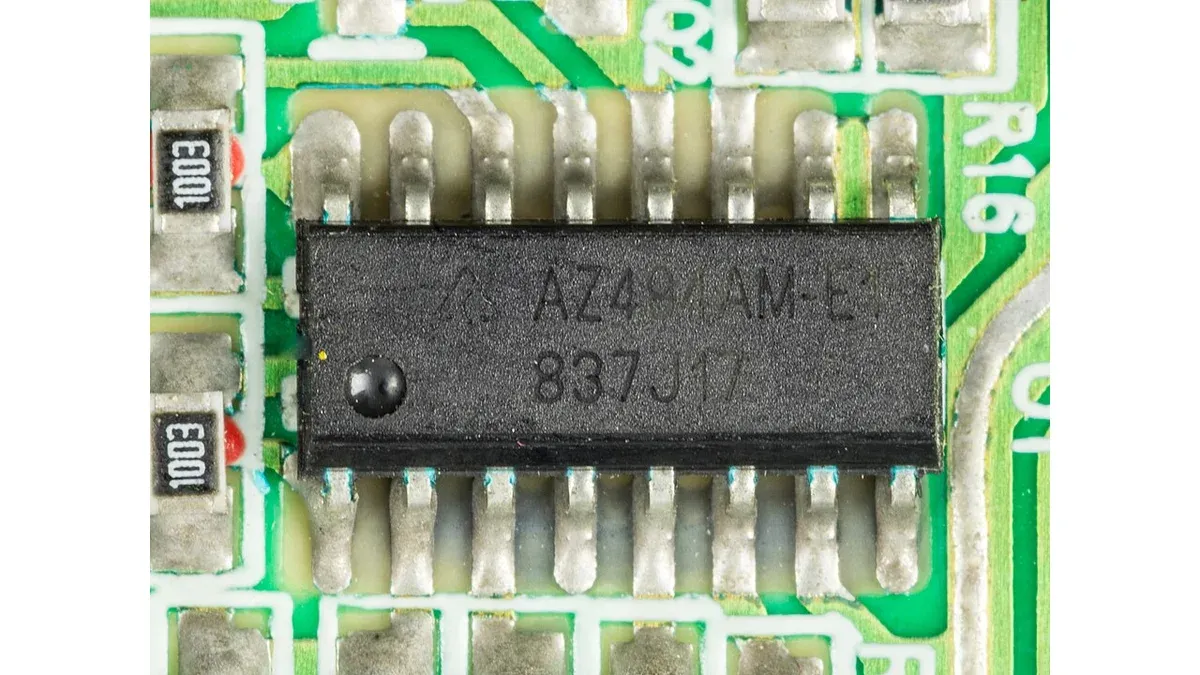
For board-level parts, start from the approved assembly and its exact ordering codes. A distributor catalog entry for a TI or ADI family is a lead, not a qualified alternate. The repair owner still has to confirm the suffix, package, temperature grade and any firmware dependency before the part enters the repair BOM.
What do the October equipment reports actually signal?
They support planning for a larger equipment base and continued service activity. They do not identify which controller, sensor or power-supply assembly a particular site will consume.
| Signal | What it supports | What it does not tell you |
|---|---|---|
| SEMI’s October 13, 2026 outlook: $149 billion of 300 mm front-end equipment spending in 2026, $227 billion in 2029 | A larger installed base and more commissioning activity | Which board, sensor or power supply a site will consume |
| SEMI’s projection of 23 new fabs or lines starting operation or shipping first silicon in 2027 | Earlier qualification and delivery dates for 2027 projects | That any specific spare is short today |
| ASML’s October 14, 2026 results: about €11.7 billion of Q3 sales, including €3.3 billion of Installed Base Management | Continued service and field-option activity | A component-level replacement rate |
ASML defines Installed Base Management as service and field options. That category is broader than spare-part sales and cannot be converted into a component replacement rate. SEMI’s figures are forecasts for a specific fab segment, not completed installations or electronic-component orders.
The planning conclusion is narrow: commissioning support and installed-base maintenance deserve separate 2027 forecasts. Revise that conclusion if tool installations slip, utilization falls or a site’s repair demand stays below plan.
How many repairable boards should stay in the pipeline?
Start with the expected number tied up in repair, then add a buffer for failure variability and the cost of an unavailable tool. Average demand alone is too thin a basis for a critical spare.
For a planning example, suppose a site sends two boards per month for repair and the complete return-to-stock cycle takes six weeks. Using four weeks per planning month, the average repair pipeline is 2 × 6 ÷ 4 = 3 boards. That is work in progress, not a recommendation to hold exactly three spares.
| Boards sent per month | 4-week cycle | 6-week cycle | 8-week cycle | 10-week cycle |
|---|---|---|---|---|
| 1 | 1.0 | 1.5 | 2.0 | 2.5 |
| 2 | 2.0 | 3.0 | 4.0 | 5.0 |
| 3 | 3.0 | 4.5 | 6.0 | 7.5 |
The same two-board site at a ten-week turnaround carries five boards in the pipeline. The buyer can then compare a larger pool with faster repair, an exchange agreement or a qualified substitute assembly. Include transport, incoming checks, firmware loading and calibration in turnaround; a repair-shop bench-time promise omits part of the downtime.
Use the site’s actual distribution of failures and return times to size the additional service buffer. Several identical tools can fail during the same maintenance campaign, and some returned boards may be beyond repair. Track repair yield separately so those losses create replenishment demand instead of disappearing into the repair ledger.
A practical release rule
Release a repaired board to available stock only after its required configuration, functional checks and calibration are complete. Label boards awaiting evaluation, approved service spares and rejected cores as different inventory states. A stock count that combines them can overstate coverage just before a shutdown.
What should change in the 2027 purchasing plan?
Bring qualification work forward where a confirmed installation or maintenance event leaves less time than sourcing, repair and validation require. Keep speculative expansion quantities separate from committed service coverage.
For electronic parts, review the component sample-to-production qualification process before authorizing an alternate. A successful board boot is only the first check when the circuit also controls motion, process temperature or a safety-related interlock.
Review the spare pool whenever an installation date, repair yield, approved BOM or turnaround changes. A postponed fab opening may release commissioning inventory while an older fleet still needs service coverage; one should not automatically cancel the other. For component-level requests, SupplyICs industrial support can quote against the approved part number, assembly context and required maintenance date, while tool-level authorization and repaired-assembly acceptance remain with the equipment owner. The trigger for the next review is a date, a yield or a BOM change, not a new market forecast.
Frequently Asked Questions (FAQ)
Should equipment capex growth set the percentage increase in spare inventory?
No. Build the quantity from the installed tool population, maintenance schedule, failure history and replenishment or repair time. Capital spending is a signal to review those inputs, not a multiplier for every spare.
Can a board-level IC substitute restore an OEM equipment module to approved status?
An electrically compatible IC does not establish approval of the repaired module. The repair owner must address firmware, calibration, safety functions and the tool-level release procedure.
What belongs in an RFQ for a repairable control board?
Include the full assembly number and revision, tool configuration, firmware constraints, fault description, required test scope, exchange-core terms and acceptable repair turnaround. Identify any component-level sourcing request separately.
How do fab-equipment spares differ from electronic component spares?
Fab-equipment spares include process consumables, vacuum-facing parts and mechanical assemblies qualified for a specific tool. Electronic component spares are board-level ICs, passives and connectors. The approval path, cleanliness requirements and supplier base differ, so combining them in one inventory plan usually hides the real constraint.