
Table of Contents
A short string on an IC package is often a compressed marking, not a purchaseable part number. The remaining characters can encode date, lot, assembly site, wafer lot, revision, or environmental information. Guessing a catalog number from the first search result can select the wrong function, package, temperature grade, or qualification level.
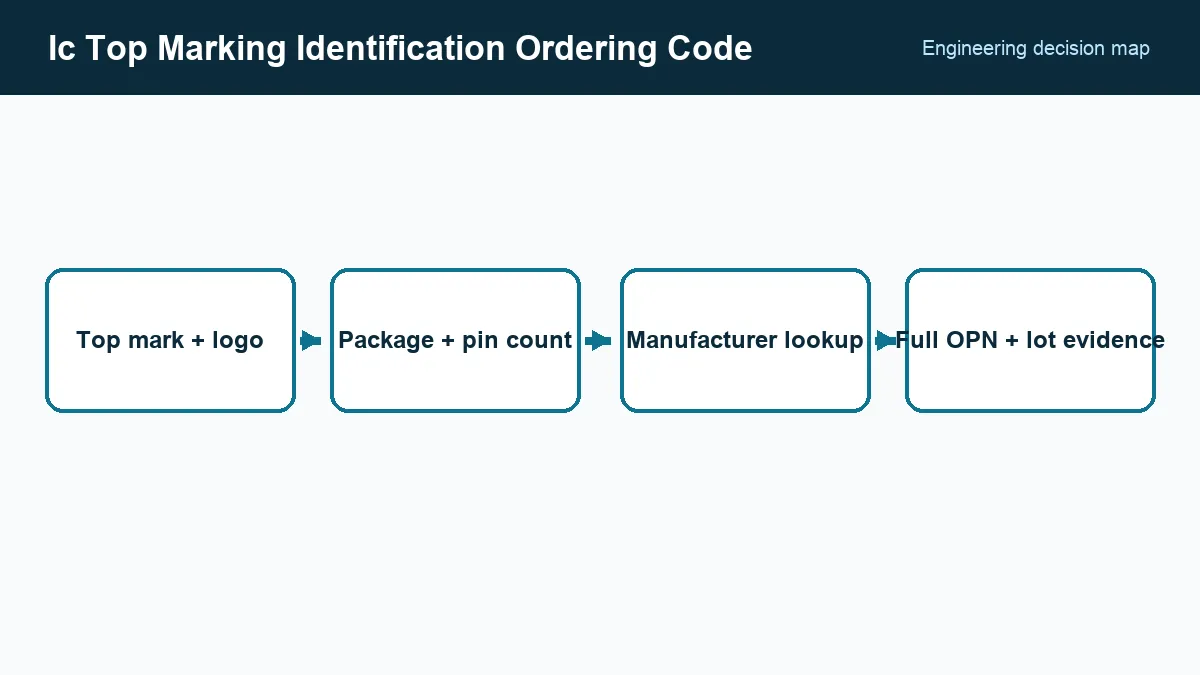
Use a documented identification chain: capture the object, segment the marking fields, identify the manufacturer, constrain the package, query an official source, and reconcile the result with labels and circuit context.
Capture the marking before interpreting it
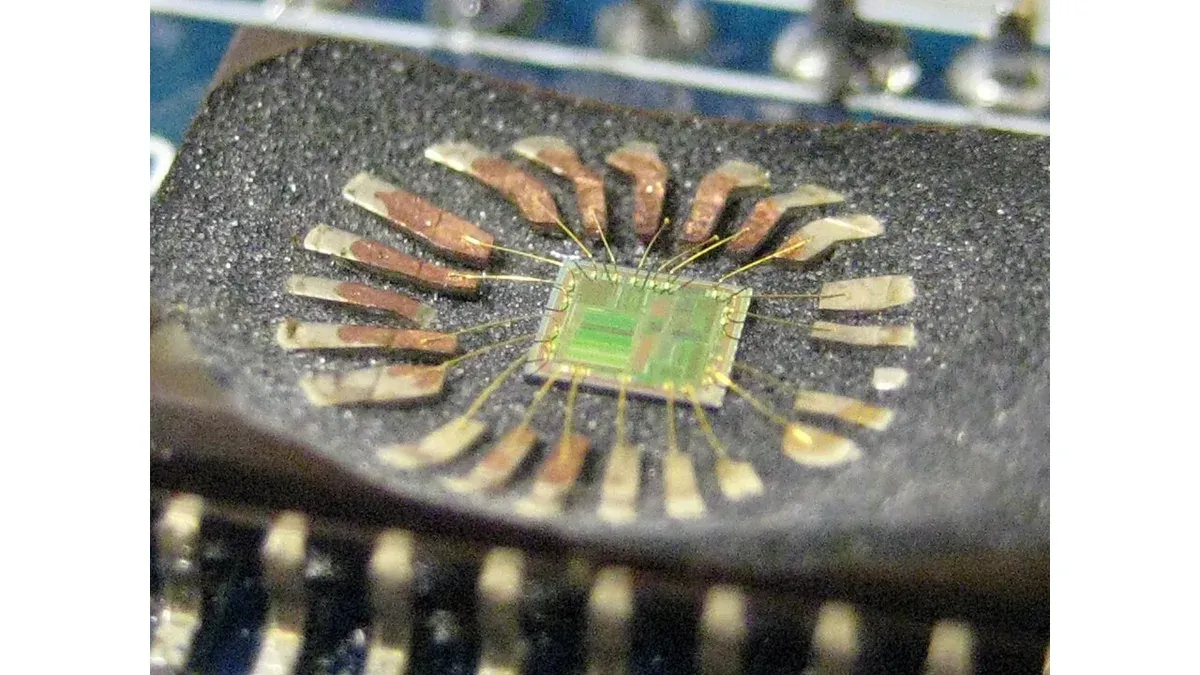
Photograph the full package under diffuse and angled lighting. Preserve orientation, pin-one feature, logo, every text line, mold marks, and package condition. Record dimensions, pin count, pitch, exposed pad, lead style, and board reference designator.
Transcribe ambiguous characters with alternatives, such as 0/O, 1/I, 5/S, and 8/B. Do not enhance an image until the original is retained; sharpening and contrast can invent edges. If the surface appears remarked, stop treating the code as reliable identification evidence.
How do you distinguish an IC device code from date and lot markings?
Use the manufacturer’s package-marking convention and official lookup to separate device identity from date, lot, and other trace fields. Comparing several units can reveal stable and changing strings, but that pattern is only a clue; it cannot establish the meaning of a field without manufacturer evidence.
Use the PCB function only as a consistency check. A six-pin device near a power inductor may be a regulator, but that observation cannot distinguish pinout or voltage option. Never let the expected circuit function override an official code conflict.
Texas Instruments’ part-marking lookup, accessed September 24, 2026, lets users search package markings and then refine the result with package information. Equivalent official tools or manufacturer support should be used for other brands.
How do you recover the full ordering code from an abbreviated IC mark?
Combine the manufacturer’s marking lookup and ordering table with measured package details and traceable reel, tray, or bag labels. A base-device match may leave package, temperature, packing, qualification, or finish suffixes unresolved. Record those gaps explicitly instead of inferring a full ordering code from the top mark alone.
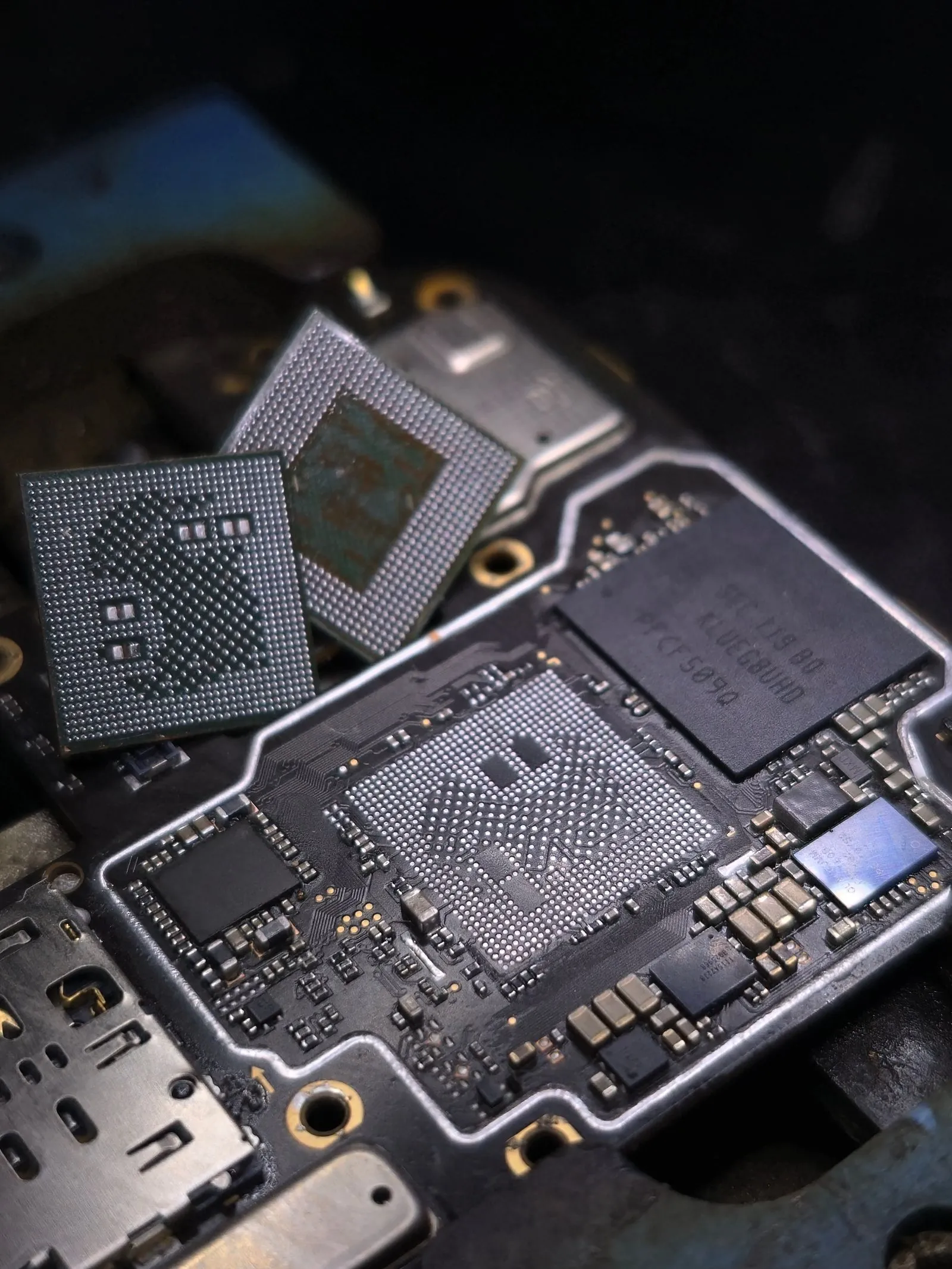
Compare measured package dimensions and ball or lead configuration with the mechanical drawing. For BGA and leadless packages, X-ray or board records may be needed to establish the ball map or exposed-pad structure without removing the part.
Reconcile the candidate with reel, tray, moisture-barrier-bag, box, and certificate labels. Manufacturer part number, quantity, lot, date, country, packing method, and purchase record should form a coherent chain.
Escalate conflicts instead of averaging evidence
An official lookup that returns several candidates is an unresolved result. A package mismatch, impossible date relationship, wrong logo, inconsistent lot code, or label conflict should trigger quarantine and manufacturer or supplier inquiry.
Do not “correct” a label to fit the device or select the nearest catalog part. Preserve photos and raw observations, name the conflict, and define the next discriminating test. That may be continuity, nondestructive electrical characterization, X-ray, XRF, decapsulation, or comparison with a traceable reference sample, depending on risk.
Visual consistency across a lot can detect mixed material, but a consistent counterfeit lot is still possible. Identification and authenticity are separate conclusions.
Produce an auditable identification record
The record should include original images, sample count, package measurements, all transcribed fields, logo assessment, official lookup URL and access date, candidate list, ordering-table excerpt, label reconciliation, circuit consistency check, and disposition.
Use explicit statuses: identified, probable with unresolved suffix, ambiguous, conflict, or not identified. Only an exact ordering code supported by converging evidence should enter a purchasing or inventory record. This prevents an abbreviated top mark from silently becoming a false full part number.
Frequently Asked Questions (FAQ)
Does the text printed on an IC always equal its orderable part number?
No. Small packages often use abbreviated device codes plus date, lot, assembly, or trace codes. The full ordering code can also include package, temperature, packing, and qualification suffixes absent from the top mark.
Can the same short top-mark code identify more than one device?
Yes. Codes can be reused across manufacturers and sometimes across package families. Manufacturer identity, package, pin count, context, label, and official lookup are required to resolve ambiguity.
Is visual marking identification proof that a component is authentic?
No. It establishes a candidate identity. Authenticity requires traceability and, according to risk, package inspection, documentation reconciliation, electrical testing, or other approved methods.