
Table of Contents
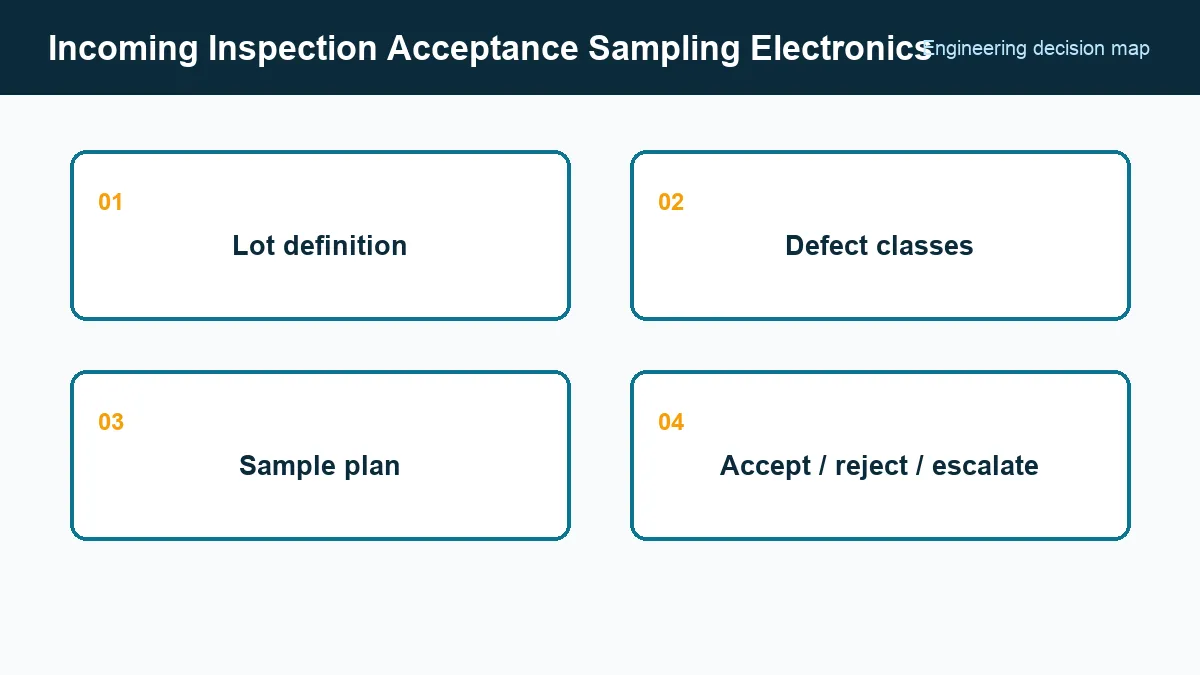
Incoming sampling is a lot-disposition tool. It does not estimate supplier process capability, prove zero defects, or make a questionable source trustworthy. A useful plan connects the consequence of a defect with an explicit probability of accepting or rejecting a lot.
Begin with the decision the inspection must support. Visual condition, labeling, dimensions, authenticity indicators, and electrical performance can have different defect classes and therefore different inspection strategies.
What counts as one lot for electronic-component acceptance sampling?
One sampling lot must be sufficiently homogeneous for a single acceptance decision, with a defined manufacturer, full ordering code, required trace-lot identity, supplier, shipment condition, and inspection history. Do not merge unrelated reels to reduce sampling or split a suspect lot to improve its chance of acceptance.
Choose the inspection unit. It may be a component, reel, tray, moisture-barrier bag, label set, or document package. A sample of ten components taken from one reel says little about labeling consistency across twenty reels.
Select units randomly across containers and positions using a documented method. Convenience samples from the top of the first box can miss mixed lots and handling damage.
How should incoming component defects be classified?
Classify incoming defects by their consequence for the product and express each class with observable acceptance criteria. Wrong identity, broken traceability, damaged leads, seal failure, and electrical failures may carry different risks; critical, major, and minor labels need application-specific definitions rather than a universal assignment.
Do not let broad labels replace criteria. “Poor appearance” creates inconsistent decisions; “lead coplanarity exceeds drawing limit” can be measured. Use reference images and measurement methods for recurring visual attributes.
NIST’s acceptance-sampling handbook, accessed September 24, 2026, explains that acceptance sampling decides whether to accept a lot and entails both producer and consumer risk. Choose a recognized attribute or variable plan whose operating-characteristic behavior matches the business and product risk.
What does AQL mean for an accepted electronic-component lot?
Acceptance quality limit (AQL) is an index used to select a sampling scheme with its associated switching rules; it is not a guarantee that an accepted lot contains no more than that percentage of defects. Sample size and acceptance number determine the probability of acceptance at different actual defect levels.
For a high-consequence characteristic, the needed consumer protection may demand a different plan, zero-acceptance rule, destructive qualification, or full screening. If a test is destructive or expensive, combine source qualification, process evidence, periodic testing, and lot sampling rather than quietly reducing the sample.

Keep authenticity and traceability controls risk-based. Sampling a few top markings cannot establish the provenance of the unexamined balance. Source approval and document reconciliation remain primary controls.
Predefine switching and escalation rules
Normal, reduced, and tightened inspection only work when the switching history is maintained. Define triggers for tightened inspection: rejection, repeated supplier defects, source or site change, corrective-action failure, mixed date or lot codes, label conflict, or field escape.
Define who can release a rejected lot, what additional evidence is needed, and whether sorting must cover the full lot. A resample after failure should follow the governing plan; repeatedly sampling until a lot passes destroys the stated statistical risk.
Restoration to normal or reduced inspection should require a stated sequence of acceptable lots and closure of corrective actions. Track results by supplier, manufacturer, part family, and defect type so recurring signals are visible.
Make the inspection record reproducible
For every lot, retain PO and line, manufacturer and part number, supplier, lot identity, quantity, plan and revision, inspection level, sample selection, sample size, acceptance/rejection numbers, actual defects by class, instruments, inspector, date, disposition, and deviation reference.
The released procedure should distinguish sampling for lot acceptance from process-capability monitoring and engineering qualification. When the plan states its risks, units, randomization, switching, and escalation, receiving can make consistent decisions without implying that a small sample certifies every component.
Frequently Asked Questions (FAQ)
Is inspecting a fixed percentage of every incoming lot a statistical sampling plan?
Not by itself. A plan must define lot formation, random selection, sample size, acceptance and rejection numbers, defect classes, and the producer and consumer risks it is intended to control.
Does acceptance sampling prove that every item in an accepted lot is good?
No. It makes a lot-disposition decision from a sample with known statistical risks. Critical characteristics may still require full screening, process controls, or stronger source assurance.
When should incoming inspection move to tightened or 100% inspection?
Use predefined triggers such as a rejected lot, repeated defects, source change, traceability break, corrective-action failure, or serious escape. Define how normal inspection is restored after sustained acceptable results.