Table of Contents
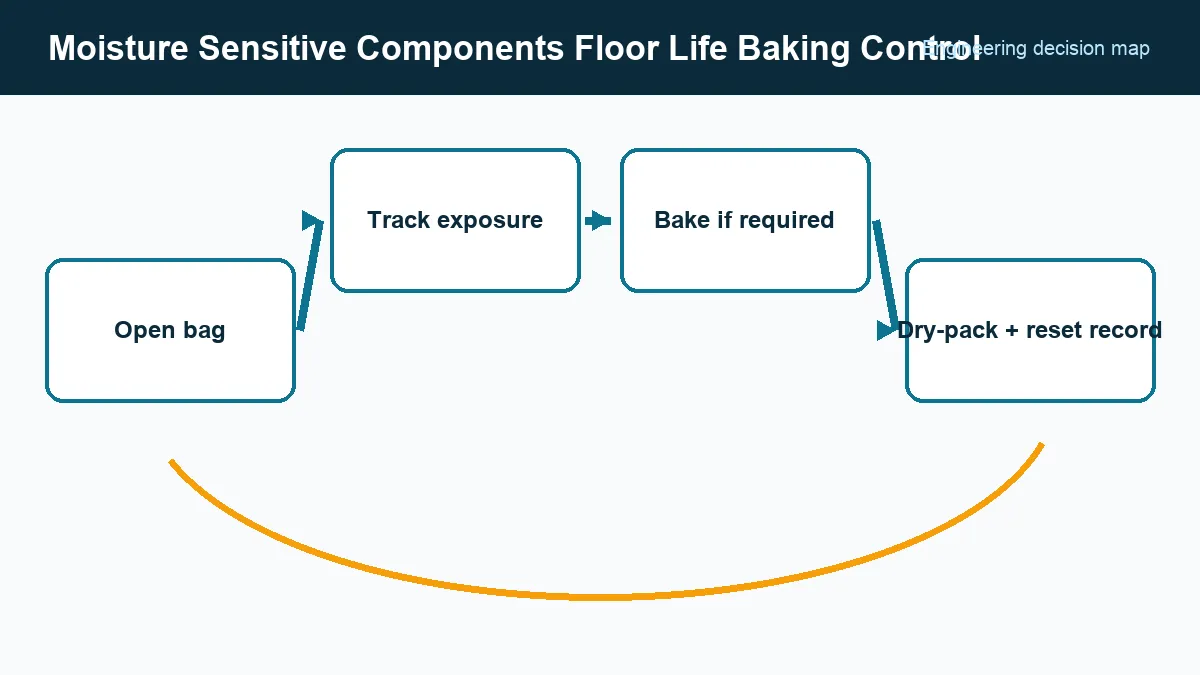
When a moisture-sensitive component exceeds its allowed exposure, the problem is no longer receiving inspection. The material needs a controlled disposition: demonstrate remaining allowance from reliable records, bake under a supported condition, or reject it for the intended assembly process.
This article focuses on recovery after exposure. Initial bag, label, MSL, and floor-life checks are covered in the MSL receiving guide.
What exposure records are needed before recovering an MSL-exceeded lot?
Recover the exact component’s moisture sensitivity level (MSL), package identity, bag seal and opening times, exposure temperature and humidity, dry-cabinet history, and previous bake records before selecting a disposition. Link partial reels and transferred trays to their original labels so an exposure allowance is not inferred from incomplete timestamps.
Do not reset the clock because material returned to a dry cabinet. Low-humidity storage can pause or alter accumulation under defined conditions, but the prior history still matters. If timestamps or environmental limits are unknown, treat the record as insufficient rather than inventing a remaining duration.
Texas Instruments’ moisture-sensitivity application report, accessed September 24, 2026, describes moisture classification, floor life, dry packing, and handling controls. Apply the current component manufacturer instructions and the contractually required handling-standard revision.
How do you choose a bake recipe without damaging the component or carrier?
Select a manufacturer-supported bake condition for the package thickness, MSL, and moisture exposure, then verify that the component and every carrier material tolerate the stated temperature and duration. Tape, reels, trays, labels, and adhesives can impose a lower limit than the package itself; higher heat is not automatically a permissible shortcut.
Texas Instruments’ component baking guidance, accessed September 24, 2026, distinguishes component moisture removal from ordinary storage and calls attention to packing-material constraints. Verify the exact carrier’s temperature rating in writing before placing it in an oven.
If parts must be transferred to high-temperature trays, use ESD controls, orientation and count checks, clean handling, and a method that prevents bent leads or lost traceability. Do not pour components into an unqualified container.
Control the oven as a process
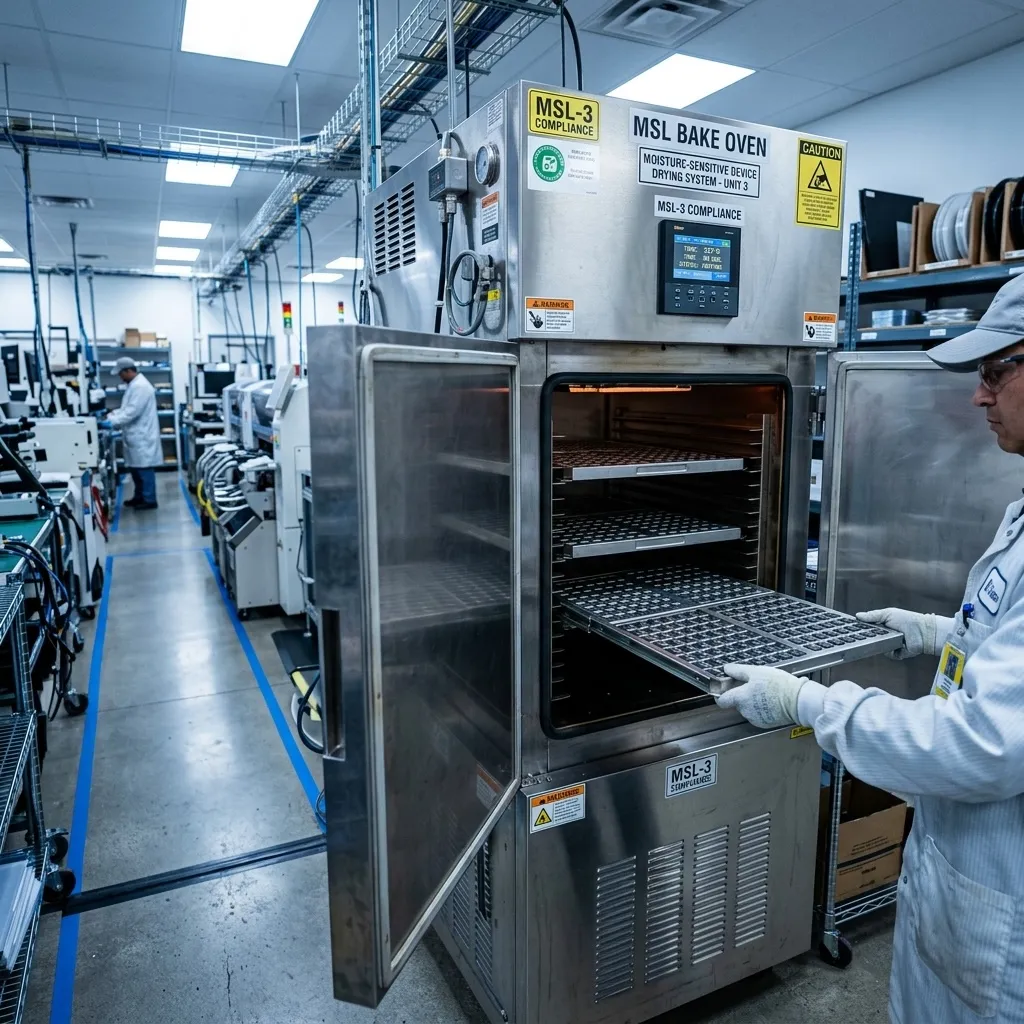
Use a calibrated oven capable of the required temperature uniformity and airflow. Define load arrangement, warm-up, timing start, allowable interruption, and overtemperature response. Record actual start and stop times, setpoint, equipment ID, operator, lot, quantity, and approved recipe.

Avoid contaminating the oven or parts. Confirm that labels, inks, reels, trays, and bags do not release residues at temperature. Check whether repeated bake exposure is limited because oxidation, intermetallic growth, packing degradation, or solderability may become concerns.
After baking, minimize uncontrolled ambient exposure. Cooling and handling steps belong in the recipe; hot material moved directly into an unsuitable bag can damage packaging or create condensation risk under abnormal conditions.
What must be included when dry-packing components after baking?
After a supported bake and controlled cooling, use a suitable moisture-barrier bag, fresh desiccant sized for the contents, the required humidity indicator card (HIC), and a validated heat seal. Preserve the lot identity and new exposure instructions, and protect the bag from sharp tray or reel edges during sealing and handling.
Texas Instruments SPRABY1A, accessed September 24, 2026, covers packing and storage considerations for semiconductor devices. Confirm whether the application requires vacuum, nitrogen, or a particular bag construction; these terms are not interchangeable.
The new external label should preserve manufacturer, full part number, lot/date information, quantity, MSL, bake record reference, repack date, and any new use-by or floor-life instruction supported by the governing process. It must not obscure the original identity chain.
Release material with a traceable new clock
Quality review should verify exposure reconstruction, disposition authority, recipe, carrier compatibility, oven record, quantity reconciliation, bag materials, HIC and desiccant, seal, and label. Define when the new floor-life clock begins and how each subsequent opening is logged.
If exposure history, package classification, carrier rating, or bake allowance cannot be established, escalation may lead to manufacturer review, a different assembly risk assessment, or rejection. Baking is a controlled recovery process, not a generic cure for uncertain storage history.
Frequently Asked Questions (FAQ)
Can moisture-sensitive components be baked on their original tape and reel?
Only if the tape, reel, cover tape, labels, and other carrier materials are rated for the selected bake temperature and duration. Otherwise transfer the components using an approved ESD-safe process.
Does baking reset floor life automatically?
Only a validated bake that meets the component and applicable handling-standard conditions can establish the intended dry state. The new exposure clock, packaging, and record must then be controlled.
Can a humidity indicator card show how much moisture is inside the package body?
No. It indicates humidity inside the sealed bag under its response conditions. It does not directly measure moisture concentration in the semiconductor package.