
Table of Contents
- Which component risks should determine purchase-order quality clauses?
- What evidence should a component purchase-order clause actually require?
- Acceptance should not shift design responsibility
- How should a PO handle component changes and shipment deviations?
- Connect clauses to receiving and remedies
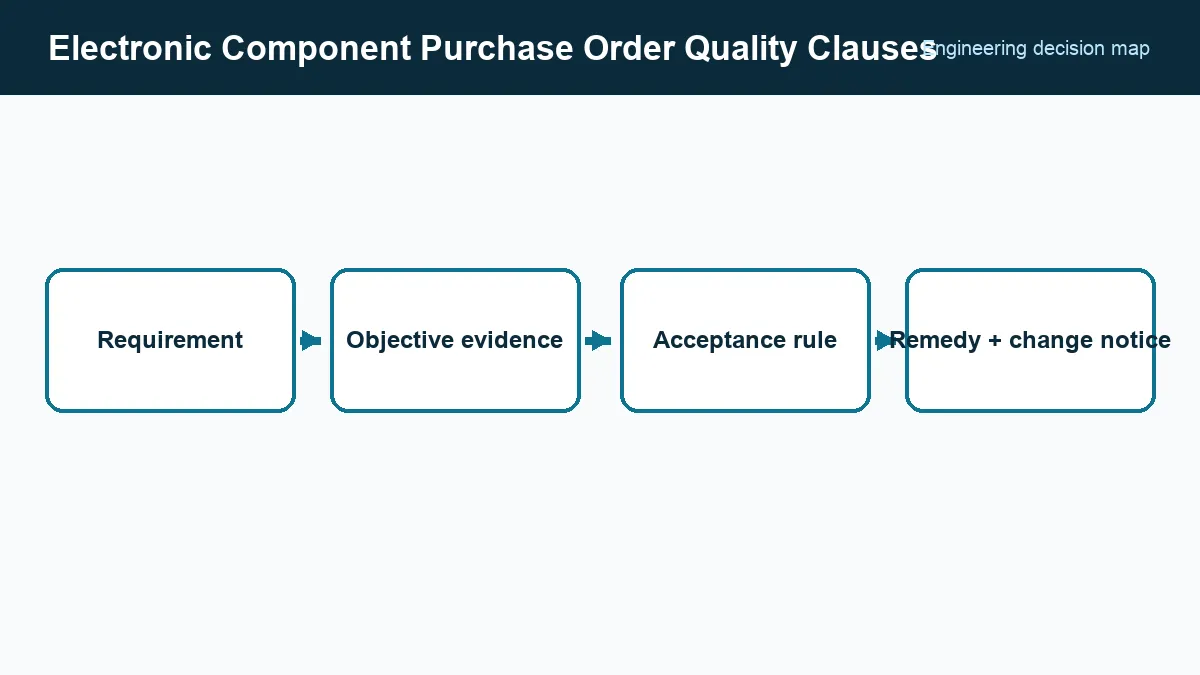
“All parts must be genuine and high quality” is not an acceptance clause. It names no evidence, measurement, decision owner, or remedy. A useful purchase order translates product and supplier risk into deliverables that receiving and quality teams can verify.
Each clause should answer five questions: what material it covers, what the supplier must do, what evidence must arrive, how acceptance is decided, and what happens when the requirement cannot be met.
Which component risks should determine purchase-order quality clauses?
Select PO quality clauses from the line item’s source, product criticality, counterfeit exposure, storage sensitivity, special processing, and customer or regulatory obligations. An authorized-distribution order for current parts and a brokered obsolete lot need different evidence packages; document the applicable risk before selecting a clause.
Create a clause matrix keyed to source tier, product criticality, counterfeit risk, age, storage sensitivity, special process, customer flow-down, and regulatory use. Apply only the clauses justified by that matrix and identify them on each affected line.
What evidence should a component purchase-order clause actually require?
Specify a verifiable deliverable tied to the shipped material: the issuer, PO and line, manufacturer, full part number, quantity, and the exact conformance statement or test result required. Where lot codes, origin, or manufacturer traceability matter, state the acceptable document chain and redaction rules so receiving can judge what arrives.
For test reports, name the method, revision, sample size, acceptance limit, equipment or laboratory qualification if necessary, and lot linkage. “Test report required” can produce a generic data sheet that proves nothing about the shipped material.
Curtiss-Wright’s published purchase-order quality clauses, accessed September 24, 2026, illustrate how a buyer can define document retention, traceability, inspection, notification, and flow-down obligations. Use such examples as drafting references while tailoring requirements to the actual contract and applicable law.
Acceptance should not shift design responsibility
Name measurable limits: exact ordering code, approved manufacturer, package, quantity tolerance, date-code policy, seal and label condition, MSL packaging, plating or finish, programming checksum, and required documents. Reference controlled specifications with revision or a contract-defined latest-revision rule.

Clarify whether buyer inspection is acceptance or only one control. Define who owns destructive-test samples, whether shortages are replenished, and how a rejected lot is contained. If a source must obtain approval before a substitution, prohibit changes in manufacturer, part number, fabrication site, die revision, package, or process unless the named change procedure is followed.
Avoid clauses that require a distributor to certify technical facts only the manufacturer can establish. Ask for the manufacturer’s declaration or traceability evidence instead of forcing an unsupported reseller statement.
How should a PO handle component changes and shipment deviations?
Require a written change or deviation notice before shipment, tied to the affected line, material, requirement, and proposed disposition. Define the notice destination and authorized buyer role; known product or process changes need sufficient detail and lead time for engineering review, rather than an assumption that a PCN subscription will reach the buyer.
For a deviation, require the supplier to identify material, quantity, lot, requirement, actual condition, cause if known, proposed disposition, and shipment deadline. Only named buyer roles should approve a waiver. The packing list and receiving record should reference the approved deviation.
Define notification and containment for suspected counterfeit, mixed lots, loss of traceability, damaged moisture barrier, test failure, or later-discovered escape. Include record-retention and access terms proportional to risk.
Connect clauses to receiving and remedies
Receiving needs a checklist generated from the PO: documents expected, label fields, packaging state, inspection level, samples, and hold triggers. A requirement that is never presented to receiving is unlikely to be enforced consistently.
State remedies such as replacement, rework by agreement, refund, expedited return, investigation support, and responsibility for agreed testing or sorting costs. Commercial and legal teams should review enforceability, liability, and jurisdiction language.
Release the clause library under revision control with an owner, purpose, trigger, evidence, acceptance rule, and standard remedy for each clause. Review supplier exceptions before order acknowledgement closes. The result is a purchase order that produces inspectable evidence and a predictable decision when the shipment arrives.
Frequently Asked Questions (FAQ)
Should every component purchase order use the same quality clauses?
No. Apply clauses according to part risk, source type, customer and regulatory obligations, storage condition, programming, and required evidence. Irrelevant clauses create cost and ambiguous exceptions.
What makes a certificate-of-conformance clause useful?
It names the issuer, covered PO and line item, manufacturer and part number, quantity, lot or date code where required, conformance statement, signature or authorization, and any required traceability attachments.
How should supplier exceptions be handled?
Require written exceptions before shipment, identify the affected clause and material, assess the risk, and record an authorized waiver or PO amendment. Silence should not be treated as an accepted exception.