Table of Contents
A lower quote for cut tape can become a more expensive build if the assembler must hand-load strips, add leader material, or consume extra devices during setup. Conversely, buying a full reel for a small build can create unnecessary surplus.
The choice should be made against the actual feeder and lot-control requirements. The same electrical part can arrive in several commercially valid formats that impose different work at the assembly line.
TI’s explanation of custom reels and cut tape, checked on September 15, 2026, describes custom reels made from one source reel with leader and trailer tape. It also notes that cut-tape orders can be supplied in multiple strips or as individual devices. These are TI’s service definitions; obtain equivalent details from another seller.
| Format | Typical reason to choose it | Verify before ordering |
|---|---|---|
| Original manufacturer reel | Repeated production using the original carrier | Reel quantity, width, pitch, orientation, and feeder support |
| Cut tape | Small builds or a process accepting strips | Number and length of strips, loading losses, and protected packaging |
| Custom reel | Exact quantity with a feeder-ready carrier | Source reel identity, splice method, leader/trailer, and labeling |
| Tray or tube | A package supplied for compatible handling | Carrier dimensions, orientation, condition, and machine support |
The format is part of the bill of materials handoff. Do not leave it to a warehouse operator to infer from a shortened distributor SKU.
The assembler defines feeder readiness
Ask the manufacturing team to approve carrier width, pocket pitch, reel diameter, component orientation, cover-tape compatibility, and the permitted splice position. Identify whether a feeder can detect or pass the splice and how the machine will respond.
A strip containing the correct quantity may still be too short to load efficiently. A custom reel may require a specific leader length. These are equipment and process constraints, so a universal “minimum 20 pieces” rule would be unreliable.
Where a seller changes the carrier or orientation, request a drawing or sample pack for evaluation before the production order. Include protection against bent leads and devices rotated in pockets.
Purchased quantity versus usable placements
Assume a hypothetical prototype build needs 240 placements. Manufacturing expects eight devices for feeder setup and four for validation or handling loss. The purchasing requirement is then 252 usable devices in the agreed carrier format.
If the purchase is rounded to 260, record the eight-unit remainder. Do not present all 260 as production demand. If the assembler instead needs 20 setup devices for multiple short strips, the quoted packaging decision changes the required quantity to 264.
Compare the total cost of accepted material, reeling, setup, labor, and surplus. The RFQ comparison guide explains how order multiples and service charges affect the commercial comparison; this packaging check establishes the usable quantity behind it.
Traceability through repacking
Record the original reel identifier where available, manufacturer and ordering code, lot/date information, quantity removed, resulting package identifiers, and the party performing the operation.
If several lots must be supplied, keep them distinguishable. Combining them physically without a traceable map can make later defect containment much broader than necessary. The required policy should be agreed before purchase, especially when an assembler expects one lot per build.
Repacking also creates a handling event. Capture moisture-barrier-bag opening and resealing times, storage conditions where required, and any approved drying or baking record. Follow the device-specific process; neither a fresh bag nor new desiccant proves that prior exposure was acceptable.
The MSL receiving guide covers exposure assessment separately from carrier choice.
Close the handoff before the line starts
A useful acceptance record confirms that the received format matches the purchase requirement and that the assembler can load it. Check labels against the source records, count usable units, examine the carrier for damage, and resolve discrepancies before the scheduled build.
For a component kitting service, preserve the package-to-BOM relationship through kit issue and unused-material return. A partially used reel needs an updated quantity and exposure record.
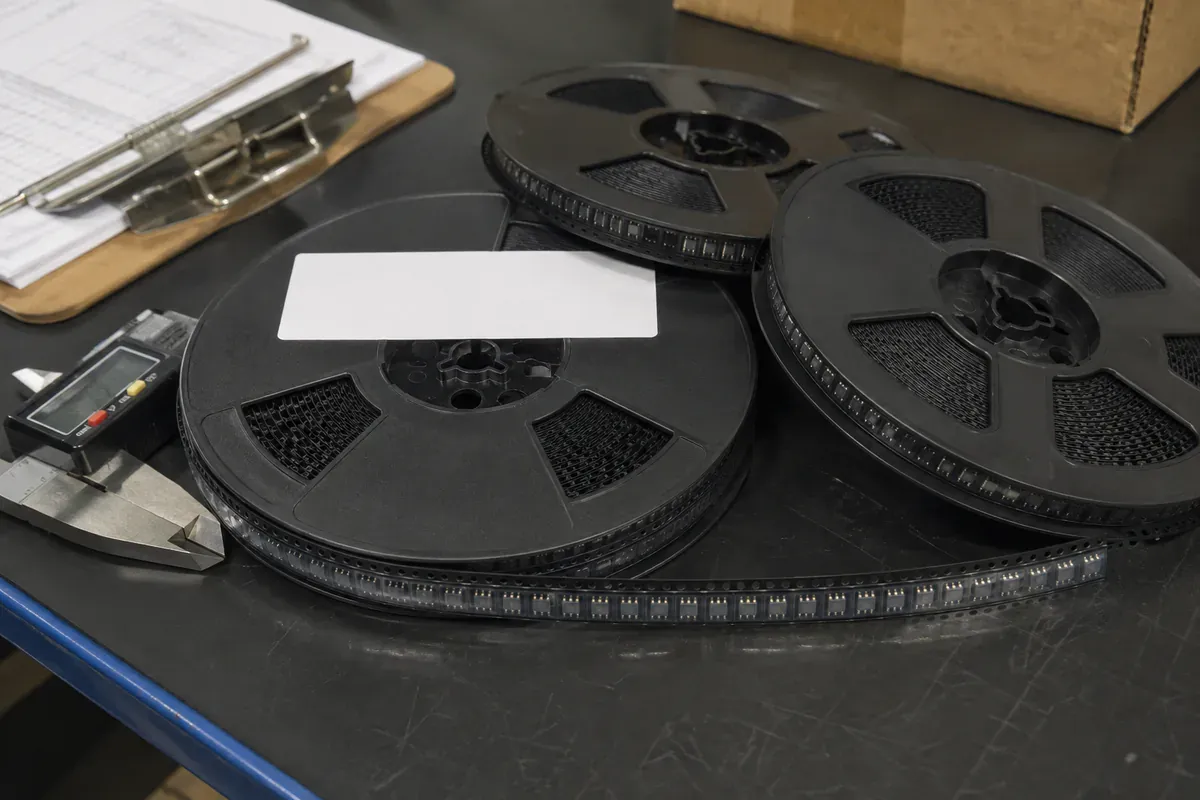
The Hero image is a generated illustration of component reels. It represents the packaging topic and does not document a supplier lot or a SupplyICs handling operation.
Frequently Asked Questions (FAQ)
Is cut tape always unsuitable for automated assembly?
No. Some feeders and processes accept cut strips. Confirm minimum strip length, leader requirements, loading method, and expected losses with the actual assembler.
Does a custom reel preserve original manufacturer traceability?
It can preserve the source relationship when the reeling process records the original reel and resulting packages. Ask for the specific service's lot controls; the phrase custom reel alone is insufficient.
Does resealing a moisture-barrier bag reset floor life?
Resealing alone does not erase previous exposure. Preserve the exposure history and follow the applicable manufacturer and moisture-handling procedure before assembly.