Table of Contents
- Why Did Infineon Announce a Second Price Hike in 2026?
- The AI Demand Factor Nobody Modeled
- Which Power Semiconductor Categories Are Most Affected?
- IGBT Modules: The Acute Bottleneck
- How Big Is the SiC Market, and Why Does the Shortage Persist?
- Infineon-ROHM Collaboration: What It Actually Delivers
- What Is the Outlook for MOSFET Pricing Through H2 2026?
- How Should Procurement Teams Respond to Power Semiconductor Allocation?
- Your BOM Audit: Where to Start
- What Are the Geopolitical and Structural Factors Beyond Infineon?
- The China Factor in Power Discretes
- European Energy Costs and Fab Economics
- Is There a Case for GaN as a Substitution Path?
- How Long Will the Power Semiconductor Crunch Last?
- What We’re Seeing on the Ground
- Six Concrete Actions for Your Procurement Team
Why Did Infineon Announce a Second Price Hike in 2026?
When Infineon posted its Q1 FY2026 financials in February, CEO Jochen Hanebeck characterized the power semiconductor market as experiencing “structural demand tailwinds in electrification and AI, offsetting normalization in consumer and commodity segments.” That normalization narrative held through the first price adjustment of the year, but the market conditions that triggered the May 26 announcement—and the July 1 effective date—tell a different story.
The second price increase reflects three converging dynamics that haven’t appeared together since the 2017-2018 super-cycle. First, AI data center build-outs are absorbing power MOSFET and module capacity at volumes that outstrip even the most aggressive 2024 demand forecasts—hyperscalers are ordering power-stage components 12-18 months forward, effectively pre-empting allocation for industrial and automotive customers who operate on 6-9 month planning cycles. Second, SiC substrate supply remains constrained at the 150mm level, and while the transition to 200mm wafers is underway at Wolfspeed’s Mohawk Valley fab and Infineon’s Villach site, ramp yields have been slower than public roadmaps suggested. Third, the structural bifurcation in the power discrete market—oversupply in low-end MOSFETs and general-purpose discretes versus a genuine capacity crunch in high-voltage IGBTs and automotive-grade SiC—means Infineon’s product mix is shifting toward higher-ASP, margin-accretive products, and the price increases reflect both input cost pass-through and deliberate portfolio optimization.
The May 26 announcement did not specify exact percentage increases across all product categories, but channel checks and distributor communications indicate adjustments in the 8-15% range for high-demand IGBT modules and automotive-qualified SiC MOSFETs, with more modest 3-7% increases for standard MOSFETs and general-purpose discretes. Infineon’s official statement cited “sustained increases in raw material costs, particularly for silicon carbide substrates and high-purity copper lead frames, combined with elevated logistics and energy costs in European manufacturing operations.” The European energy cost component is not trivial—Infineon’s Villach and Dresden fabs consume substantial power for SiC crystal growth furnaces and wafer processing, and European industrial electricity prices remain 2-3x above pre-2022 levels.
Related Reading: For broader context on power discrete and module market dynamics leading into this price adjustment, see our analysis: Power Discrete and Module Market Trends: Lead Time and Allocation Outlook, June 2026. For the SiC and GaN supply-demand picture in data center applications, see: The AI Power Wall: SiC, GaN, and 800V HVDC in Data Centers.
The AI Demand Factor Nobody Modeled
The single largest variable driving power semiconductor pricing in mid-2026 is the AI data center build-out. NVIDIA’s Blackwell Ultra ramp, AMD’s MI400 series production, and the custom ASIC programs at Google (TPU v6), Amazon (Trainium3), and Microsoft (Maia 200) are all consuming power delivery silicon at volumes that have fundamentally altered the demand profile for high-current MOSFETs, power stages, and IGBT modules.
Each rack-scale AI server deployment requires power management ICs, MOSFET driver stages, and DC-DC converter modules in quantities that dwarf a typical industrial motor drive or EV on-board charger. A single NVIDIA GB300 NVL72 rack—72 GPUs interconnected via NVLink—pulls approximately 120-140 kW and requires roughly 200-300 power-stage MOSFETs and associated gate drivers for the voltage regulator modules alone. When hyperscalers are deploying these racks by the tens of thousands, the aggregate power semiconductor consumption from AI infrastructure rivals the entire European EV on-board charger market.
Infineon’s OptiMOS and CoolMOS product families, along with its integrated power stages, are spec’d into a significant share of these AI server voltage regulator designs. The knock-on effect for procurement teams outside the AI ecosystem is that MOSFET capacity that historically served industrial drives, solar inverters, and automotive subsystems is being bid away by hyperscaler volumes with longer order visibility and higher willingness to pay.
Which Power Semiconductor Categories Are Most Affected?
Not all power semiconductor categories are experiencing the July 2026 price hike equally. The impact varies significantly by product type, voltage rating, and qualification level. Understanding the gradient is essential for prioritizing your sourcing response.
Three categories face the most acute supply-pressure and price-action combination. IGBT modules—particularly 1200V and 1700V industrial-grade units in EconoPACK and PrimePACK form factors—are seeing lead times of 30 to 52 weeks with some high-demand SKUs effectively on allocation, meaning orders are accepted but delivery dates extend beyond 12 months. Automotive-qualified SiC MOSFETs in TO-247-4 and surface-mount packages are in severe allocation across all major suppliers, with Infineon’s CoolSiC product line reportedly booked through Q1 2027 on several automotive-traction-inverter-qualified part numbers. High-voltage super-junction MOSFETs (CoolMOS 600V-950V) are tightening as the AI data center power delivery pull combines with industrial and renewable-energy demand. In contrast, low-voltage trench MOSFETs (sub-100V) and general-purpose SMD discretes (SOT-23, SOT-223 packages) remain in oversupply with competitive pricing—the bifurcation is stark and procurement teams should avoid extrapolating the tightness in high-end categories to commodity discretes where buyer leverage remains intact.
The table below provides a category-by-category assessment of the power semiconductor landscape as of July 2026:
| Power Semiconductor Category | Typical Lead Time (July 2026) | Price Trend (H2 2026) | Allocation Status | Procurement Urgency |
|---|---|---|---|---|
| IGBT Modules (1200V/1700V) | 30-52 weeks | ▲ 8-15% increase | Allocation / Extended Lead Times | CRITICAL — Act Now |
| Automotive SiC MOSFETs | 40-52+ weeks | ▲ 10-15% increase | Severe Allocation | CRITICAL — Act Now |
| HV Super-Junction MOSFETs (600-950V) | 20-36 weeks | ▲ 5-10% increase | Tightening | HIGH — Plan Within 30 Days |
| Industrial SiC Diodes & Discretes | 16-26 weeks | ▲ 3-8% increase | Moderate — Book Ahead | MEDIUM — Review Q3 Orders |
| GaN HEMT Power Transistors | 12-20 weeks | Stable to slight increase | Available | LOW — Monitor |
| Low-Voltage Trench MOSFETs (<100V) | 8-16 weeks | Stable / Oversupply | Readily Available | LOW — No Immediate Action |
| General-Purpose SMD Discretes | 4-10 weeks | Declining | Oversupply | LOW — Opportunistic Buying |
IGBT Modules: The Acute Bottleneck
IGBT modules represent the most structurally constrained segment. Unlike discrete MOSFETs, which can be produced across multiple fab geometries, IGBT modules combine power semiconductor die with specialized packaging—direct bond copper (DBC) substrates, aluminum wire bonds, and gel-filled housings—in a supply chain that is far less elastic. Capacity additions require not just front-end wafer processing but back-end module assembly lines with specific tooling for each form factor.
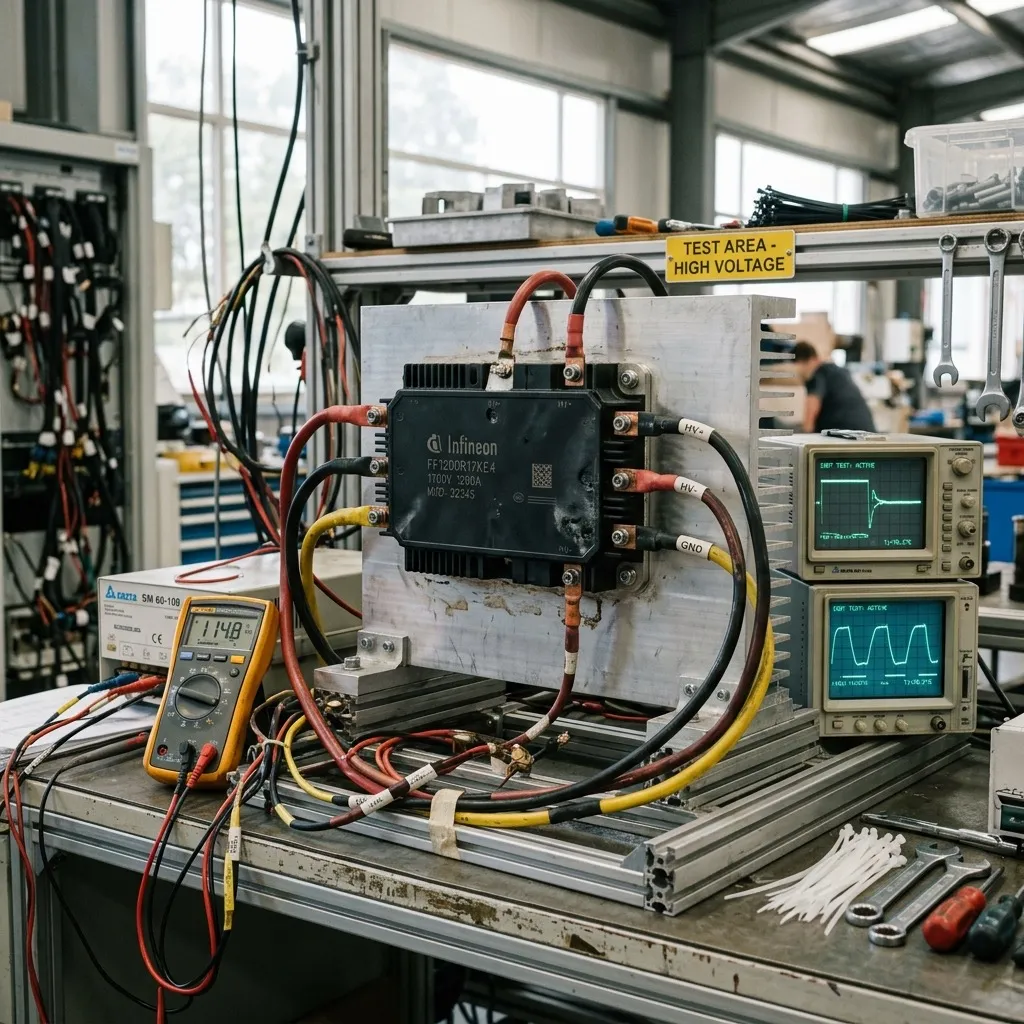
Infineon’s EconoPACK, PrimePACK, and EconoDUAL families dominate the industrial IGBT module market, and for good reason: they are characterized into thousands of motor drive, UPS, and renewable energy designs that cannot be redesigned without requalification cycles of 6-18 months. When lead times on these modules stretch past 40 weeks, procurement teams facing line-down risk have few options other than to pay premiums on the open market. We recently worked with a European solar inverter manufacturer whose central-inverter IGBT module allocation was cut by 35% for Q3 2026 with four weeks’ notice. Through our global supply network, we located authenticated stock of the exact Infineon FF-series modules at three independent warehouses in Europe and Asia, bridging their production gap while their engineering team qualified an alternative IGBT module from Mitsubishi Electric.
Explore Infineon power semiconductor options and authorized distribution channels: Infineon Product Portfolio at SupplyICs
How Big Is the SiC Market, and Why Does the Shortage Persist?
The silicon carbide market has become the most closely watched segment of the power semiconductor industry, and for good reason: its growth trajectory combines structural demand from vehicle electrification with supply-side constraints that cannot be resolved quickly.
The SiC market reached $3.41 billion in 2026, expanding at a 24.68% compound annual growth rate according to Mordor Intelligence, with the power semiconductor market overall projected to grow from $46.1 billion in 2025 to $60.6 billion by 2034 (IMARC Group). These are not incremental growth numbers—they imply a near-doubling of demand within four to five years. The shortage persists because SiC wafer production is fundamentally different from silicon: boule growth takes 7-14 days per crystal versus 2-3 days for silicon, defect densities remain orders of magnitude higher, and the transition from 150mm to 200mm wafers—while mechanically underway at multiple suppliers—has been slower than roadmaps indicated. Infineon’s expanded collaboration with ROHM on SiC substrate supply, announced in 2025 and now in active implementation, will provide incremental wafer relief, but the volume from this arrangement represents a fraction of total Infineon SiC demand. Mitsubishi Electric’s June 2026 announcement of 5th-generation SiC MOSFET bare die samples signals additional capacity entering the market, but sampling to volume production in SiC typically takes 18-24 months, meaning these devices will not materially affect the supply-demand balance before 2028.
The automotive SiC procurement challenge is compounded by the qualification barrier. Traction-inverter SiC MOSFETs require AEC-Q101 qualification plus additional OEM-specific reliability testing that can take 12-18 months. This means that even if a second-source SiC MOSFET becomes commercially available tomorrow, it cannot be dropped into an existing automotive design without a qualification cycle that extends well beyond current allocation windows. For EV platforms in production, the procurement reality is that the SiC MOSFET supplier is effectively locked in for the model year, making allocation risk a direct production-line risk.
Infineon-ROHM Collaboration: What It Actually Delivers
The Infineon-ROHM SiC collaboration has received substantial press coverage but warrants a clear-eyed assessment of what it means for near-term procurement. Under the agreement, ROHM supplies 150mm SiC substrates and epitaxial wafers to Infineon, which processes them into CoolSiC MOSFETs at its Villach and Kulim fabs. The collaboration is notable because it diversifies Infineon’s SiC wafer supply beyond its primary internal source and existing Wolfspeed/Cree supply agreements.
However, the collaboration’s volume ramp is gradual. Industry estimates suggest the ROHM supply agreement will contribute an additional 5-8% to Infineon’s total SiC wafer intake in 2026, growing toward 15% by 2028. For procurement teams, this means the collaboration is a meaningful but insufficient response to the demand acceleration—it shaves weeks off lead times at the margin but does not shift the market from allocation to availability.
What Is the Outlook for MOSFET Pricing Through H2 2026?
The MOSFET market in mid-2026 is best understood as two separate markets sharing a common product category name. The pricing dynamics in each are driven by entirely different demand and supply forces.
High-voltage super-junction MOSFETs—Infineon’s CoolMOS, onsemi’s SuperFET, and ST’s MDmesh families—are in a tightening cycle driven by AI data center power delivery, EV on-board charger demand, and solar inverter deployments. These products require specialized epitaxial processing and deep-trench etching that constrain capacity growth. Pricing on 600V-950V parts rose an estimated 5-10% with the Infineon July 1 adjustment, and we expect another 3-5% increase before year-end as Q4 bookings consolidate. The low-voltage trench MOSFET market (sub-100V), by contrast, is in oversupply—capacity added during the 2021-2023 shortage cycle has come online, consumer and computing demand has softened, and Chinese foundries have expanded mature-node MOSFET production aggressively. Procurement teams buying general-purpose MOSFETs should be driving hard on price concessions; teams buying high-voltage or application-specific MOSFETs should be locking in volumes and, where possible, negotiating price-protection clauses for H2 2026 deliveries. The key insight: do not let the narrative of power semiconductor shortages lead you to accept price increases on commodity discretes where your leverage is real.
The following table captures current sourcing conditions for major power MOSFET suppliers:
| Manufacturer | Key Product Families | Lead Time Range (July 2026) | Price Direction | Second-Source Viability |
|---|---|---|---|---|
| Infineon | CoolMOS, OptiMOS, CoolSiC, EconoPACK | 20-52 weeks (product-dependent) | ▲ Increasing (July 1 adjustment) | Possible — plan qualification cycles |
| onsemi | SuperFET, EliteSiC, NTMFS/Trench | 16-40 weeks | ▲ Selectively increasing | Good — cross-reference available |
| STMicroelectronics | MDmesh, STPOWER SiC, STD/STP MOSFETs | 14-36 weeks | ▲ Modest increases on SiC | Good — broad portfolio |
| ROHM Semiconductor | SiC MOSFET (4th Gen), HV MOSFETs | 16-30 weeks | Stable | Growing — SiC portfolio expanding |
| Mitsubishi Electric | IGBT Modules, 5th-Gen SiC (sampling) | 20-40 weeks | Stable — new SiC gen on horizon | Watch — 5th-gen SiC in sampling |
| Vishay / Siliconix | TrenchFET, E-Series HV MOSFETs | 10-20 weeks | Stable / Decreasing | Good — broad commodity coverage |
How Should Procurement Teams Respond to Power Semiconductor Allocation?
The Infineon price hike is not a singular event to react to—it is a signal that the power semiconductor market is entering a period of sustained tightness in specific categories, and the procurement response needs to be correspondingly structured rather than tactical.
Procurement teams should execute four actions in sequence. First: conduct a structured BOM audit that identifies every Infineon power semiconductor line item, tags it by category (IGBT module, SiC MOSFET, HV MOSFET, LV MOSFET, discrete), and risk-ranks it by combining lead time, single-source status, and annual spend. The 20% of line items that account for 80% of supply risk should be the focus of immediate action. Second: qualify pin-compatible or functionally equivalent alternatives for all high-risk positions. For IGBT modules, Mitsubishi Electric and Fuji Electric offer credible second-source options. For SiC MOSFETs, onsemi’s EliteSiC and ST’s STPOWER SiC families are the most mature alternatives to Infineon CoolSiC. For HV super-junction MOSFETs, onsemi SuperFET and ST MDmesh offer competitive drop-in candidates. Third: lock in allocations through authorized distribution now—do not wait for Q4 budget cycles. Distributors allocate capacity on a first-committed basis, and Q3-Q4 2026 capacity for IGBT modules is filling rapidly. Fourth: for positions where authorized channels are fully committed and production continuity is at immediate risk, engage vetted independent distribution with a documented quality-assurance process. SupplyICs maintains authenticated inventory of Infineon, onsemi, ST, and other major power semiconductor lines with full traceability documentation and anti-counterfeit inspection as standard.
Your BOM Audit: Where to Start
The data you need for the audit is straightforward. Export your BOM, filter for power semiconductor part numbers, and create a risk-scoring matrix:
- Category Risk Score (1-5): IGBT Modules and Automotive SiC = 5; HV Super-Junction MOSFETs = 4; Industrial SiC = 3; LV MOSFETs = 1; General-Purpose Discretes = 1.
- Single-Source Risk Score (1-5): No approved alternative on file = 5; Alternative identified but not qualified = 3; Qualified alternative available = 1.
- Lead Time Risk Score (1-5): Lead time > 40 weeks = 5; 26-40 weeks = 4; 16-26 weeks = 2; < 16 weeks = 1.
Multiply the three scores. Any line item scoring above 45 requires immediate action—qualification of alternatives, allocation booking, and safety-stock provisioning. Items scoring 25-44 should be reviewed and addressed within 60 days. Items scoring below 25 can be managed through normal procurement cycles.
For a comprehensive assessment of your BOM against current market conditions, use the SupplyICs BOM Upload Tool for an availability and pricing cross-reference.
What Are the Geopolitical and Structural Factors Beyond Infineon?
The Infineon July 2026 price hike does not occur in a vacuum. Several structural forces are compressing the power semiconductor supply chain simultaneously, and understanding them helps procurement teams distinguish between transient price adjustments and secular shifts that demand strategic responses.
The China Factor in Power Discretes
Chinese power semiconductor manufacturing capacity has expanded rapidly—companies like StarPower, CRRC Times Electric, and Silan Microelectronics have added significant IGBT and MOSFET production lines in the past three years. This expansion is one reason low-end power discretes are in oversupply. However, the export control framework described in our earlier analysis continues to restrict advanced SiC and high-voltage IGBT technology transfer to Chinese fabs. The practical effect: Chinese-sourced power discretes are increasingly viable for cost-sensitive, non-safety-critical applications in consumer and light industrial markets, but remain far from qualified for automotive traction inverters, aerospace power systems, or high-reliability industrial drives. For procurement teams managing multi-tier BOMs, the opportunity is in migrating commodity power discretes to Chinese sources—freeing budget to absorb price increases on the high-end Infineon/onsemi/ST products where alternatives do not yet exist.
European Energy Costs and Fab Economics
Infineon’s European manufacturing footprint—Villach (Austria), Dresden, Regensburg, and Warstein (Germany)—is material to its cost structure. European industrial electricity prices, while down from the 2022 peak, remain structurally higher than pre-energy-crisis levels due to the combination of higher natural gas prices, carbon-pricing mechanisms under the EU ETS, and the phase-out of nuclear generation in Germany. Energy represents an estimated 8-12% of Infineon’s total fab operating costs, and while the company does not break out energy-cost-driven price components, the sustained elevation of European power prices provides a persistent input-cost tailwind for price increases that will not reverse if natural gas markets normalize.
For context on how semiconductor fabrication costs intersect with broader supply chain dynamics, see our analysis: Semiconductor Fab Construction Economics: Timeline, Cost, and Capacity Planning in 2026.
Is There a Case for GaN as a Substitution Path?
Gallium nitride (GaN) power transistors continue to gain design-in momentum, particularly in AC-DC adapters, data-center power supplies, and low-to-mid-power automotive DC-DC converters. For procurement teams evaluating whether GaN can relieve SiC or high-voltage MOSFET allocation pressure, the answer is nuanced.
GaN is a substitution path for specific use cases, not a blanket alternative to SiC or silicon MOSFETs. In applications below 650V and under 10 kW—USB-C chargers, server power-supply PFC stages, 48V DC-DC converters—GaN HEMTs from Infineon CoolGaN, Navitas, and Power Integrations are increasingly cost-competitive with silicon super-junction MOSFETs while offering efficiency advantages. Lead times on GaN discretes remain 12-20 weeks with stable pricing, making them a viable option for new designs in the sub-650V space. However, for the applications driving the current shortage—1200V EV traction inverters, 1700V wind-turbine converters, and high-current industrial motor drives—GaN is not a substitute. GaN’s voltage and current ratings top out at roughly 650V and 150A in commercially available discrete devices, and GaN modules at 1200V remain in research and early sampling. Procurement teams can use GaN to offload some silicon MOSFET demand in sub-650V designs, freeing capacity for the high-voltage positions where alternatives do not exist, but GaN does not directly address the IGBT and SiC allocation problem.
The GaN market in 2026 is approximately $1.2-1.5 billion, with Infineon, Navitas, and Power Integrations as the primary merchant suppliers. Infineon’s CoolGaN portfolio has expanded to include 650V, 150-milliohm devices in DFN packages suitable for high-density power supplies, and the company’s acquisition of GaN Systems in 2023 has been fully integrated into its product roadmap. For procurement teams with active power-supply designs, engaging GaN suppliers now—while lead times remain manageable—is a prudent hedge against silicon MOSFET tightening.
How Long Will the Power Semiconductor Crunch Last?
Every procurement director asks this question, and while precise forecasting is impossible, the structural indicators point toward a specific timeline for each affected category.
IGBT module tightness is likely to persist through at least Q3 2027. New module assembly capacity added by Infineon (Kulim 3 expansion) and onsemi (Bucheon, Korea) will begin contributing volume output in early-to-mid 2027, but the demand pipeline from renewable energy, EV charging infrastructure, and industrial automation is deep enough to absorb this capacity as it comes online. Automotive SiC MOSFET allocation will begin easing in H2 2027 as Wolfspeed’s Mohawk Valley and onsemi’s Hudson facilities reach volume 200mm output, and as Infineon’s ROHM substrate supply arrangement ramps. High-voltage super-junction MOSFETs should begin normalizing earlier—Q2-Q3 2027—because the capacity additions for silicon MOSFETs are less capital-intensive than for SiC, and foundry expansion in the 200mm and 300mm nodes is progressing on schedule. The oversupply in low-voltage MOSFETs and general-purpose discretes is likely to persist through 2027 and potentially deepen, as Chinese fab capacity continues to expand and consumer electronics demand remains flat to modestly growing. The overall picture: a market that remains bifurcated, with high-end tightness and low-end abundance coexisting for at least 18 months.
For procurement planning purposes, teams should model three scenarios:
| Scenario | IGBT Module Lead Times (End-2026) | SiC MOSFET Availability | Recommended Posture |
|---|---|---|---|
| Base Case (most likely) | 35-45 weeks | Gradual improvement; allocation continues | Lock Q1-Q2 2027 allocations by October 2026 |
| Bull Case (demand softening) | 20-30 weeks | Spot availability on select SKUs | Maintain safety stock; renegotiate pricing in Q1 2027 |
| Bear Case (further tightening) | 50+ weeks | Allocation worsens; no spot market | Qualify all second-sources; extend inventory coverage to 6+ months |
The base case assumes AI data center demand growth moderates from its current pace—not declines, but decelerates—and that SiC wafer capacity additions proceed on announced timelines. The bear case assumes a macro or geopolitical shock that simultaneously constrains supply (e.g., expanded export controls on SiC substrates) and increases demand (e.g., an infrastructure stimulus program in China or Europe).
What We’re Seeing on the Ground
As a distributor operating across the global power semiconductor market, our vantage point gives us visibility into patterns that don’t appear in quarterly earnings calls or press releases. Here is what we are observing in July 2026:
Authorized distribution channels for IGBT modules are essentially sold out for 2026 delivery on the most in-demand SKUs. Customers placing new orders for Infineon FF-series and FS-series IGBT modules this week are being quoted delivery dates in Q2-Q3 2027. The spot market for these modules exists but with premiums of 25-50% above contract pricing for authenticated, traceable stock—and significantly higher for counterfeit-risk sources that procurement teams should avoid entirely.
SiC MOSFET allocation is the most asymmetric market we track. A Tier-1 automotive supplier with a 5-year LTA (long-term agreement) and 12-month rolling forecasts will receive their contracted volumes. A mid-tier industrial OEM ordering the same part number without an LTA will be told “no availability” by authorized distribution. This is not a matter of price negotiation—it is a matter of whether the supplier relationship has been structured to guarantee allocation, and many procurement teams are discovering that the answer is no.
The Infineon-onsemi cross-reference window is open but narrowing. Six months ago, procurement teams could qualify an onsemi SuperFET as an alternative to Infineon CoolMOS with reasonable sample availability and application-engineering support. Today, onsemi’s own allocation is tightening on high-voltage products, and lead times for samples of the most popular cross-reference candidates are extending. Procrastination is expensive: every month that a qualification effort is delayed reduces the probability of securing an alternative before the current supplier’s allocation tightens further.
We recently helped a European solar inverter manufacturer whose central-inverter IGBT module allocation was cut by 35% for Q3 2026 with just four weeks’ notice. The manufacturer’s engineering team had been planning to qualify a Mitsubishi IGBT module alternative for their next-generation design cycle in 2027—but the allocation cut forced an immediate requalification sprint for the current production design. Through our global supply network, we located authenticated stock of the exact Infineon FF-series modules at three independent warehouses across Europe and Asia, bridging eight weeks of production while the engineering team completed bench validation of the Mitsubishi alternative. The bridging stock carried a premium, but the cost of a single week of line-down at a 500 MW/year inverter production rate would have exceeded the premium by a factor of 20x.
This is the procurement reality of mid-2026: the time to qualify alternatives is before the allocation cut arrives, not after.
Six Concrete Actions for Your Procurement Team
-
Complete a power-semiconductor BOM risk audit this week. Tag every line item by category, single-source status, and lead time. Calculate the composite risk score. The output is a prioritized action list, not a theoretical exercise.
-
Initiate alternative qualification for all single-sourced IGBT modules and SiC MOSFETs. Request samples, datasheets, and reliability reports from second-source manufacturers. Even if qualification cannot be completed before year-end, having the process underway improves your negotiating position with the incumbent supplier.
-
Negotiate Q3-Q4 2026 volumes now. Distributors and manufacturers allocate capacity to committed orders. An order placed in July for December delivery has a meaningful probability of fulfillment; an order placed in October for December delivery is wishful thinking for constrained categories.
-
Build safety stock on high-risk line items to a minimum of 8-12 weeks of consumption. For single-sourced IGBT modules and SiC MOSFETs, extend to 16-20 weeks if working capital allows. The carrying cost of inventory is almost certainly lower than the cost of a production stoppage.
-
Evaluate your contractual force majeure and allocation clauses. Many supply agreements permit suppliers to allocate production pro-rata across customers during periods of constrained capacity. Understand what your contract allows—and whether your procurement volumes are large enough to justify negotiating allocation guarantees into your next LTA cycle.
-
Engage a vetted independent distributor as a supply bridge. For positions where authorized channels cannot deliver within required timelines, an audited independent distributor with documented quality processes can provide traceable, authenticated components. The key word is “vetted”—demand full traceability documentation, date-code verification, and anti-counterfeit inspection reports for every shipment.
Upload your BOM for a no-obligation availability assessment: SupplyICs BOM Upload. For wider sourcing strategy support, explore our Supply Chain Solutions.
Frequently Asked Questions (FAQ)
What did Infineon's second price hike of 2026 cover, and when did it take effect?
Infineon announced its second price increase of 2026 on May 26, effective July 1. The adjustment applies to a broad range of power discrete and module products including IGBTs, high-voltage MOSFETs, SiC MOSFETs, and power modules used in automotive, industrial, and AI data center applications. Specific percentage increases vary by product category, with IGBT modules and automotive-qualified SiC MOSFETs seeing the steepest adjustments—reportedly in the 8-15% range for high-demand SKUs.
Why are power semiconductor lead times stretching out again in mid-2026?
IGBT module lead times currently range from 30 to 52 weeks, driven by: (1) surging AI data center demand consuming power MOSFET and module capacity that would otherwise serve industrial and automotive customers, (2) ongoing SiC substrate supply constraints that limit total available automotive-qualified SiC MOSFET output, and (3) a structural mismatch where high-end power discretes face a supply crunch while low-end discretes remain in oversupply, creating uneven allocation patterns across the market.
How should procurement teams adjust sourcing strategy for power semiconductors through H2 2026?
Procurement teams should immediately: (1) audit BOMs for Infineon single-sourced power discretes and modules, identifying the top 20% of line items by spend and lead time risk; (2) qualify pin-compatible alternatives from second-source manufacturers including onsemi, STMicroelectronics, and ROHM for high-risk IGBT and MOSFET positions; (3) engage authorized distributors to lock in Q3-Q4 allocations now rather than waiting for price increases to cascade through the channel; and (4) consider vetted independent distribution as a bridge for allocation-constrained automotive-qualified SiC MOSFETs where authorized sources are fully committed.
Is the SiC MOSFET shortage expected to ease before 2027?
The SiC market is projected to grow from $3.41 billion in 2026 at a 24.68% CAGR according to Mordor Intelligence, indicating demand continues to outstrip supply additions. Infineon's expanded collaboration with ROHM on SiC substrate supply will incrementally improve wafer availability, and Mitsubishi Electric's 5th-generation SiC MOSFET bare die samples (announced June 2026) signal additional future capacity. However, the bulk of new SiC capacity additions from ongoing fab expansions by Wolfspeed, onsemi, and STMicroelectronics will not reach volume production before mid-to-late 2027, meaning allocation conditions on automotive-qualified SiC MOSFETs are likely to persist through at least Q2 2027.