

Table of Contents
Cross-border semiconductor shipments to the United Arab Emirates and Saudi Arabia operate under heightened documentation scrutiny in late 2026—even when the bill of materials consists of standard industrial FPGAs, precision voltage references, and digital isolators rather than hyperscale AI GPUs. Buyers who prepare commercial quotes without aligning Export Control Classification Numbers (ECCNs), ultimate consignee identities, and end-use statements routinely lose two to four weeks to carrier compliance holds.
Two dated U.S. government actions between July and November 2026 underscore why trade-document readiness is now part of every Gulf electronics RFQ. On July 14, 2026, the U.S. Bureau of Industry and Security (BIS) published its final rule (91 FR 43034, Document 2026-14132; announced via BIS press release on July 10, 2026), adding the UAE to EAR Country Group A:5 and removing it from Country Groups D:3 and D:4 while maintaining targeted controls and approved-entity conditions for advanced computing items (3A090 / 4A090). Then on November 20, 2026, the U.S. Department of Commerce Office of Inspector General (OIG) initiated Project No. 2027-552 to audit whether BIS established adequate oversight measures for advanced computing exports to the UAE and Saudi Arabia.
What do the July and November 2026 U.S. export developments mean for industrial buyers?
The July 2026 UAE rule eased certain legacy EAR restrictions for eligible UAE parties while leaving advanced-computing licensing rules and end-user screening firmly intact, and the November 20, 2026 OIG audit initiation signals active federal scrutiny over Gulf semiconductor export oversight—not a blanket ban on lawful industrial trade. The practical effect for OEMs, EMS factories, and plant maintenance buyers in Riyadh, Dammam, Dubai, and Abu Dhabi is stricter know-your-customer (KYC) and end-use documentation from global suppliers and forwarders.
Regulatory scope note: Public regulatory summaries below are provided strictly for procurement document preparation as of November 21, 2026, and do not replace formal classification or licensing advice from qualified trade-compliance counsel.
| Compliance dimension | UAE context (late 2026) | Saudi Arabia context (late 2026) | Buyer preparation step |
|---|---|---|---|
| EAR Country Group & advanced-computing oversight | Added to Group A:5 (July 14, 2026 rule); approved-entity & advanced-computing rules still apply | Distinct EAR country-group and advanced-computing licensing rules apply | Never copy one country’s compliance template to the other; verify per destination |
Typical industrial BOM scope (XC7A/XC7K, Cyclone V/10 LP, LTC6655, ADuM, AD862x) |
ECCN varies by exact device/grade (e.g., 3A001 sub-items, 3A991, EAR99, or 5A002 crypto-enabled parts) |
Identical part-level ECCN lookup required before quoting freight & export route | Capture manufacturer ECCN & HTS code on every BOM line before issuing PO |
| Consignee vs forwarder chain | Frequent free-zone / Jebel Ali / Dubai forwarder handoffs | Plant site vs Riyadh/Eastern Province importer of record | Name purchasing entity, consignee, forwarder, and ultimate end user separately |
| Audit & screening posture (Nov 20, 2026 OIG Project 2027-552) | Heightened verification of end-use & re-export controls | Heightened verification of end-use & diversion safeguards | Keep signed End-Use / End-User Statement (EUS) ready for controlled lines |
Which ordering codes on a typical Gulf industrial BOM trigger extra ECCN checks?
Never assume every chip in a brand catalog shares one ECCN. Within AMD Xilinx, Analog Devices, and Altera portfolios, exact technical parameters—such as high-speed transceiver count, logic-cell capacity, ADC sampling rate, extended military temperature ratings, or hardware encryption—can push a specific ordering code from EAR99 or 3A991 into a controlled 3A001 or 5A002 bucket:
- FPGAs & SoCs (
/brands/xilinx/,/brands/altera/): Higher-density flip-chip devices (XC7K325T,XC7K410T,5CSXFC6) or enhanced/extended variants should always be screened against the manufacturer’s current export-classification portal by full MPN, never by base family name. - Enhanced-product & precision analog (
/brands/adi/): Extended-temperature (−55 °C to +125 °C) enhanced products such as ADUM1200UR-EP-RL7 or ceramic hermetic packages such asLTC6655LS8variants can carry different export classifications or supplier screening questionnaires than standard plastic commercial parts. - Dual-use multi-line BOMs: One controlled line inside a 60-line BOM can hold up an entire consolidated air-freight shipment if the forwarder discovers a missing ECCN or unsigned End-Use Statement at the export gateway.
What belongs in a ready-to-clear UAE or Saudi component RFQ pack?
Assembling a clean five-item trade packet alongside the technical BOM cuts turnaround time between quotation, compliance screening, and dispatch:
- Normalized full-MPN BOM: One exact ordering code per line (preserving
#PBF,#TRPBF, decimal voltages, and finish letters), manufacturer name, exact quantity, and declared application. - Explicit commercial role separation: Full legal company names, physical addresses, and contact details for the buyer, importer of record / consignee, freight forwarder (if any), and ultimate end user—distinguishing UAE mainland vs free-zone delivery as detailed in our UAE component and BOM sourcing page, and including complete SPL National Address fields as outlined in our Saudi Arabia component sourcing page.
- End-Use and Civil-Application Statement: A concise description of the finished equipment (e.g., industrial SCADA controller, oilfield telemetry instrumentation, commercial HVAC inverter) and explicit confirmation of destination country and non-diversion compliance.
- Customs-ready invoice data alignment: Consistent part descriptions, HS codes (typically Chapter
8542for integrated circuits), unit values, and manufacturer Country of Origin verified against our semiconductor Country of Origin guide. - Split-shipment priority rules: State upfront whether unrestricted
EAR99/3A991lines may dispatch ahead of any line undergoing additional export screening or licensing review.
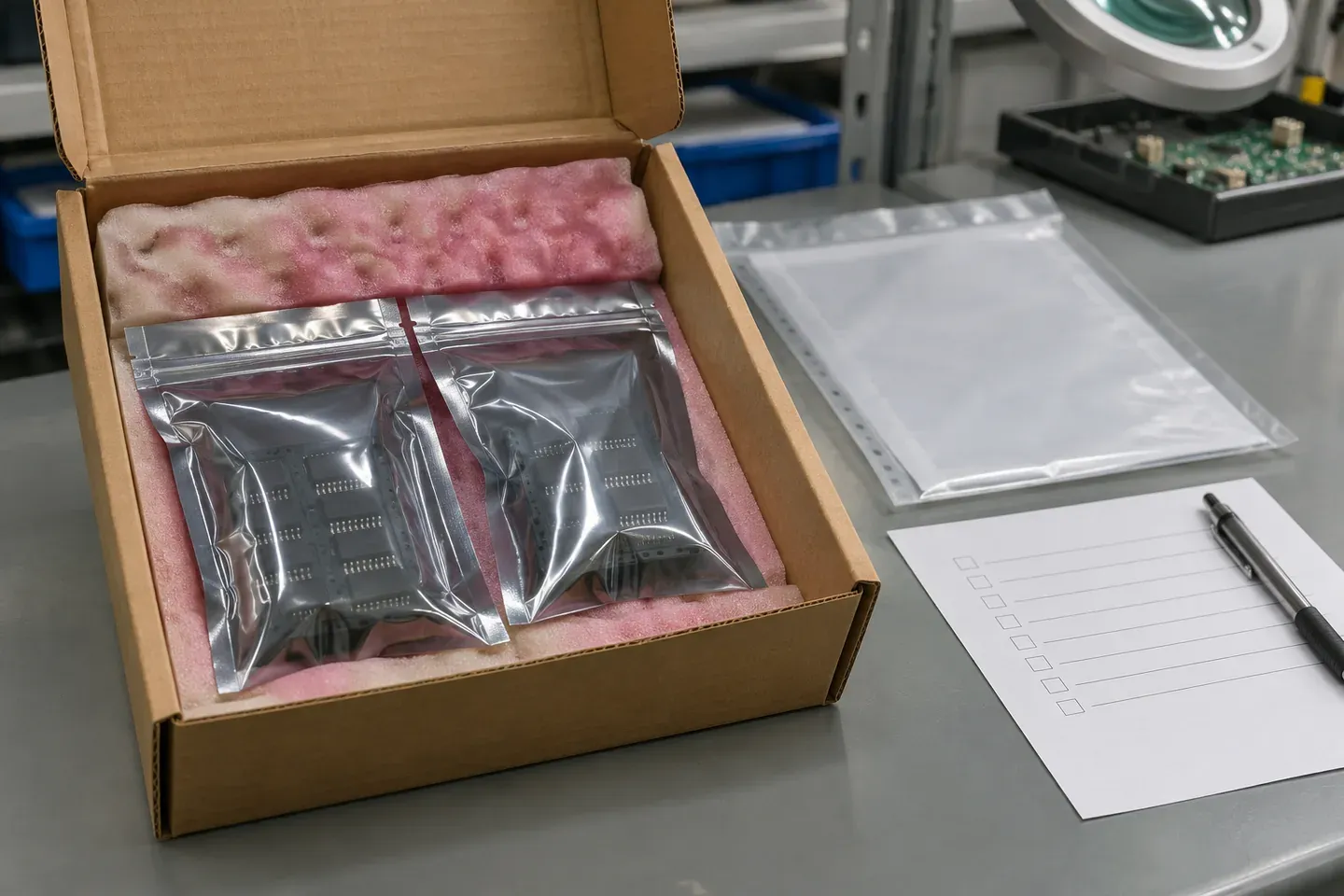
Connecting regional documentation to line-level BOM execution
Keep regulatory screening connected to technical risk management inside your BOM risk assessment pillar and verify landed-cost impacts using our 2026 semiconductor tariff and RFQ controls guide.
When submitting multi-line inquiries destined for Saudi Arabia or the UAE, start with the dedicated regional workflow on the Saudi Arabia sourcing page or UAE sourcing page, or upload the complete full-MPN file directly via the BOM submission workflow with destination and end-use fields populated upfront. Clear documentation does not eliminate applicable export rules, but it prevents avoidable administrative holds on fully compliant industrial components.
Frequently Asked Questions (FAQ)
Did the July 2026 U.S. BIS rule remove all export compliance checks for UAE semiconductor shipments?
No. While the July 14, 2026 Federal Register rule (91 FR 43034) added the UAE to EAR Country Group A:5 and expanded specific license-exception eligibility for government and approved commercial entities, standard ECCN classification, denied-party screening, end-use verification, and advanced-computing restrictions remain enforced.
Are standard industrial FPGAs like Artix-7 or Cyclone V controlled the same way as high-end AI GPUs?
Not necessarily. Export Control Classification Numbers (ECCNs) depend on exact technical thresholds—such as processing performance, interconnect speed, radiation hardening, or cryptographic features—defined in the Commerce Control List. Confirm the manufacturer's official ECCN for every exact ordering code rather than assuming EAR99 or 3A090 status.
What is the biggest cause of customs holds on electronics shipments entering Saudi Arabia or the UAE?
Mismatches between the commercial buyer, freight forwarder, and ultimate consignee/end user—along with incomplete MPN descriptions, missing HS codes, unverified Country of Origin, or omitted end-use declarations when controlled ECCNs appear on a multi-line BOM.
Does this guide constitute formal legal or export-licensing advice?
No. This article summarizes public regulatory developments as of November 2026 and outlines procurement document preparation. Importers, exporters, and trade-compliance counsel must determine actual licensing obligations for each specific transaction.