

Table of Contents
Late-2026 distributor briefs have revived urgent warnings of “52-week FPGA lead times” pushing new orders deep into 2027. Yet buyers who request quotes on standard Artix-7, Kintex-7, or Cyclone V codes immediately see a confusing contradiction: one part number quotes 26 to 52 weeks from factory backlog while an adjacent package in the very same family shows ready distributor availability.
As of November 18, 2026, FPGA supply is not a single curve. Treating a 28 nm wire-bond industrial maintenance FPGA the same as a leading-edge high-layer adaptive SoC causes buyers either to over-commit cash on multi-quarter NCNR orders or to get blindsided on a sole-sourced flip-chip suffix.
What do late-2026 manufacturer and distributor signals actually show?
Independent distributor trackers published in October and November 2026 report widening dispersion by exact part number rather than uniform scarcity. A2 Global’s Q4 2026 semiconductor market update (published October 20, 2026) highlights that price and supply are now split sharply by exact part number, while Fusion Worldwide’s October 2026 Greensheet (published October 29, 2026) and related late-2026 FPGA briefs note 40 to 52+ week factory quotes on select advanced adaptive SoCs alongside 22–26 week or longer windows on specific constrained legacy 28 nm lines.
On the manufacturer side, AMD’s October 27, 2026 adaptive computing update reaffirmed multi-generation portfolio investment alongside AMD’s previously announced 7 Series long-lifecycle support through at least 2040. Meanwhile, standalone Altera maintains broad mature-node production across Cyclone V and Cyclone 10 LP per Altera Product Catalog 25.1. Long-term lifecycle support confirms the family is not disappearing—it does not eliminate quarterly build-to-order queues on low-volume suffixes or flip-chip BGA substrates.
| FPGA sourcing tier | Typical families & packages | Primary 2027 lead-time driver | Planning posture (conditional) |
|---|---|---|---|
| High-density advanced adaptive SoCs | Versal, UltraScale+ high-pin-count flip-chip | Advanced foundry nodes, high-layer ABF substrates, test slots | Forecast 9–12+ months ahead; align NCNR exposure with firm customer backlog |
| Mature 28 nm high-pin-count flip-chip | XC7K325T/XC7K410T (FFG900, FBG676), 5CSXFC (F31) |
BGA substrate mix, industrial/defense restocking, batch fab runs | Maintain rolling 6-month visibility; keep approved alternates documented |
| Mature 28 nm/40 nm mid-density industrial | XC7A100T/XC7A200T, 5CEFA5/5CEFA7, 10CL016/10CL025 |
Specific suffix demand (-I, -L1, -L2, leaded FG/FB vs G/N) |
Separate active high-runner suffixes from low-runner custom/leaded codes |
| Small control-plane FPGAs / CPLDs | Boot, power-sequencing, and board-management CPLDs/FPGAs | Server platform buildouts (see our small FPGA control-plane demand analysis) | Track server-board demand spillover separately from main data-path FPGAs |
Why do exact suffixes drive lead-time cliffs inside the same family?
Factories schedule wafer lots by die, but back-end assembly, speed-bin yield, and finish options split one wafer run into dozens of distinct orderable SKUs. A buyer looking only at the base family misses three structural bottlenecks that routinely add 12 to 24 weeks to a single line item:
- Leaded (
SnPb) and non-standard finishes: Legacy packages without Pb-freeGorNsuffixes (such asXC7K325T-1FF900Ior5CEFA7U19I7) run in far smaller assembly batches than standard RoHSFFG/Nparts. - Low-power and special-option bins: Screened
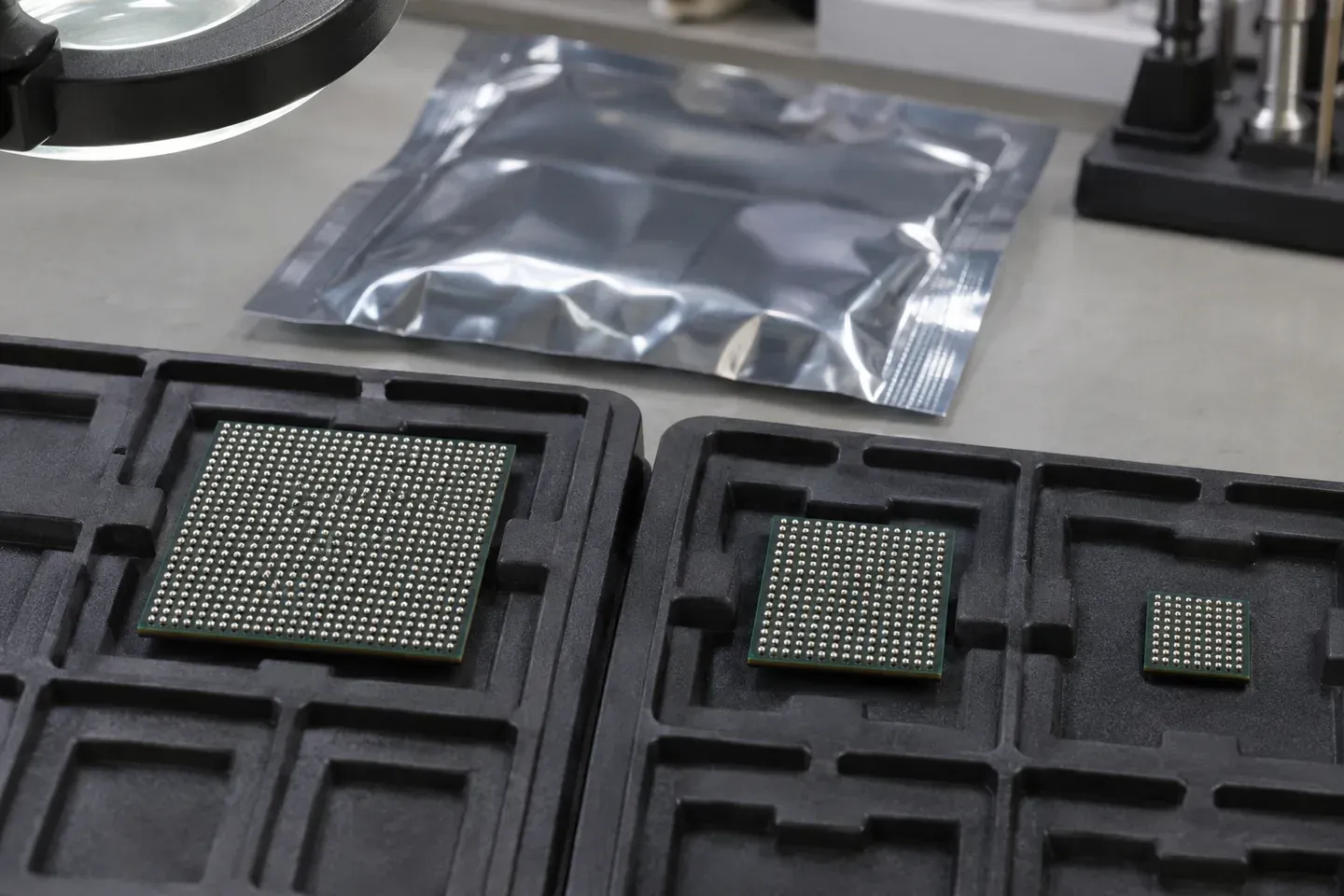
-L1/-L2low-power 7 Series grades,LNlow-power Cyclone V SX variants, andNTSTSN-enabled codes depend on narrower test-bin yields and lower distributor safety stock. - Flip-chip BGA substrate competition: Large 676-, 896-, 900-, and 1156-ball flip-chip packages draw from substrate suppliers that also serve networking and AI accelerator demand, as analyzed in our 2027 ABF substrate capacity review.
What conditions would widen or narrow 2027 FPGA lead times?
Use observable triggers rather than one blanket buffer across all programmable logic:
- Suffix-level dispersion continues: High-runner RoHS industrial codes clear in 12–24 weeks through franchise channels, while flip-chip
FFG/F31,-L1/-L2, and leadedSnPbsuffixes run 26–40+ weeks on build-to-order schedules. - Late-Q4 price revisions meet Q1 restocking: If year-end OEM budget releases collide with distributor lean stock and back-end substrate bottlenecks, quoted lead times on 28 nm industrial FPGAs could jump into 30–52 week territory, triggering spot premiums on urgent maintenance spares.
- Order pull-ins normalize: If industrial capex stays flat into mid-2027, channel inventory catches up on standard Artix-7 and Cyclone V E packages, turning early speculative overbuys into excess liability.
A resilient 2027 FPGA RFQ plan
Start by splitting every programmable-logic BOM line into two tracks: scheduled production (place rolling authorized orders matched to realistic factory lead time and NCNR boundaries) and maintenance or shortage bridges (define exact suffix rules, MSL/date-code limits, and inspection plans before approaching independent stock).
Before sending any RFQ, require six answers in writing so quotes are comparable:
| Question | Why it changes the comparison |
|---|---|
| What is the exact ordering code, including speed, temperature, package, and finish? | A base family code can hide a different suffix with a different lead-time queue |
| Is the quoted lead time factory or distributor stock? | Distributor stock can ship now; factory quotes carry backlog and allocation risk |
| What quantity, MOQ, and NCNR terms apply? | A low unit price on a non-cancelable multi-quarter lot can be worse than a shorter lead time |
| Which date code and lot will ship? | Older lots need solderability and MSL checks; mixed lots complicate traceability |
| Is an alternate suffix or package proposed, and who approves it? | Electrical, timing, and finish changes require engineering sign-off, not purchasing judgment |
| What PCN/PDN or allocation notice affects the code? | Lifecycle notices change both availability and the replacement path |
Use the dedicated series hubs for XC7A100T, XC7K325T, Cyclone V E, and Cyclone V SX alongside the Xilinx and Altera catalogs to compare exact ordering codes before issuing quotes. Combine lead-time tracking with the Xilinx FPGA sourcing pillar so schedule pressure never forces an unqualified package, voltage, or finish substitution onto a released board.
Frequently Asked Questions (FAQ)
Why are some FPGA part numbers quoted at 40 to 52 weeks while other FPGAs ship from stock?
FPGA lead times split sharply by process node, substrate complexity, and ordering-code volume. High-layer flip-chip adaptive SoCs and specialized aerospace/industrial packages face longer fab and substrate queues, whereas high-volume standard commercial packages often clear much faster.
Does AMD's 2040 lifecycle extension guarantee short lead times on every 7 Series ordering code?
No. AMD's public long-lifecycle commitment for 7 Series FPGAs supports extended product longevity, not guaranteed constant distributor stock or short factory lead times across every legacy leaded package, speed grade, or low-volume suffix.
Should industrial buyers switch from 28 nm FPGAs to newer families purely to avoid lead times?
Not without checking total migration cost and availability of the newer node. Leading-edge adaptive SoCs can carry equally long substrate and packaging lead times plus full PCB, power, and firmware requalification costs.
When does independent open-market sourcing make sense for an FPGA BOM line?
Independent sourcing is typically used to bridge a confirmed factory lead-time gap, cover an urgent maintenance repair, or support a legacy suffix with high factory MOQs—always paired with lot traceability, MSL inspection, and appropriate authenticity screening.