Table of Contents
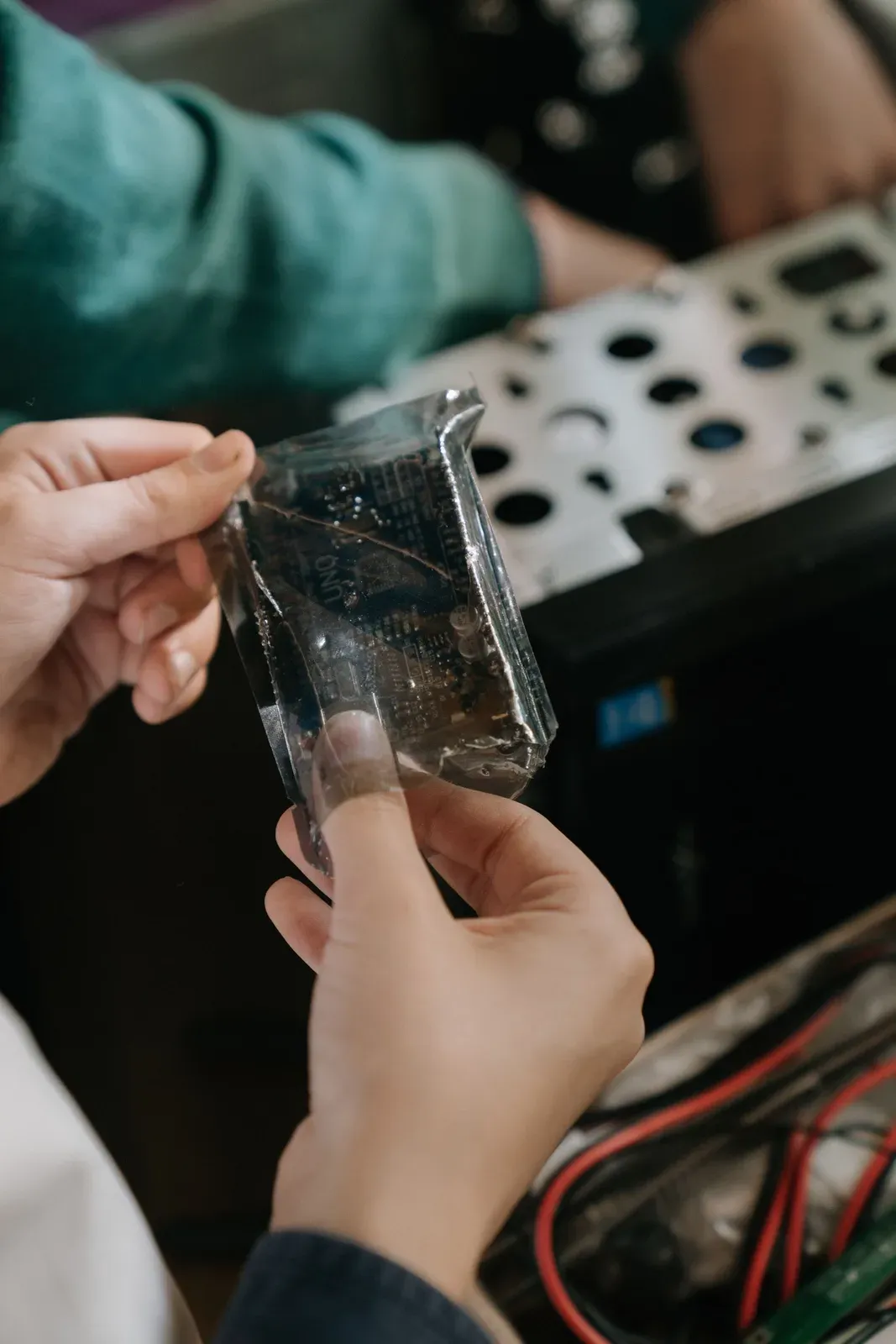
Pink plastic is not a specification. An “antistatic” bag can reduce charge generation without providing the static shielding needed for an electronic assembly during shipment, so the purchasing decision must cover the complete package and the environments it crosses—not only the bag’s color or surface-resistance description.
For ESD packaging of electronic components and printed-circuit-board assemblies, define how the item moves from an electrostatic protected area (EPA), through uncontrolled transport, into the receiving EPA. Each boundary can change the protection required.
How are antistatic, dissipative and shielding properties different?
Low-charging behavior reduces charge generated by contact and separation; dissipative or conductive behavior permits controlled charge movement; ESD shielding bags limit the energy reaching the item from an external discharge. These are related properties, but one is not proof of the others.
The ESD Association’s control-material guidance, checked November 4, 2026, distinguishes low charging, resistance behavior and discharge shielding. It describes the additional shielding requirement for packaging outside an EPA. Use the applicable standards and the organization’s ESD control plan to specify qualification methods and limits; a visual bag inspection cannot establish those electrical properties.
| Package description | What it may establish | What must still be verified |
|---|---|---|
| Low-charging or “antistatic” material | Reduced triboelectric charging under specified conditions | Resistance behavior and shielding of the finished package |
| Dissipative material | A defined resistance characteristic | Low charging and the required external-discharge protection |
| Shielding package | Protection demonstrated by an applicable shielding method | Correct closure, integrity, size and compatibility with the item |
| Moisture-barrier package | A specified moisture-control function | ESD properties, mechanical protection and the required dry-pack process |
Do not approve a package because it is pink, silver or printed with an ESD symbol. Those features can help identify a product, but the qualification record must identify the material and finished package being supplied.
What should the packaging specification include?
Specify the item, its sensitivity and handling constraints, the transit environment, the complete enclosure and the qualification evidence. The packaging supplier needs more than the instruction “use an ESD bag.”
Identify the exact bag or container code, dimensions, closure method, cushioning and internal supports. Confirm that the item can be enclosed without sharp leads, board edges or connectors puncturing the protective structure. If multiple layers provide the overall protection, document the assembled configuration rather than approving each layer in isolation.
For example, a low-charging inner support may protect the component from contact-generated charge while an outer enclosure provides shielding. The qualification needs to address the complete arrangement, including its closure and handling. Removing the outer enclosure during a transport step changes that arrangement even if the inner material remains intact.
For industrial component sourcing, connect the packaging requirement to the full part number or assembly and the receiving process. Do not assume that the same package fits loose ICs, loaded trays, populated boards and heavy modules equally well.
How should receiving handle an opened or damaged package?
Contain the material, document the packaging condition and transfer it using the receiving ESD procedure. Damage to a protective package creates an exposure question; it does not by itself prove either that every device failed or that the lot is unaffected.
Record the outer and inner package identities, visible damage, closure condition and affected quantities before repacking. Lot and date-code information should stay connected to the contents. If there is evidence of puncture, an open seam or uncontrolled repacking, route the material through the predefined quality disposition process.
Electrical function testing may reveal some damage, but a passing test does not reconstruct the handling history or universally rule out latent effects. Determine the response from the item sensitivity, customer requirements and the actual evidence of exposure.
The incoming inspection sampling framework helps define the lot and escalation rules. Avoid turning a packaging discrepancy into an arbitrary rule that either scraps every item or accepts every electrically functional sample.
Can shielding bags be reused?
Reuse is acceptable only where the packaging specification and ESD control process permit it and the package continues to meet the required performance and condition criteria. Appearance alone is insufficient to establish ongoing shielding performance.
Set criteria for closure damage, punctures, abrasion, contamination, identification loss and any required requalification or service-life control. Retain the package type and applicable supplier instructions. A bag that has been repeatedly folded, stapled or pierced should not be treated as equivalent to an intact approved enclosure without supporting evidence.
The handling procedure matters during reuse as well. Opening, loading and closing should occur within the appropriate controlled environment. A protective bag is not a substitute for a properly controlled work surface or personnel-grounding process.
Keep ESD and moisture decisions connected but distinct
A component can need both electrostatic protection and moisture control, and the evidence for one does not establish the other. When a moisture-sensitive lot is repacked, maintain its exposure and dry-pack records along with its ESD packaging identity.
The MSL receiving guide covers moisture-sensitive-device records and floor life. Use that process to determine moisture disposition; use the ESD control plan to determine electrostatic protection. A dry cabinet does not retroactively remove an ESD exposure, and a new shielding enclosure does not reset a moisture-exposure history.
The purchase and receiving records should finish with a defined package configuration, evidence of its required properties and a controlled transfer procedure. That gives both the supplier and the receiving team a reproducible requirement instead of an ambiguous “antistatic” instruction.
Frequently Asked Questions (FAQ)
Does a moisture-barrier bag automatically prove ESD shielding?
No. Verify its specified ESD properties and the complete package configuration separately from moisture-barrier performance and dry-pack controls.
Can a new shielding bag erase an earlier exposure?
No. Repacking protects subsequent handling but does not reconstruct or reverse a previous uncontrolled exposure. Preserve the original condition and follow the quality disposition process.
Is an ESD symbol sufficient incoming evidence for a packaging lot?
No. Match the exact packaging product to its qualification records, condition and intended use. The symbol alone does not establish low charging, resistance behavior or shielding performance.