

Table of Contents
An 800 V distribution bus leaves a major purchasing decision unresolved: which voltage should the isolated intermediate bus converter (IBC) deliver to the board? A 50 V output, a 12 V output and a 6 V output move current, copper loss, magnetics and downstream conversion into different parts of the assembly. Their bills of materials are not interchangeable.
The public record through October 27, 2026 gives buyers concrete architectures to evaluate. Infineon’s October 21 announcement describes GaN high-voltage intermediate bus converters supporting 800-to-50 V, 800-to-12 V and 800-to-6 V approaches. TI’s October 7 reference-design presentation describes a 10 kW, isolated 800-to-50 V converter. These disclosures justify architecture trials; neither establishes an approved production substitute for a buyer’s existing power assembly.
Terminology depends on the architecture. In a traditional 48 V rack, “intermediate bus converter” often refers to the 48-to-12 V stage; in the 800 V architecture discussed here, it describes the isolated stage that creates the intermediate bus from the 800 V input.
The 800 V HVDC distribution overview covers the system-level chain, and the SiC versus GaN sourcing guide covers device-technology trade-offs. The broader AI data-center power BOM guide addresses the grid-to-processor chain. The sourcing boundary here is the IBC itself: its input envelope, isolation barrier, output behavior and qualified implementation.
How should buyers compare 800-to-50 V and lower-voltage IBCs?
Compare complete conversion paths at the required load, including output distribution and the downstream point-of-load converters. Lowering the intermediate voltage increases current for the same delivered power; removing a conversion stage is beneficial only if the remaining stages and interconnect meet efficiency, thermal and transient requirements.
At a 10 kW delivered load, the ideal DC current is I = P / V:
| Voltage boundary | Ideal current at 10 kW | Procurement consequence |
|---|---|---|
| 800 V input | 12.5 A before conversion loss | Input protection, insulation and switching topology dominate the review |
| 50 V output | 200 A | Output rectification, terminals and bus impedance need defined limits |
| 12 V output | About 833 A | Distribution length and connection resistance become more restrictive |
| 6 V output | About 1,667 A | The power path may need to be very short and closely integrated with the load |
These are alternative voltage boundaries, not successive stages carrying the same current. With 10 kW output and an assumed 98% converter efficiency, input power becomes about 10.204 kW, input current at 800 V becomes 12.76 A, and converter loss is about 204 W. The cooling specification must remove that loss at the stated ambient or coolant condition. An efficiency number without load and cooling conditions cannot size the thermal system.
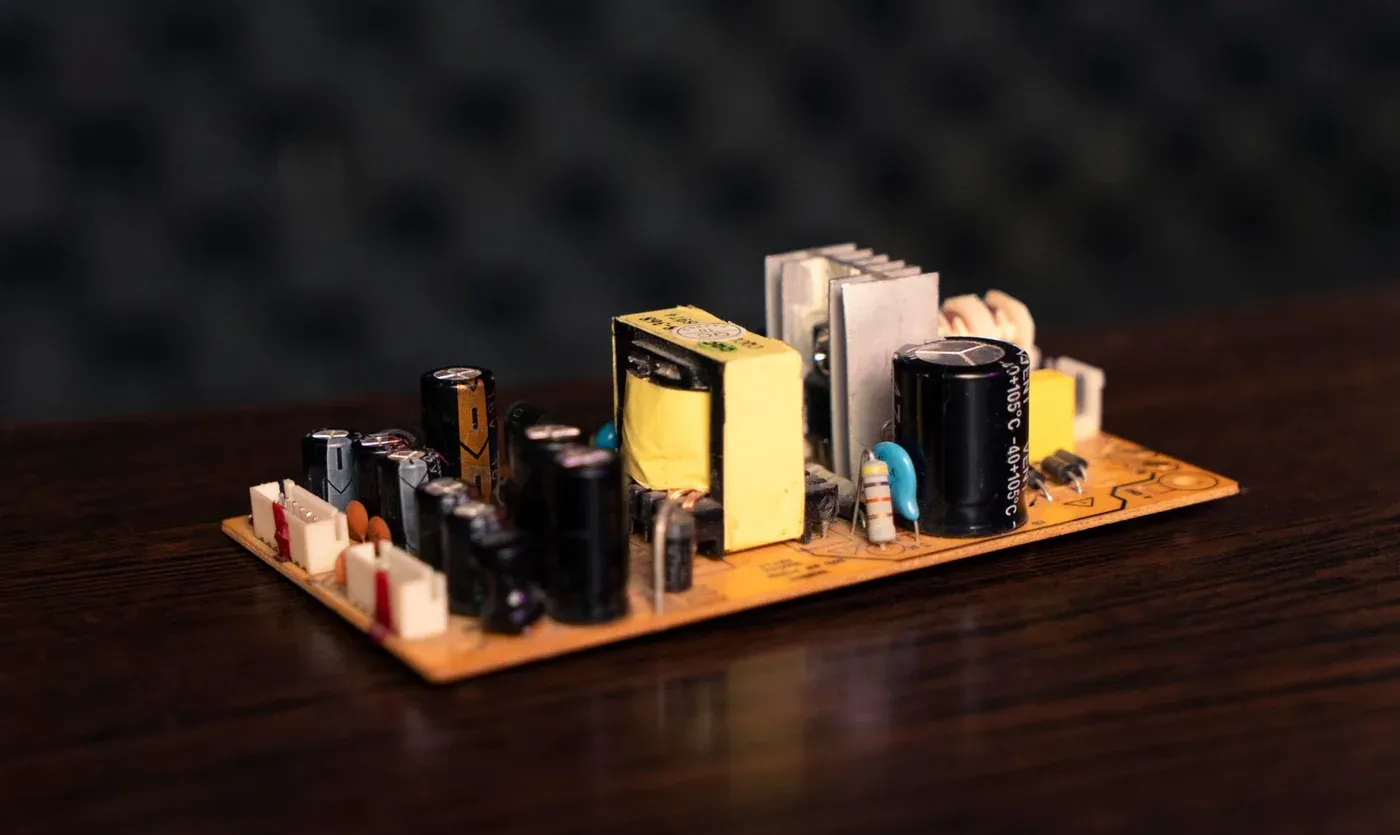
Use an efficiency map across the operating profile. A converter optimized for full load can lose its advantage during idle or partial utilization. Compare the weighted energy loss of the complete path, plus the copper loss between stages, before selecting the nominal intermediate voltage. A 50 V output is often offered for equipment specified around a 48 V bus; the distinction matters when the equipment’s input-range check is written into the RFQ.
Why does an 800 V bus not specify the transistor voltage rating?
The converter topology determines the voltage across each transistor. Bus voltage is a system input; device stress depends on the switching arrangement, voltage sharing, parasitic inductance and abnormal operating states. A transistor rating must cover its own worst-case stress with the design’s required margin.
TI’s disclosed implementation illustrates this distinction. Its stacked half-bridge LLC primary uses 650 V GaN devices, a 16:1 step-down matrix transformer and 100 V GaN devices in the secondary rectifier. The lower primary-device rating is part of that particular topology, not permission to put an arbitrary 650 V transistor across an 800 V rail.
For a proposed alternate, request the relevant stress analysis and waveforms at maximum input, startup, shutdown, load steps and specified fault conditions. Include tolerances that affect voltage sharing. A supplier offering a similar voltage/current headline still needs to establish gate-drive behavior, protection, package parasitics and thermal suitability in the released design.
For this reason, component-alternative screening should start with the approved converter schematic and exact ordering codes. A controller, integrated GaN power stage or isolated auxiliary supply can change the validation scope even when the nominal conversion ratio is preserved.
Freeze the isolation and control boundaries together
An isolated converter needs more than a transformer turns ratio. The product team must specify the required insulation arrangement, working voltage, transient environment, creepage and clearance, relevant material constraints and verification method. The isolated DC-DC module selection guide covers module-level working-voltage and barrier-capacitance checks. Those requirements apply to every path crossing the boundary: main magnetics, feedback, communications, sensing and auxiliary power.
Also define whether the output is regulated, loosely regulated or proportional to input. A downstream stage may tolerate steady variation but fail during startup or a load rejection. Record the permitted output-voltage envelope, sequencing, startup into a prebiased rail, shutdown behavior and recovery after a fault.
Controller firmware and configuration are part of this boundary. A power stage that restarts automatically after an overload behaves differently from one that remains latched off. Purchasing should preserve the released configuration and the owner’s change-control process, rather than treating the controller as an independent commodity line.
What must an 800 V IBC RFQ specify?
Specify the purchased item and the evidence needed to accept it: a component set, an evaluation board, a custom converter assembly and a production module require different deliverables. Then state the electrical envelope, physical interfaces, cooling conditions, validation responsibility and delivery milestone for that item.
The request for quotation should separate three groups of requirements:
- Operating envelope: minimum and maximum input, output range, continuous and transient load, ripple, permitted overshoot, efficiency conditions and cooling limits.
- Implementation baseline: complete manufacturer part numbers, package and grade, magnetics drawing, PCB revision, firmware/configuration identity and approved alternates.
- Release evidence: insulation and fault-test scope, thermal results at defined conditions, manufacturing test coverage, sample-to-production differences and the exact acceptance criteria.
For custom magnetics, dimensional fit alone is insufficient. The flyback transformer replacement guide explains why winding and test conditions must be controlled, although its topology-specific calculations should not be transferred to an LLC transformer.
Treat a demonstration as the architecture-learning milestone. A pilot build must establish repeatable assembly and operation; production release must connect that evidence to an orderable configuration. If only development hardware is available, purchase the quantity needed for the trial and keep the production award conditional on those milestones.
The decisive comparison is therefore between two defined converter implementations. Once the voltage boundary, cooling arrangement and released configuration are fixed, procurement can compare supply routes and commercial terms without accidentally reopening the power architecture.
Frequently Asked Questions (FAQ)
Can a 50 V intermediate bus converter supply equipment specified for a 48 V bus?
Only if the equipment's permitted input range includes the converter's complete operating envelope, including tolerance, startup overshoot, ripple and transients. Nominal 48 V and 50 V labels alone do not establish compatibility.
Does access to a reference design establish production availability?
No. A reference design provides implementation evidence. Production supply also requires orderable component identities, released revisions, manufacturing and test arrangements, and a supplier commitment for the required quantities and dates.
Should the isolated converter and its auxiliary supply use the same isolation requirement?
Evaluate each barrier within the complete insulation architecture. The auxiliary supply can bridge domains with different working voltages, transients and insulation requirements; its rating must be assessed in that position rather than copied from the main converter.