
Table of Contents
Two isolated DC-DC modules with the same input, output, power, and pinout can behave differently at no load, during startup, across the insulation barrier, and in an emissions test. A procurement comparison therefore needs an electrical boundary specification and an insulation boundary specification.
This guide applies to board-mount isolated converter modules. The end equipment’s safety standard remains the controlling requirement; a module certificate does not automatically certify the finished assembly.
Which isolation ratings must match the DC-DC module application?
Match the module’s continuous working voltage and insulation type to the end equipment’s requirements, then check transient withstand, creepage, clearance, and certificate scope. Pollution degree, material group, altitude, and overvoltage category affect that comparison; a short-duration isolation test voltage alone does not establish suitability.
RECOM’s isolation overview, accessed September 24, 2026, distinguishes test voltage from working voltage and explains how functional, basic, supplementary, and reinforced insulation serve different purposes. Keep those labels explicit in the approved-source record.
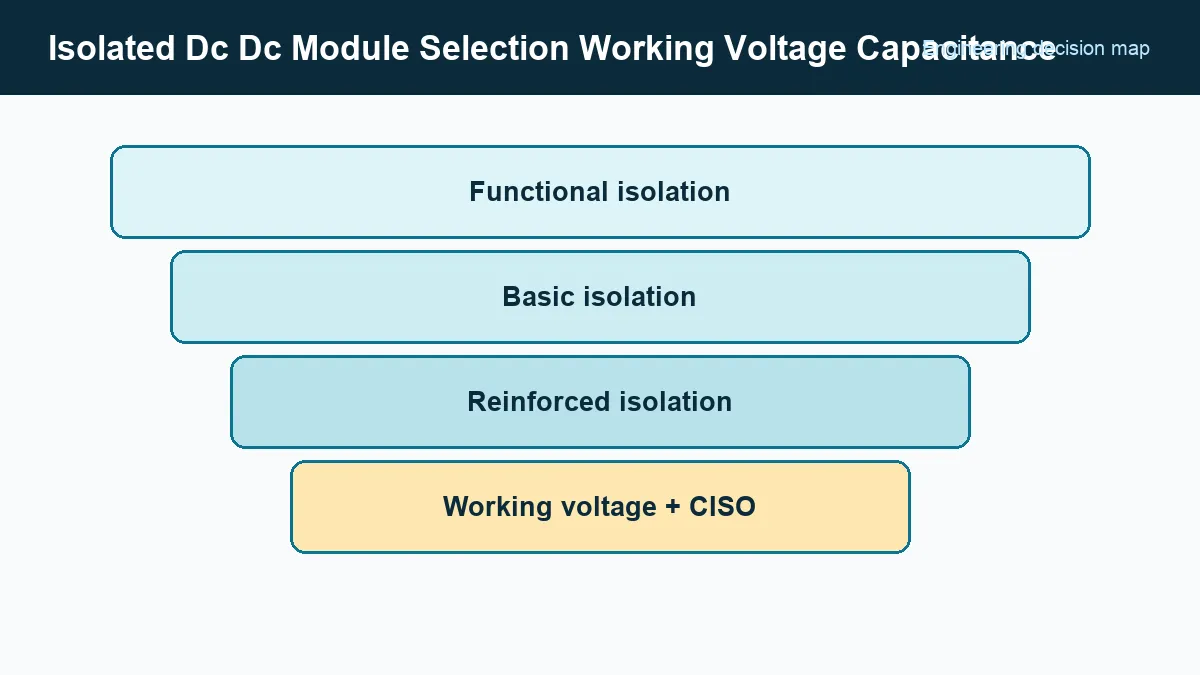
Compare the exact certificate, standard edition, module series, and package option. Similar names may have different spacing or agency coverage. Check whether the stated rating is valid at the target altitude and PCB footprint; copper, slots, and nearby components can reduce spacing outside the module.
How can light load disqualify an isolated DC-DC replacement?
An isolated DC-DC replacement can exceed the downstream circuit’s voltage limit at light or zero load even when its nominal output rating matches. Define minimum, typical, transient, and maximum load for each output, then check the manufacturer’s regulation data; unregulated modules may specify nominal voltage only at a particular input and load.
Regulated modules still have line regulation, load regulation, ripple, dynamic response, current limit, and startup behavior to compare. For dual-output parts, unbalanced loading can shift both rails. Measure the actual load combinations instead of splitting rated power evenly by assumption.
Efficiency affects temperature and available output at the environmental limit. Review derating curves with the intended airflow, copper area, enclosure, input voltage, and altitude. A power headline is rarely a guarantee at every condition.
How do you estimate current through a DC-DC isolation barrier?
Estimate common-mode displacement current through an isolated DC-DC module with I = C × dV/dt, using barrier capacitance and the voltage slew rate across that barrier. For the same edge rate, lower capacitance reduces this current; the full system still includes external capacitors, shields, and other coupling paths.
RECOM’s discussion of isolation in DC-DC converters, accessed September 24, 2026, links transformer construction, barrier properties, and parasitic capacitance. Compare capacitance using stated test conditions and include external Y capacitors or shields in the complete system model.
Do not treat low capacitance as the only EMI objective. Input-current pulsation, switching frequency, layout, transformer shielding, and output rectification also shape emissions. A candidate can reduce common-mode current while increasing differential noise.
Check startup, protection, and external parts
Record maximum input current during startup, soft-start time, undervoltage behavior, enable thresholds, output overshoot, current-limit mode, short-circuit duration, and recovery. A module that hiccups indefinitely differs from one rated for only a brief short.
Review mandatory input capacitors, output capacitors, fuses, EMI networks, and minimum clearances. Some module ratings depend on a named external fuse or specific capacitor range. If the replacement needs a different external network, it is an engineering change even when the pins align.
For a design using the module to power a digital isolator, confirm the total barrier and common-mode requirements on both devices. The converter’s isolation rating does not upgrade another component in the signal path.
A procurement matrix should expose exceptions
The comparison sheet should include full ordering code, input range, output accuracy across the load envelope, rated and derated power, ripple bandwidth, efficiency conditions, no-load behavior, isolation test voltage and duration, maximum working voltage, insulation type, creepage, clearance, barrier capacitance, certification, package, moisture classification, and lifecycle data checked on the sourcing date.
Qualify samples with input and output waveforms, temperature rise, load steps, no-load voltage, short-circuit recovery, conducted emissions, and the end product’s dielectric test where applicable. Procurement can then approve an alternate only when its exceptions are visible and accepted, rather than equating one short Hipot number with long-term isolation performance.
Frequently Asked Questions (FAQ)
Is a higher isolation test voltage enough to approve a replacement module?
No. Hipot is normally a short-duration withstand test. Continuous working voltage, insulation classification, creepage, clearance, partial-discharge data, and the relevant safety standard define long-term suitability.
Why does isolation capacitance matter in a DC-DC converter?
Barrier capacitance carries common-mode displacement current during fast voltage changes. It can affect EMI, touch current, measurement accuracy, and common-mode transient behavior.
Can an unregulated isolated converter operate with no load?
Only if the datasheet permits it and the resulting output voltage is acceptable. Some unregulated modules require a minimum load or an external clamp to remain within the downstream voltage limit.