Table of Contents
PCIe 6 retimer announcements are giving server teams more options, but a second supplier becomes useful only when its device can be built, configured, diagnosed and supplied in the target platform. Compliance is one important gate within that process.
The supplier milestones available on October 14, 2026 broaden the shortlist. For an existing board, the useful distinction is whether a candidate can share the approved assembly and firmware configuration or needs a separate design revision.
What does PCIe retimer compliance prove?
It establishes the scope covered by the applicable compliance program for the identified product and conditions. It does not establish compatibility with every board layout, firmware stack or production environment.
Credo reported on August 31, 2026 that its Toucan Gen6x16 retimer had achieved PCI-SIG 6.x retimer compliance at 64.0 GT/s and joined the Integrators List. This is a vendor-reported milestone; it should be retained with the product identity rather than expanded into an endorsement of the buyer’s complete system.
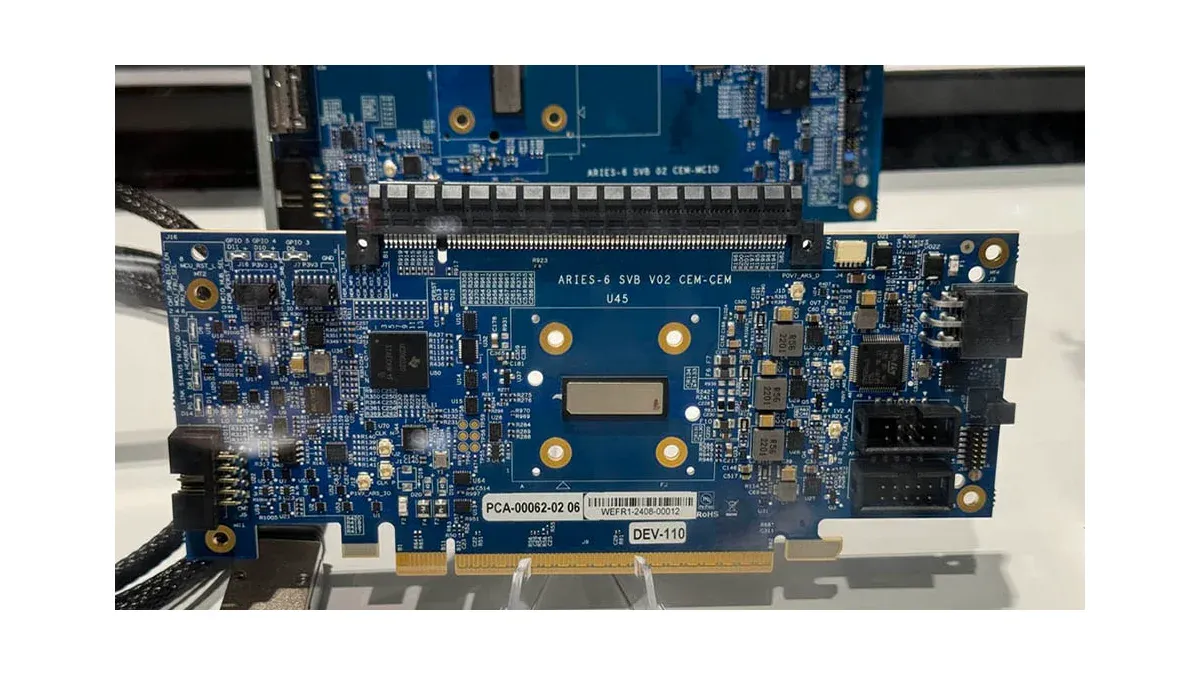
Separately, Microchip’s June 2 announcement introduced XpressConnect PCIe 6.0 and CXL 3.1 retimers and described flexible 1×16, 2×8 and 4×4 link configurations. A product release and a reported compliance result answer different sourcing questions. Neither is a current stock statement.
Treat 64 GT/s as a signaling-rate specification, not a direct application-throughput result. Protocol overhead, link width and workload behavior still affect useful data movement.
Can two PCIe 6 retimers be approved as drop-in alternates?
Only after the specific devices and platform demonstrate the required compatibility. A common footprint guideline or vendor “drop-in” positioning is a starting point for comparison, not a substitute for a pin-by-pin and configuration review.
The comparison should cover:
| Dependency | Evidence for the proposed alternate |
|---|---|
| Physical and electrical interface | Package drawing, ball assignment, power rails and sequencing |
| Link arrangement | Supported lane mapping, bifurcation and clock architecture |
| Board channel | Validated routing, connectors, cables and operating conditions |
| Control path | Strap settings, management bus behavior and initialization sequence |
| Software support | Approved firmware, update procedure and diagnostic access |
Document any board or firmware changes needed for the alternate. An option that requires a new layout can still improve supply resilience, but it is a redesign source rather than an unrestricted substitution on the existing assembly line.
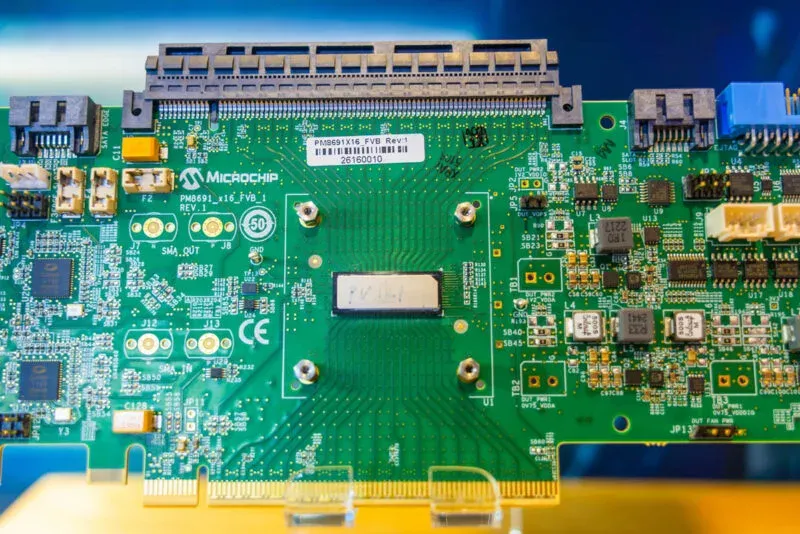
The board-level review also prevents a category mistake: a PCIe switch sourcing decision concerns routing and topology, whereas a retimer addresses a link’s signal path. Matching lane count does not make the devices interchangeable.
Firmware, diagnostics and repeatable bring-up
Include the firmware image, configuration procedure and diagnostic tooling in the trial deliverable. A board that trains a link once is incomplete evidence if the production team cannot reproduce its setup or investigate failures.
Build the trial matrix from the channels the product actually supports: the shortest and longest allowed routes or cables, intended endpoint combinations, lane arrangements and required operating rates. Repeat cold starts and warm resets across the specified temperature conditions. Keep the channel hardware fixed when comparing candidates.
For each run, capture trained speed and width, relevant error counters, recovery events and application traffic results. A link that silently falls back below the required generation or width has not passed merely because traffic continues. Agree acceptable error and recovery behavior with the platform owner before the trial; retain failed-run logs as well as the passing runs.
Include the qualified firmware image, configuration file and repeatable programming procedure in the deliverable. Check whether settings persist through reset and how a device with missing or incompatible configuration is identified. The operating team needs access to the diagnostic tools and logs used in the trial, together with an owner for updates and fault escalation.
The same principle applies when the link carries CXL traffic: the CXL memory procurement review treats the host, device and software as a configuration. Protocol support on one component does not qualify the entire path.
Production release and change control
It is ready when the approved technical configuration and the commercial delivery record refer to the same orderable device. Keep engineering samples, qualified production parts and acknowledged deliveries as separate states.
Confirm the ordering code, silicon revision rules, package, test configuration, change-notification process and support arrangement. Attach the approved configuration record to the purchase specification so a future revision is not accepted solely because the family name has stayed the same.
Release the alternate against the tested board and firmware combination. If it requires another strap population, layout or firmware branch, make that distinction explicit in the BOM and build instructions. Keep development quantities separate until production can identify and reproduce the approved variant. More suppliers can improve the 2027 sourcing position only when that manufacturing distinction is under control.
Frequently Asked Questions (FAQ)
Is a PCIe retimer a substitute for a PCIe switch?
No. A retimer restores signal timing along a link; a switch connects and routes between multiple PCIe ports. They perform different architectural roles and should not share a replacement approval.
Does backward generation support prove a retimer will work on an existing board?
No. It addresses one capability. The board still needs compatible connections, power, clocking, configuration, firmware and system validation.
Should a compliance claim be recorded without a date or product identity?
No. Record the exact device and revision, the claimed specification or test program, the evidence source and the observation date. A family-level statement can be too broad for a production approval.