Table of Contents
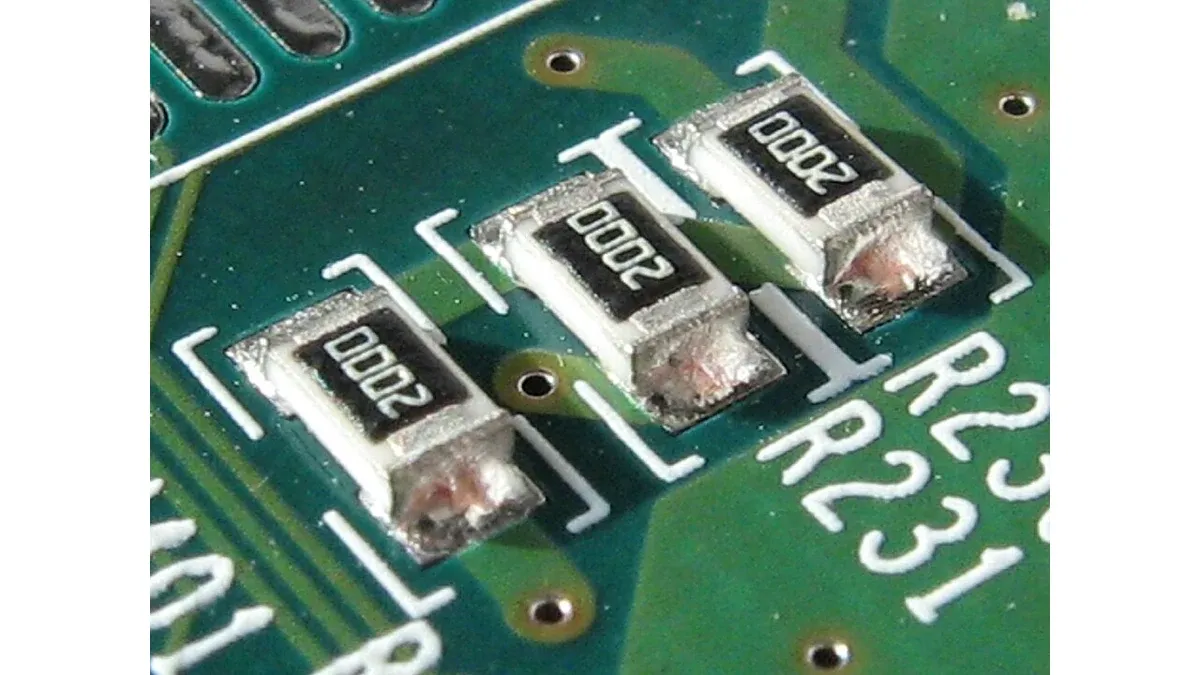
A chip resistor may operate below its average power rating and still be unsuitable for a short pulse. The instantaneous power, pulse duration, repetition and voltage across the resistive element can impose separate limits.
When sourcing a resistor replacement, capture the waveform before comparing the catalog wattage. Case size and resistance value narrow the search, but they do not establish equivalent pulse performance.
Why can a resistor fail even when average power is below its rating?
Average power can hide a brief load that exceeds the resistor’s permitted pulse power or voltage. Local heating and electrical stress depend on the waveform and construction, not just energy averaged over a long interval.
Vishay’s pulse-load application note discusses pulse power, duration and shape as selection inputs. Its construction-specific examples also show why a curve for one resistor family should not be applied to an unrelated chip series.
Obtain the candidate’s own pulse data. If only a continuous power rating is available, mark pulse suitability as unresolved rather than estimating it from another part with the same outline.
How do you calculate pulse energy and average power?
For a constant rectangular current pulse, use P = I²R during the pulse and E = P × t. For a varying waveform, integrate instantaneous power over time. Multiply the energy per pulse by repetition frequency to find the average contribution from repeated pulses.
Consider a hypothetical 100 Ω resistor carrying a rectangular 0.10 A pulse for 5 ms, repeated 20 times per second:
- Instantaneous power: 0.10² × 100 = 1 W.
- Pulse energy: 1 × 0.005 = 0.005 J, or 5 mJ.
- Average pulse contribution: 0.005 × 20 = 0.10 W.
- Voltage during the pulse: 0.10 × 100 = 10 V.
A nominal 0.25 W continuous rating would not, by itself, approve this load. The candidate must permit the pulse at the stated duration and repetition, with any steady load and temperature derating also included.
Equal energy does not mean equal stress. A 1 W, 5 ms pulse and a 50 W, 0.1 ms pulse both contain 5 mJ, but their peak power differs by a factor of 50. A manufacturer’s applicable pulse curve is needed to assess either case.
Which voltage limit applies to the replacement?
Check both the voltage implied by the permitted power and resistance and the manufacturer’s separate limiting voltage for the relevant operating condition. Use the more restrictive applicable limit, including any distinct pulse or overload restrictions.
For example, the power-based voltage at 0.25 W across 100 kΩ is approximately √(0.25 × 100,000) = 158 V. If a hypothetical candidate permits only 75 V continuously, the 158 V calculation does not authorize operation at that voltage.
This example is an independent screening calculation, not a specification for a real resistor. Temperature derating and the exact manufacturer’s definitions still govern the comparison.
Translate the waveform into a supplier request
Give the supplier the resistance, tolerance, package, temperature range and the waveform needed for the application review. Ask for the exact series and code rather than an unspecified “pulse-proof equivalent.”
| Input | What the comparison should retain |
|---|---|
| Pulse shape and duration | Rectangular, exponential or measured waveform, including its time scale |
| Peak current or voltage | Stress at the resistor terminals rather than elsewhere in the circuit |
| Repetition and background load | Single event, repeated events and any continuous contribution |
| Ambient and mounting | Conditions used for derating and heat removal |
| Acceptance criterion | Permitted resistance change and required behavior after the specified exposure |
A one-time overload statement is not automatically a repetitive-life rating. Likewise, a typical demonstration cannot replace a guaranteed limit where the design requires one.
Release the exact construction that was evaluated
Record the original and candidate codes, the applicable curves, assumptions and verification results. If a different series or technology is offered later, repeat the affected checks even when resistance, tolerance and case size remain unchanged.
For current-sensing applications, pulse survival is only one requirement. The separate current-shunt selection guide addresses Kelvin connections, temperature coefficient and measurement behavior.
The purchasing approval should therefore name a specific construction within a defined load envelope. That makes the alternate reproducible and prevents a generic wattage match from silently replacing the resistor that was actually evaluated.
Frequently Asked Questions (FAQ)
Does a 1% resistor necessarily have better pulse capability than a 5% resistor?
No. Tolerance describes resistance accuracy, while pulse capability depends on the construction and specified load conditions. Compare the exact series data.
Can two series resistors share a pulse voltage equally?
That requires an assessment of resistance, tolerance, parasitics and the waveform. Do not assume equal transient sharing from the nominal resistance values alone.
Is a fusible resistor interchangeable with a standard resistor of the same value?
No. A fusible function has additional behavior and approval requirements. Preserve that function explicitly rather than selecting only by resistance and power.