Table of Contents
Engineers transitioning between AMD Xilinx and Altera programmable logic frequently invert a basic ordering rule: on Altera Cyclone V E devices (5CEFA5, 5CEFA7, 5CEFA9), -6 is the fastest speed grade and -8 is the slowest—the exact reverse of AMD 7 Series numbering. Combine that with strict Power-On Reset (PORSEL) ramp rules and the presence of legacy non-N tin-lead ordering codes on industrial BOMs, and a careless procurement substitution can halt a factory controller before configuration even finishes.
Density-by-package I/O differences across M13, M15, U19, F23, F27, and F31 packages belong in our Cyclone V E package I/O migration guide. Once the package footprint is locked, three remaining fields govern safe ordering across the 46 catalogued Cyclone V E variants: speed-grade timing, power-on ramp discipline, and lead-free (N) finish verification.
How do C6, C7, I7, C8, and A7 speed grades map across Cyclone V E?
According to the Altera Cyclone V Device Datasheet (December 2025) and Altera Product Catalog 25.1, Cyclone V E commercial devices ship in -C6 (fastest), -C7, and -C8 (slowest) speed grades, while industrial (-I) and automotive (-A) temperature devices ship in -I7 and -A7 speed grades. Speed grade cannot be separated from temperature grade on this family.
| Speed & temp code | Junction temp (TJ) |
Relative speed | Representative BOM codes | Substitution caution |
|---|---|---|---|---|
C6 |
0 °C to +85 °C | Fastest | 5CEFA5F23C6N, 5CEFA7F31C6N | No industrial -I6 equivalent exists; moving to -I7 requires Quartus timing re-closure |
C7 |
0 °C to +85 °C | Mid | 5CEFA7F23C7N, 5CEFA9F23C7N | Often can move up to -I7 for wider temp with timing verification |
I7 |
−40 °C to +100 °C | Mid (industrial) | 5CEFA5F23I7N, 5CEFA7F31I7N, 5CEFA9F23I7N | Standard industrial baseline; never downgrade to -C8 (slower AND narrower temp) |
C8 |
0 °C to +85 °C | Slowest | 5CEFA5U19C8N, 5CEFA9F31C8N | Budget bin; verify DDR3/LVDS max frequency ceilings before selecting |
A7 |
−40 °C to +125 °C | Mid (auto temp) | 5CEFA5U19A7N, 5CEFA7U19A7N, 5CEFA9U19A7N | Extended junction temp; does not alone establish full AEC-Q100 system approval |
Notice the practical asymmetric trap when a -C6 commercial part runs short: buyers cannot simply “upgrade” to an industrial part of equal speed because Altera does not offer an -I6 Cyclone V E grade. Stepping from 5CEFA7F31C6N to 5CEFA7F31I7N moves from speed grade 6 to speed grade 7, which tightens internal setup slack and drops maximum external DDR3 memory-interface clock ceilings. Always re-compile and inspect Quartus TimeQuest setup and hold reports for the exact speed-grade target before releasing an alternate.
| Quartus or board check | What to compare | Pass condition |
|---|---|---|
| Setup and hold | TimeQuest results for the exact speed and temperature grade | Non-negative slack at all released corners |
| DDR3 interface | UniPHY/EMIF maximum frequency report | At or above the board’s memory rate |
| PLL outputs | PLL report for the target speed grade | Within VCO and output range |
POR / PORSEL |
Datasheet ramp window | Board ramp within the 12 ms or 100 ms selection |
| Configuration | Active Serial clock and flash timing | Within device and flash specification |
Why do PORSEL ramp times and power sequencing matter on Cyclone V E?
Cyclone V E FPGAs monitor core (VCC, nominal 1.1 V), auxiliary (VCCPD, 2.5 V), and configuration bank (VCCPGM) rails through internal Power-On Reset (POR) circuitry before releasing nSTATUS to read the Active Serial (AS) or Passive Serial configuration bitstream. The dedicated PORSEL pin selects between two monotonic ramp-time ceilings documented in the Cyclone V Device Datasheet:
- Standard POR (
PORSEL = GND,tRAMPup to 100 ms): Gives multi-rail industrial buck regulators wider startup tolerance and delays configuration start slightly longer so external EPCQ/QSPI flash devices stabilize cleanly. - Fast POR (
PORSEL = VCCPGM,tRAMPup to 12 ms): Intended for rapid boot systems (such as PCIe enumeration deadlines), requiring fast, tightly coordinated power-rail ramps across every monitored supply.
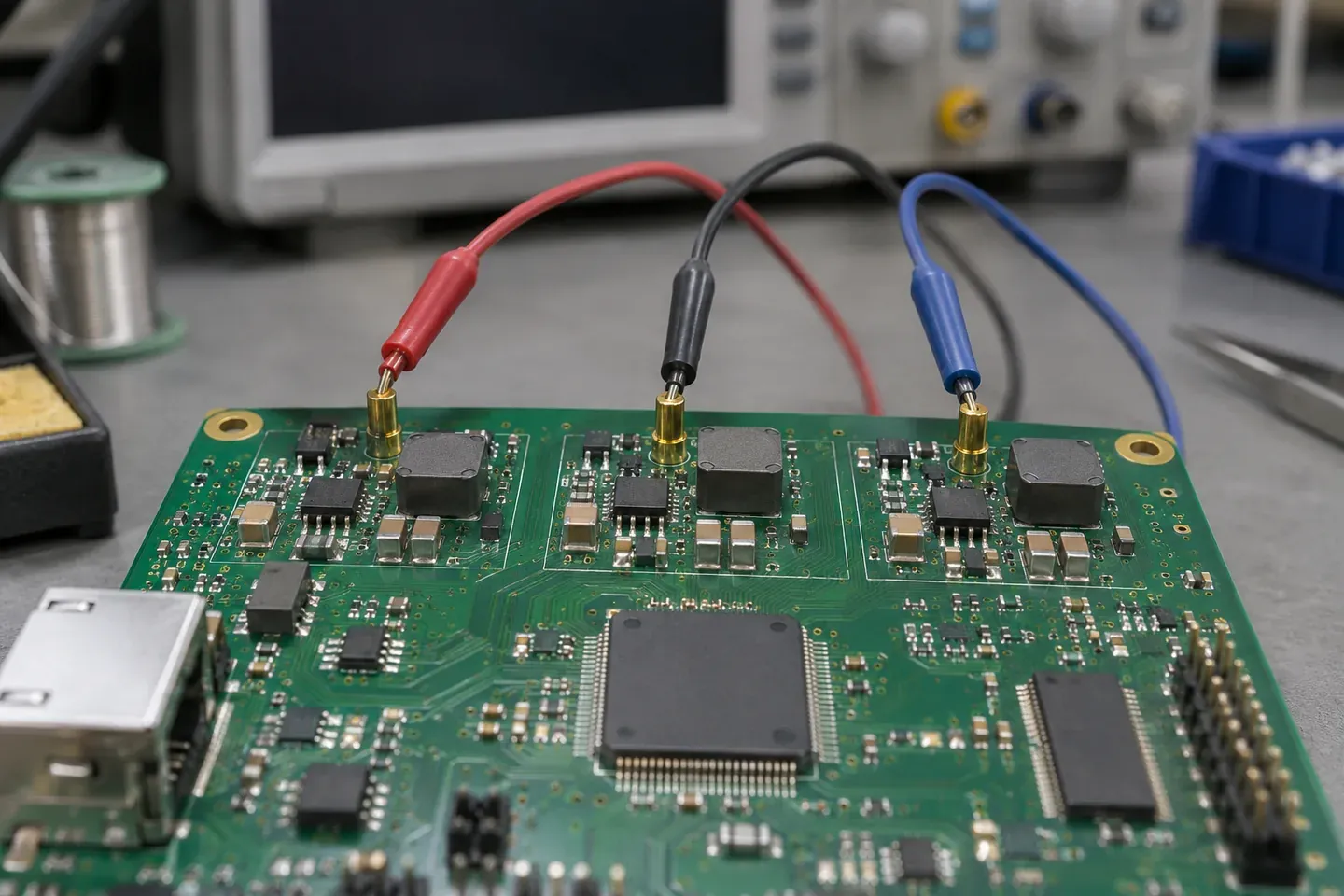
When an industrial board undergoes a power-regulator second-source change (for example, swapping a DC/DC converter with a different soft-start capacitor during a component shortage), exceeding the tRAMP limit on VCC or VCCPD can lock the FPGA in POR or corrupt initial Active Serial boot from flash—making a healthy 5CEFA7 or 5CEFA9 look dead on arrival. Check PORSEL strapping and monotonic rail ramp plots on an oscilloscope whenever either the power tree or configuration memory changes.
How should receiving handle legacy non-N codes like 5CEFA7U19I7?
Almost all modern Cyclone V E codes terminate with N to specify RoHS-compliant Pb-free BGA solder balls (5CEFA7U19I7N). However, legacy industrial and aerospace service BOMs still carry non-N leaded (SnPb) ordering strings such as 5CEFA7U19I7.
Keep three controls active at quoting and receiving:
- Block silent suffix stripping or appending: Never let a spreadsheet macro automatically add
Nto5CEFA7U19I7(or dropNfrom5CEFA7U19I7N). The two codes carry different solder-ball alloys and reflow peak-temperature requirements. - Verify MSL dry-pack and baking logs: Cyclone V E BGA packages are moisture sensitive (typically MSL 3; confirm the exact bag label). Aged legacy non-
Nlots should pass visual inspection, XRF ball-alloy verification where scoped, and MSL floor-life recovery controls prior to assembly. - Preserve exact branding expectations: Lots produced before and after Altera’s independence may display Intel or Altera packaging/top-mark formats; reconcile date codes using our post-independence Altera sourcing guide.
Comparing all 46 Cyclone V E variants without losing ordering suffixes
Use the Cyclone V E series directory to compare 5CEFA5, 5CEFA7, and 5CEFA9 across speed grades, temperature ranges, package-specific user I/O counts, and finish codes before requesting a lot, and check broader brand navigation in the Altera catalog.
For industrial maintenance teams deciding whether to stock a legacy speed grade or fund a board revision, align these speed and finish rules with the industrial spare-parts decision pillar and verify total BOM exposure inside the BOM risk framework.
Frequently Asked Questions (FAQ)
Is speed grade 6 faster or slower than speed grade 8 on Altera Cyclone V E FPGAs?
On Altera Cyclone V devices, lower numbers are faster: -C6 is the fastest speed grade, followed by -C7/-I7/-A7, and -C8 is the slowest commercial speed grade. This numbering is the opposite of AMD Xilinx 7 Series, where -3 is faster than -1.
Can a commercial 5CEFA7F31C6N replace an industrial 5CEFA7F31I7N on a factory board?
Not without a thermal and engineering waiver. Although -C6 is faster than -I7, commercial C grade is rated only from 0 °C to +85 °C junction temperature versus -40 °C to +100 °C for industrial I grade.
What does the missing N at the end of 5CEFA7U19I7 signify compared with 5CEFA7U19I7N?
In Altera's ordering nomenclature, the trailing N indicates a RoHS-compliant Pb-free package finish. Omitting N (as on legacy 5CEFA7U19I7) indicates a leaded tin-lead (SnPb) finish requiring leaded assembly controls and excluded from RoHS production.
Why does PORSEL matter when validating a Cyclone V E power-supply redesign?
The PORSEL pin selects Standard (100 ms max) versus Fast (12 ms max) Power-On Reset ramp-time windows. If board power rails ramp slower than the selected POR window, the FPGA can stall before active-serial configuration begins.