
Table of Contents
- The threshold window sits between valid and unsafe voltage
- Why must a voltage supervisor’s falling and rising thresholds be checked separately?
- How do you set reset-release delay for the complete startup chain?
- When should a reset supervisor use an open-drain output?
- Validate brownout and recovery sequences
- Preserve the acceptance window for future changes
A reset supervisor converts an analog rail into a system-state decision. Its job is not simply to assert reset below a catalog threshold. It must assert early enough to protect the processor, remain stable through rail noise, and release only after power and clocks are usable.
The useful selection output is a permitted reset window and timing diagram. Begin with the load’s operating limits and the regulator’s behavior, then choose the supervisor threshold and delay.
The threshold window sits between valid and unsafe voltage
Define the load’s minimum safe operating voltage and the lowest voltage the healthy supply can deliver, including regulator tolerance and permitted droop. The supervisor’s minimum falling threshold must leave enough voltage and time margin to assert reset before operation becomes unsafe; its maximum falling threshold must remain below the lowest healthy rail voltage to avoid nuisance resets.
Account for threshold tolerance and temperature on the supervisor side, and assertion delay plus the rail’s fall rate on the system side. If those limits overlap, no nominal threshold solves the problem: tighten the rail or threshold tolerance, revise the transient requirement, or change the supervision design.
Analog Devices’ voltage-supervisor design discussion, accessed September 24, 2026, separates threshold accuracy, transient response, and reset timing. That separation prevents a tight DC threshold from being credited for a transient it may intentionally ignore.
Why must a voltage supervisor’s falling and rising thresholds be checked separately?
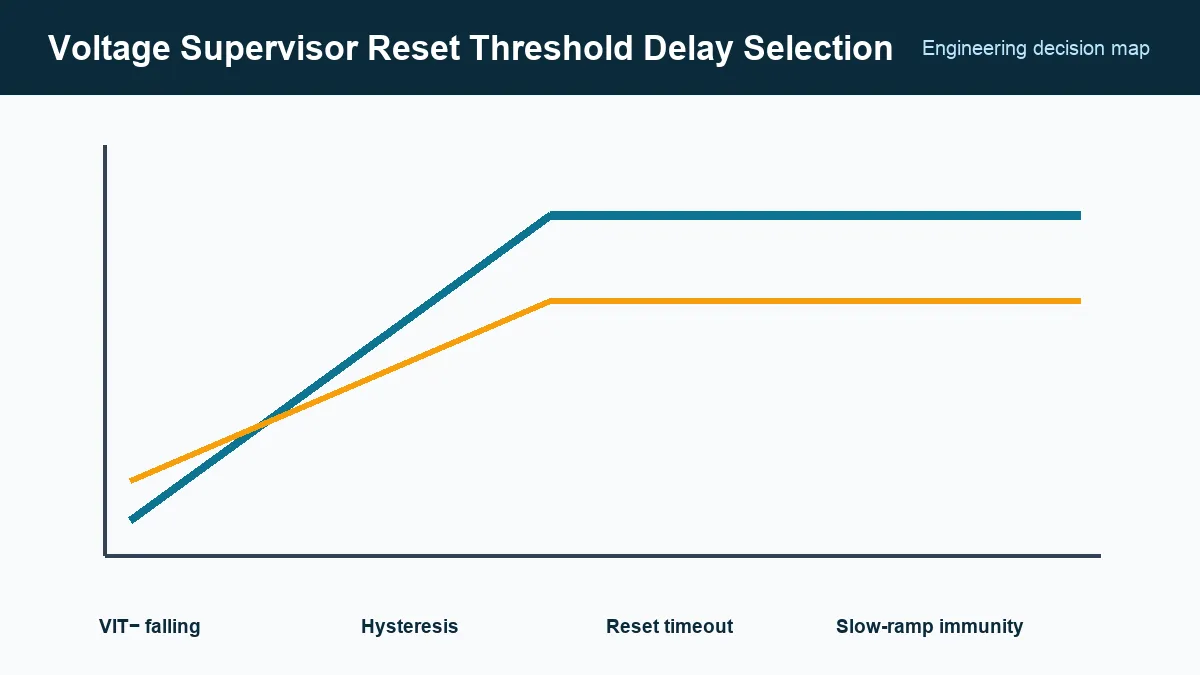
The falling threshold determines when undervoltage asserts reset, while the rising threshold determines when recovery can begin. Hysteresis separates these points to reduce chatter during noise or slow ramps, so one nominal threshold cannot define both reset protection and release voltage.
Some datasheets guarantee a falling threshold and specify hysteresis only typically. Others provide separate rising and falling limits. If release voltage matters, derive it only from guaranteed data or qualify it by measurement. For an adjustable supervisor, include reference accuracy, external-divider tolerance, bias current, leakage, and noise pickup.
Measure a slow downward ramp as well as abrupt removal. A supervisor can have a finite propagation delay or transient-rejection filter, so a narrow dip may not assert reset. Decide which dips the system must ride through and which must cause an orderly restart.
How do you set reset-release delay for the complete startup chain?
Set reset-release delay to cover the remaining regulator, oscillator, PLL, memory, and other required-rail startup after the supervisor’s documented timeout trigger. That trigger is often a rising-threshold crossing, but the exact device definition and delay tolerance must be checked against the slowest supported system startup.
Texas Instruments SLVAE47, accessed September 24, 2026, shows how threshold, hysteresis, and reset delay contribute to reliable processor supervision. Build the timeout requirement from the slowest supported startup condition, including cold temperature and a slow supply ramp, rather than from a room-temperature oscilloscope capture.
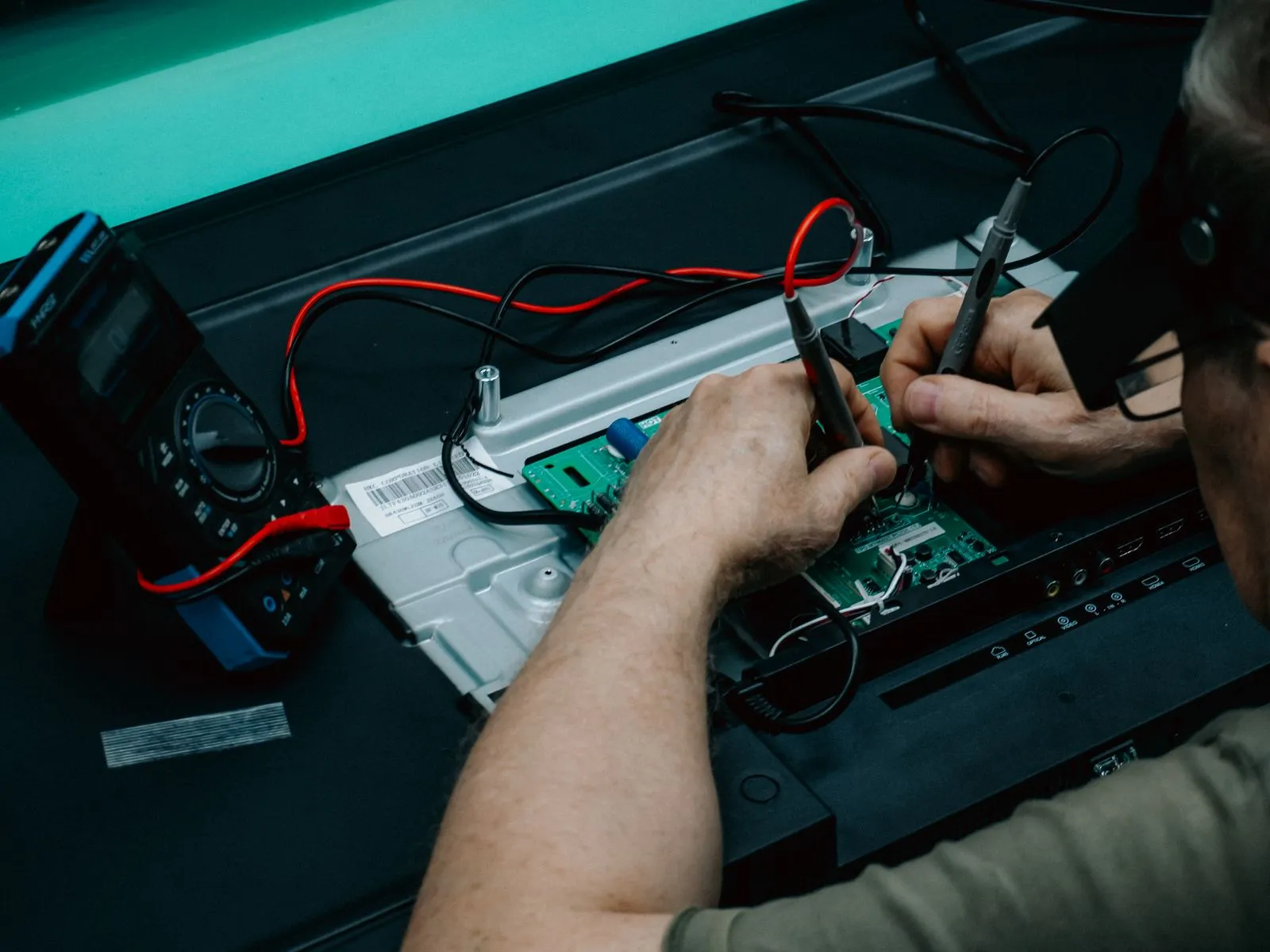
Also verify assertion time. Many supervisors assert reset quickly when voltage falls, but their behavior can change when the monitored rail approaches zero. If reset must remain valid at very low supply, check the guaranteed output-voltage or output-current specification and whether an external resistor is recommended.
When should a reset supervisor use an open-drain output?
Use an open-drain reset output when compatible reset sources must share a line, provided the pull-up supply is present and the resistor, capacitance, and leakage meet the receiver’s timing and voltage requirements. A push-pull output drives both states and normally cannot share a wired reset line with other active drivers.
If manual reset, watchdog, or multiple supervisors share the line, define their electrical combination. Check polarity, minimum pulse width, debounce, and whether the output is guaranteed when the supervisor supply is absent. A manual-reset pin may include an internal pull-up yet still need external filtering for a long cable or noisy switch.
Validate brownout and recovery sequences
Run ramps at the fastest and slowest credible rates, short dips at several amplitudes, repeated brownouts, rapid off-on cycles, and cases where auxiliary rails remain powered. Capture the monitored rail at the supervisor pin, reset output, processor supply, and a signal that proves firmware execution.
Release documentation should include threshold limits, hysteresis data, transient immunity, assertion delay, release timeout, output type, pull-up rail, low-voltage output guarantee, quiescent current, manual-reset behavior, package, and temperature range. Record the permitted rail window beside the chosen ordering code. That makes future substitutions a bounded timing problem instead of a comparison of nominal threshold suffixes.
Preserve the acceptance window for future changes
Store the regulator limits, processor safe boundary, supervisor threshold distribution, ramp conditions, and reset timing on one reviewed diagram. If a regulator, processor, or supervisor changes, engineering can recalculate the same window before samples are ordered. The diagram also gives production test a small set of meaningful timing and voltage limits rather than a generic reset toggle check.
Frequently Asked Questions (FAQ)
Should a supervisor threshold equal the rail's nominal minimum?
No. The threshold window must sit below the lowest valid rail voltage yet above the highest unsafe voltage, after including rail tolerance, transient drop, supervisor accuracy, temperature, and processor requirements.
Are reset delay and power-on reset delay the same for every supervisor?
No. Datasheets may specify assertion delay, release timeout, startup behavior, and manual-reset timing separately. Compare the exact definitions and test conditions.
When is a window supervisor needed?
Use a window function when both undervoltage and overvoltage must force a known state. A conventional supervisor commonly monitors only a falling undervoltage threshold.