Table of Contents
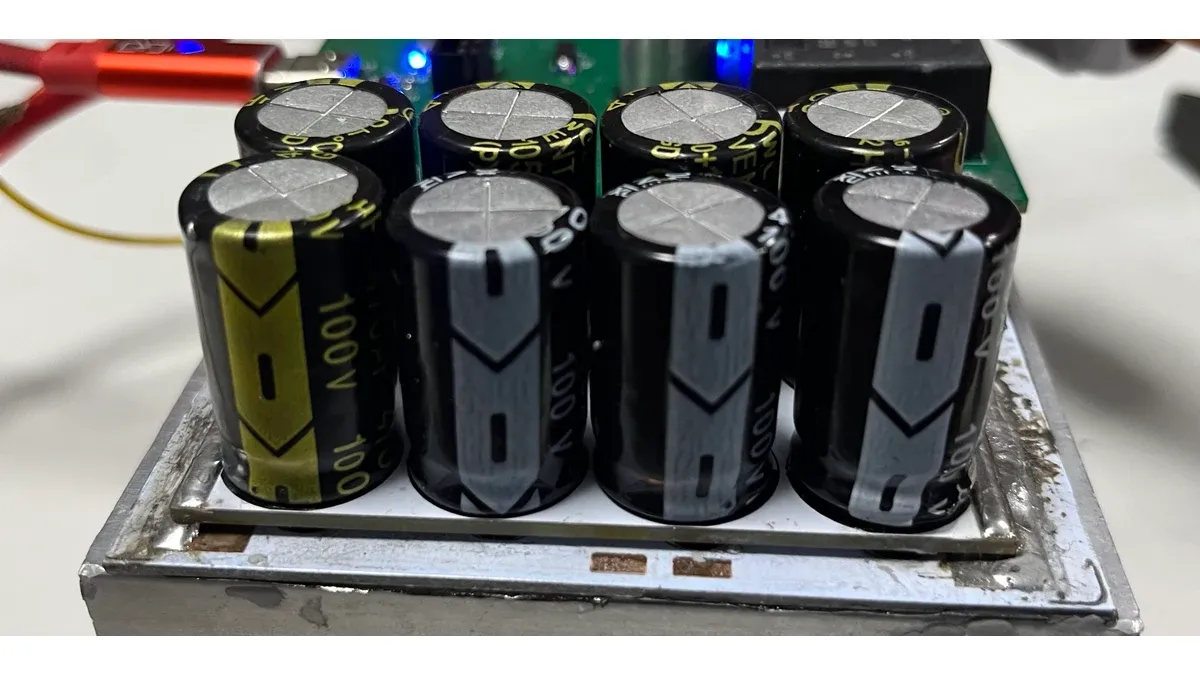
An electrolytic capacitor replacement can fit the board and show the correct microfarads while delivering a different ripple-current capability. That gap matters when the purchasing team is replacing a discontinued series, consolidating suppliers or buying material for a repair program.
The approval should preserve the capacitor’s function over the required operating life. Nominal capacitance and voltage are the start of the comparison. Ripple spectrum, equivalent series resistance, temperature, endurance conditions and mechanical installation decide whether a proposed replacement is usable.
Can a higher-voltage electrolytic capacitor replace the original?
A higher rated voltage may provide a candidate, but it does not establish an acceptable replacement. Capacitance tolerance, ripple rating, ESR, size, lead spacing, temperature behavior and circuit response must still meet the design requirement.
A 25 V replacement for a 16 V part may be physically larger or belong to a different series. Even when the case fits, the buyer needs the complete ordering code. Reusing a distributor description such as “low ESR, 105°C” loses the distinctions that engineering needs to approve.
Nichicon’s aluminum-electrolytic technical notes describe frequency and temperature dependence, ripple heating, lifetime evaluation and storage considerations. The notes support a series-specific assessment; they do not make all capacitors with matching headline values interchangeable.
How do you compare ripple-current ratings on supplier quotes?
Bring each rating to the same frequency and temperature using the manufacturer’s stated correction method. Compare that capability with the current actually flowing through the capacitor, including multiple frequency components where relevant.
A rating specified at a low mains-related frequency should not be compared directly with one specified at a switching frequency. Similarly, a value allowed at a lower ambient temperature does not establish capability at the hottest board location.
For an illustrative single-frequency case, a 1.2 A RMS ripple through 80 mΩ ESR dissipates approximately:
P = I² × ESR = 1.2² × 0.080 = 0.115 W
At 140 mΩ, the same calculation gives 0.202 W. This is a loss comparison, not a temperature or lifetime prediction. Heat removal and frequency-dependent ESR still matter.
With several ripple components, estimate their individual losses using the applicable ESR at each frequency, then combine them under the manufacturer’s method. Do not apply a frequency multiplier twice: once in the allowable-current figure and again as an unexplained reduction in measured current.
What should an endurance comparison include?
Compare the stated endurance test temperature, duration, applied voltage, ripple condition and end-of-test limits. A published endurance result is evidence under those conditions, not a guarantee that the same number of hours applies in every product.
Procurement can ask engineering to return this compact record:
| Comparison item | Required evidence | Purchasing consequence |
|---|---|---|
| Capacitance and ESR | Initial limits and allowed end-of-life change | Determines functional margin |
| Ripple | Frequency, ambient and correction factors | Prevents unlike current ratings being compared |
| Lifetime model | Exact series guidance and temperature inputs | Supports a conditional service-life estimate |
| Mounting | Diameter, height, pitch, polarity and vent clearance | Prevents a nominally compatible mechanical substitution |
| Storage | Package condition, history and manufacturer guidance | Defines extra evaluation for aged material |
A cooler ambient does not by itself establish a cooler internal element. Nearby heat and ripple losses can offset the apparent benefit. Avoid applying a universal temperature-doubling rule across constructions or extrapolating a model beyond its stated range.
Why should ESR be checked against the circuit, rather than minimized?
Some circuits depend on the capacitor’s impedance characteristics for damping or regulator stability. Lower ESR can be useful, but replacing a part with the lowest available ESR may change transient response or resonance.
The alternate evaluation should include startup, load changes, cold operation and the hot steady state. Check the surrounding capacitor network as well as the single replacement. A change involving ceramic parts requires a separate effective-capacitance assessment, because the dominant mechanisms differ.
Keep the approved series attached to the purchase line
Request an explicit deviation when a supplier offers another series, a different case or a different packing option. Retain the marked sample, its full identity and the approval evidence, then confirm that the production shipment matches.
For repair stock, separate an acceptable present electrical measurement from a remaining-life estimate. A meter reading cannot reconstruct storage history or all prior operating stress. Where history is incomplete, define the additional evaluation and the intended use before purchasing the lot.
Frequently Asked Questions (FAQ)
Can a polymer capacitor replace a wet aluminum electrolytic capacitor?
Possibly, but it is a technology change. Recheck ESR, ripple, leakage, surge behavior, voltage range and circuit stability rather than treating equal capacitance as equivalence.
Is a 105°C marking enough to compare two capacitor lifetimes?
No. Endurance hours, applied voltage, ripple conditions and the manufacturer's life model also matter. The same maximum temperature can accompany different endurance ratings.
Should old stock be reformed automatically before shipment?
Do not apply a universal reforming procedure. Obtain the manufacturer's storage and voltage-treatment guidance for the exact series, and define the evaluation and acceptance conditions.