Table of Contents
- What Are the Current Constraints in the High-Speed Data Converter Market?
- Why Are Precision ADCs and DACs So Difficult to Cross-Reference?
- How Should Buyers Vet Independent Sources for Data Converters?
- What Are the Projected Lead Times for Major Brands in 2026?
- How Can We Secure Supply for Q3 and Q4 2026?
What Are the Current Constraints in the High-Speed Data Converter Market?
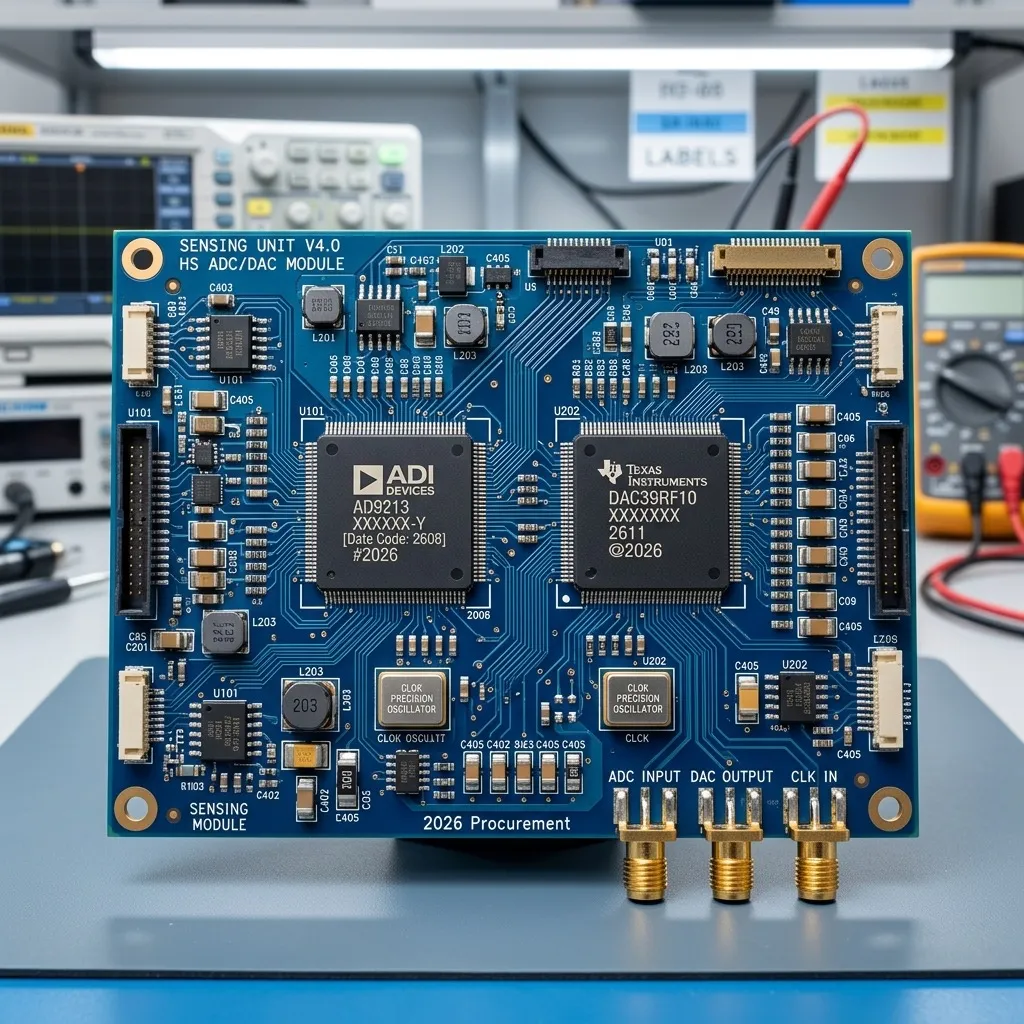
The surge in AI networking infrastructure and advanced military radar deployments in 2026 has monopolized the mature 65nm and 40nm foundry capacities required for high-speed data converters (ADCs/DACs). Consequently, we are seeing lead times for key components—such as the Analog Devices AD9208 and Texas Instruments ADC12DJ3200—stretch from a normalized 18 weeks back out to 30+ weeks. According to independent foundry utilization data published by TrendForce in Q2 2026, precision analog and mixed-signal capacity remains heavily constrained. For procurement teams supporting medical imaging, aerospace, or 5G telecom, securing allocation requires moving beyond standard franchised channels and utilizing validated independent distributors with rigorous anti-counterfeit testing.
As an independent distributor actively navigating the global supply chain, we’ve witnessed firsthand how the high speed data converter market has shifted from a buyer’s market to a hyper-competitive allocation environment. Just last month, we helped a Tier-1 medical device manufacturer locate 5,000 pieces of a critical Texas Instruments DAC after their franchised supplier de-committed on a 12-month blanket order.
This article outlines exactly how procurement professionals can navigate these shortages and secure authentic, high-performance data converters in Q3 2026.
Why Are Precision ADCs and DACs So Difficult to Cross-Reference?
When a standard microcontroller goes on allocation, engineers can often pivot to a pin-to-pin (P2P) alternative with a few weeks of firmware updates. Can you do the same with high-speed data converters?
The short answer is: rarely.
High-speed Analog-to-Digital Converters (ADCs) and Digital-to-Analog Converters (DACs) are the bridge between the physical and digital worlds. At sampling rates exceeding 1 GSPS (Gigasamples per second), the performance is deeply tied to the specific silicon architecture, package parasitics, and PCB layout.
- JESD204B/C Interface Compatibility: High-speed converters rely on the JESD204 serial interface to stream massive amounts of data to FPGAs. Swapping an ADC often means rewriting complex FPGA IP cores.
- Noise and Linearity Characteristics: Even if two chips share the same resolution (e.g., 14-bit) and sample rate, their Signal-to-Noise Ratio (SNR) and Spurious-Free Dynamic Range (SFDR) profiles will differ, potentially violating strict system-level certifications in medical or aerospace applications.
How Should Buyers Vet Independent Sources for Data Converters?
When franchised distribution lead times stretch into 2027, buyers must turn to the independent market. However, high-speed data converters are premium, high-ASP (Average Selling Price) components, making them prime targets for counterfeiters.
How can you ensure the parts you buy will actually pass your incoming quality control (IQC)?
At SupplyICs, we mandate a zero-tolerance policy for substandard components. When sourcing high-speed ADCs or DACs from the open market, you must demand the following documentation and testing:
| Quality Assurance Protocol | Why It Matters for High-Speed Converters | SupplyICs Implementation Standard |
|---|---|---|
| X-Ray Inspection | Verifies internal die size and wire bonding patterns against known-good golden samples. | 100% of lots processed. |
| Decapsulation (De-cap) | Physically removes the epoxy molding to inspect the manufacturer’s logo and die topography under high magnification. | Performed on a statistical sample of every high-risk lot. |
| Electrical Testing (Curve Trace) | Checks for degraded pin characteristics, which is critical for RF/high-frequency input pins that are easily damaged by ESD. | Mandatory for all components lacking original factory seals. |
| Bake & Dry Pack | Moisture-Sensitive Devices (MSD) like high-pin-count BGA converters will “popcorn” during reflow if moisture is absorbed. | JEDEC J-STD-033 compliant baking before shipping. |
Reference: For comprehensive insights into anti-counterfeit testing standards, consult the ERAI guidelines on component mitigation.
What Are the Projected Lead Times for Major Brands in 2026?
Based on our internal trading data and continuous dialogue with the global supply network, here is the current outlook for the dominant players in the high speed data converter market:
- Analog Devices (ADI) / Linear Technology: Lead times for high-end RF converters (e.g., AD9xxx series) remain stubborn at 26-34 weeks. ADI’s mature node capacity is heavily burdened by aerospace and defense contracts, which receive priority allocation over commercial telecom customers.
For industrial simultaneous-sampling requirements rather than RF converters, the AD7606B and AD7606BBSTZ sourcing guide resolves the easily missed difference between AD7606BSTZ and AD7606BBSTZ and adds model-level lifecycle, PCN and migration controls.
- Texas Instruments (TI): TI’s aggressive internal fab expansion (particularly their 300mm RFAB2 and LFAB) has improved lead times for mid-tier converters (10-14 weeks). However, their flagship high-speed GSPS converters still face 20-28 week delivery horizons due to complex backend test bottlenecks.
- Renesas / IDT: Lead times have stabilized somewhat at 18-24 weeks, though localized shortages persist for specific JESD204B timing and converter chipsets.
How Can We Secure Supply for Q3 and Q4 2026?
The “just-in-time” procurement model is functionally broken for high-reliability analog components. What actionable steps can you take today?
- Broaden Your Approved Vendor List (AVL) for Distributors: Do not rely solely on your primary franchised partner. Cultivate relationships with vetted independent stocking distributors who hold physical inventory or have direct access to OEM excess.
- Forecast at the Die Level: If you consume multiple variants of the same base silicon (e.g., different speed grades or temperature ratings of the same ADC), communicate your aggregate die-level forecast to your partners. Sometimes a faster speed grade is available and can be down-rated for your application.
- Leverage Global Excess: Many contract manufacturers (CMs) over-ordered in 2024/2025 and are now quietly offloading excess inventory of high-value ADCs. Working with a distributor like SupplyICs gives you visibility into these hidden OEM/EMS inventory pools.
Sources:
- TrendForce, “2026 Foundry Capacity Utilization and Mature Node Dynamics”
- EE Times, “The RF Component Sourcing Crisis of 2026”
- JEDEC, “JESD204C High-Speed Serial Interface Standard”
- ERAI, “Counterfeit Electronic Component Mitigation Standard”
- SupplyICs Solutions, “High-Reliability Analog Sourcing”
[!TIP] Need immediate allocation for an ADC or DAC? Don’t let a 30-week lead time stall your production line. Send your exact MPN requirements to our procurement desk, and our team will leverage our global network to find available, authentic stock. Contact us via our Solutions page.
Frequently Asked Questions (FAQ)
Why are high-speed data converter lead times extending in 2026?
The surge in AI infrastructure, 5G base stations, and aerospace radar systems has monopolized the mature foundry capacity (65nm/40nm) used to fabricate precision analog components, pushing lead times beyond 30 weeks for specific high-frequency ADCs and DACs.