Table of Contents
A safety capacitor alternate should be purchased against its role in the equipment and its documented classification. Equal capacitance, lead spacing and a larger voltage number do not establish that a proposed replacement is suitable.
For buyers, the practical task is preserving the approved construction. This means checking the exact manufacturer code and approval scope before comparing packing, price or delivery terms.
Can an X2 capacitor replace a Y2 capacitor?
An X2 classification alone does not qualify a capacitor for a position requiring Y2. Use a candidate with the required Y classification and applicable ratings, then confirm its suitability within the equipment’s approved design.
Vishay’s safety capacitor selection overview distinguishes Class X applications across the line from Class Y applications involving line-to-ground filtering. The classes address different application conditions; they are not a single ascending product-quality scale.
A dual-marked part must be read according to both classifications and their stated conditions. A combined marking is not permission to ignore the equipment’s required class or operating voltage.
What is the difference between X1, X2, Y1 and Y2?
The labels identify subclasses within the X and Y safety-capacitor categories, with different qualification requirements. Determine the required category from the circuit and equipment requirements, then verify the subclass and exact part documentation.
The Vishay overview lists typical peak impulse levels of 4.0 kV for X1, 2.5 kV for X2, 8.0 kV for Y1 and 5.0 kV for Y2. Those figures help distinguish the categories; they are not continuous operating-voltage ratings or a complete substitution rule.
Keep the AC voltage, temperature and other declared operating limits separate from the impulse classification. Where the equipment documentation requires a particular approval or construction, an apparently stronger individual rating does not eliminate that requirement.
Four checks before releasing a purchase order
Use a comparison that can be tied to the actual bill of materials and component documentation:
| Check | Record to compare | Reason to hold the candidate |
|---|---|---|
| Circuit position | Function and required X or Y classification | The candidate has only a different category |
| Electrical and environmental limits | Capacitance, AC rating, temperature and other required conditions | A required condition is missing or incompatible |
| Exact approval scope | Manufacturer code, series coverage and current approval documents | The offered variant cannot be connected to the approval |
| Installed construction | Dimensions, lead spacing, insulation distances and mounting | The substitute changes an assessed construction requirement |
This is a procurement review framework, not a certification procedure. The responsible equipment process determines whether further evaluation is required.
Read the actual orderable suffix. Lead form, pitch, coating, temperature option or another variant may affect the construction being purchased. If a certificate uses a series designation, confirm how the offered code maps to that designation.
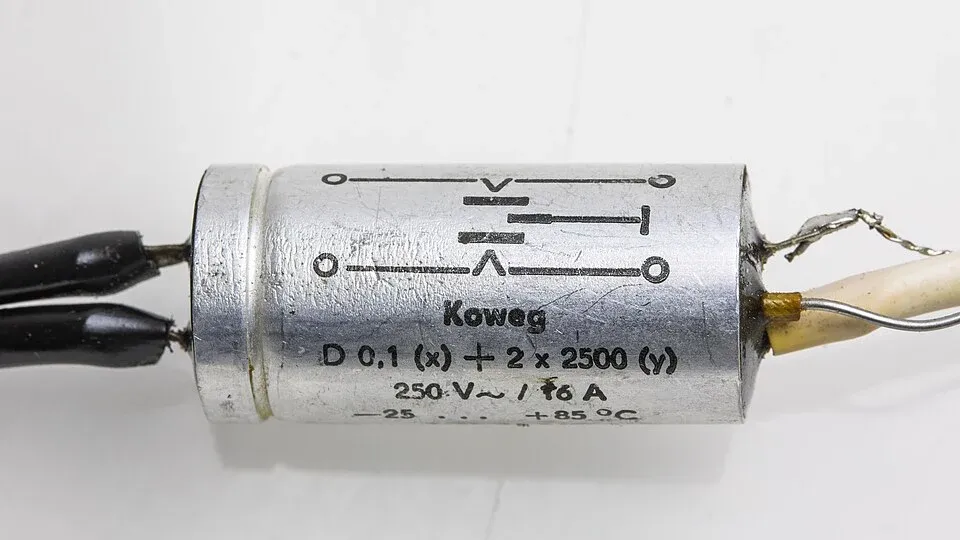
How should approval markings be verified?
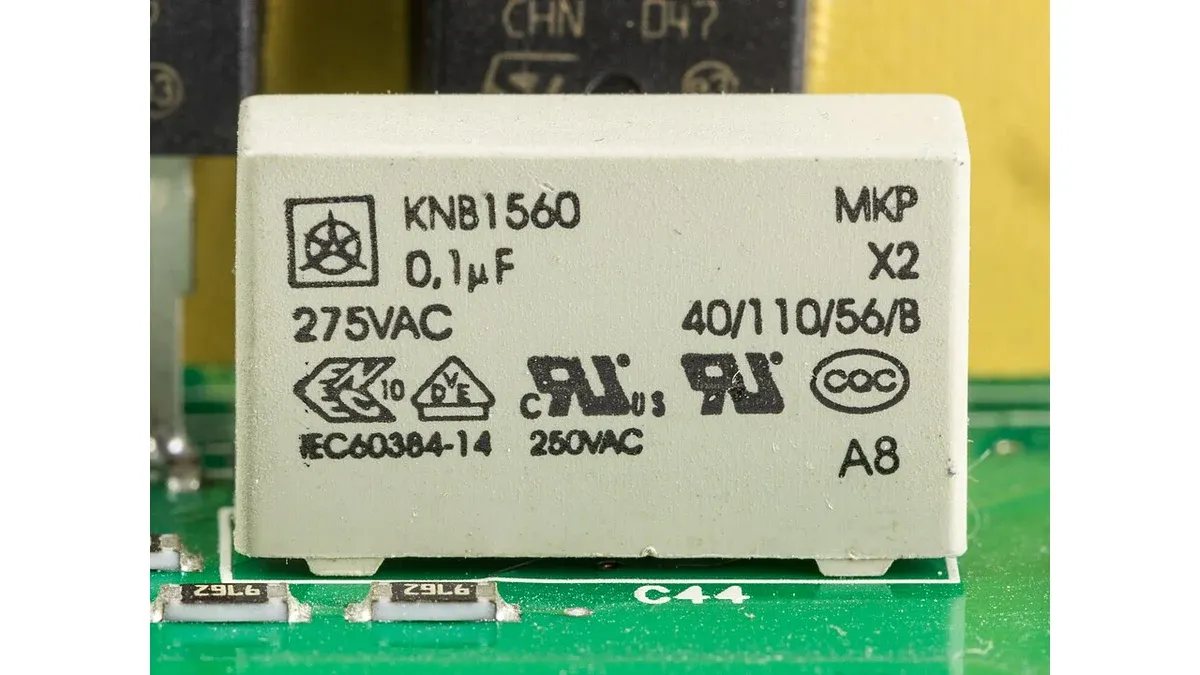
Use markings as an identity clue, then check the exact part against manufacturer and relevant certification documentation. A photograph of an approval logo or a generic supplier declaration does not establish that the offered variant is covered.
Obtain legible product identification and the document reference used for approval. Check the listed family, applicable ratings and any conditions or limitations. Resolve differences between a quotation, datasheet and approval document before release.
For an obsolete part, preserve the original requirement as the comparison baseline. Do not infer a modern replacement’s approval from the appearance of an older component or from a cross-reference table with no supporting documents.
Capacitance changes can affect more than filtering
Changing capacitance can alter filter behavior and, in relevant Y-capacitor applications, current through the capacitive path. A substitute with a nearby nominal value therefore needs an application assessment even if its safety class matches.
The engineering review should retain the equipment conditions and any required tests. Mechanical fit and component approval do not alone establish the finished assembly’s behavior.
Ordinary MLCC replacement checks address a different set of selection questions. For safety capacitor purchases, preserve the required classification and approved construction as explicit buying constraints, and release the exact documented candidate within that scope.
Frequently Asked Questions (FAQ)
Does a higher DC voltage rating replace an AC safety rating?
No. A DC voltage value does not establish the required safety classification, AC operating conditions or approval scope.
Can a dual-marked capacitor be used at one voltage for both classifications?
Read the exact marking and datasheet. Dual classifications can have different applicable voltage ratings and conditions, so the ratings must be interpreted separately.
Does approval of the capacitor certify the finished product?
No. Component approval supports only its defined scope. The completed equipment has its own construction, installation and compliance requirements.