Table of Contents
A fuel gauge reports state of charge; the product needs usable energy at its cutoff. The two diverge fastest at low temperature, under a heavy load pulse and after a cell change, which is where a smooth percentage display stops being useful.
Choose the battery fuel gauge IC around the actual cell and operating profile, and define what “empty” means for the product before comparing algorithms. The reading matters most near empty, when the product must finish a transaction or shut down safely.
Which gauging method fits the battery and workload?
A voltage-based model avoids a current-sense resistor and can suit low-power designs. Coulomb counting measures charge flow but needs control of offset and initialization error. Hybrid gauges combine charge counting with a battery model to correct accumulated error and account for operating conditions.
| Item | MAX17048 | MAX17055 | What to verify |
|---|---|---|---|
| Gauging method | Voltage-model ModelGauge | Coulomb counting plus voltage model | Model behavior under the product’s load profile |
| Current sense | None | External sense resistor | Shunt value, Kelvin layout and measurement range |
| Chemistry | Single-cell Li-ion | Datasheet-listed Li-ion and LiFePO4 support | Exact cell, temperature range and configuration |
| Temperature input | Confirm host-supplied temperature and update rate in the datasheet | Current and temperature measurement | Who supplies temperature, at what interval |
| Host effort | Low; simple configuration | Higher; characterization and configuration | Firmware, production data and calibration |
| Footprint | Different package and pin count | Different package and pin count | Land pattern and surrounding components |
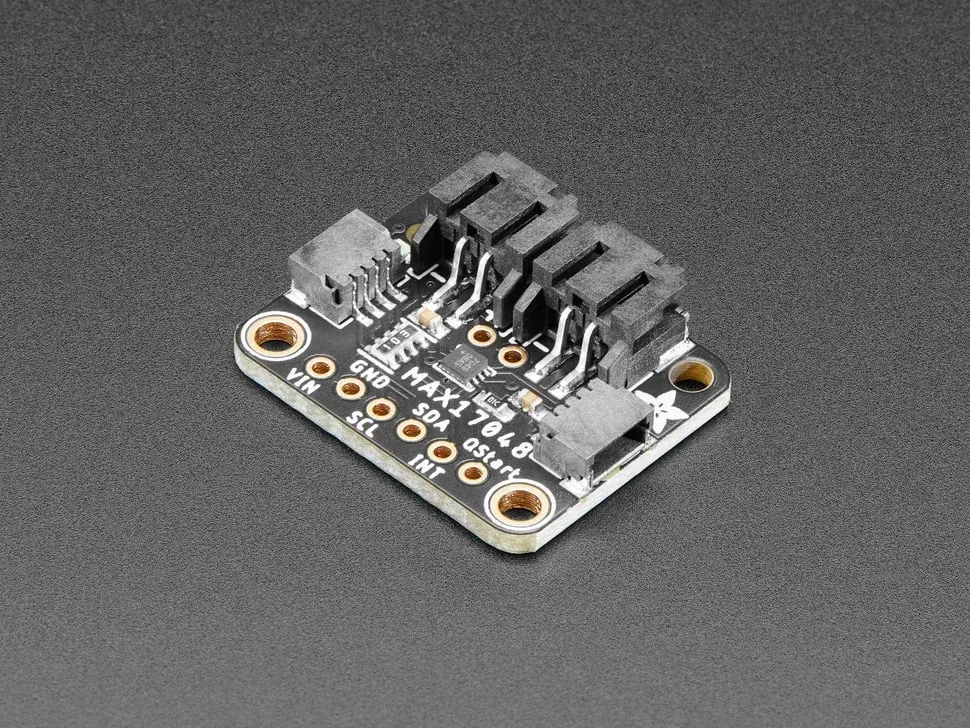
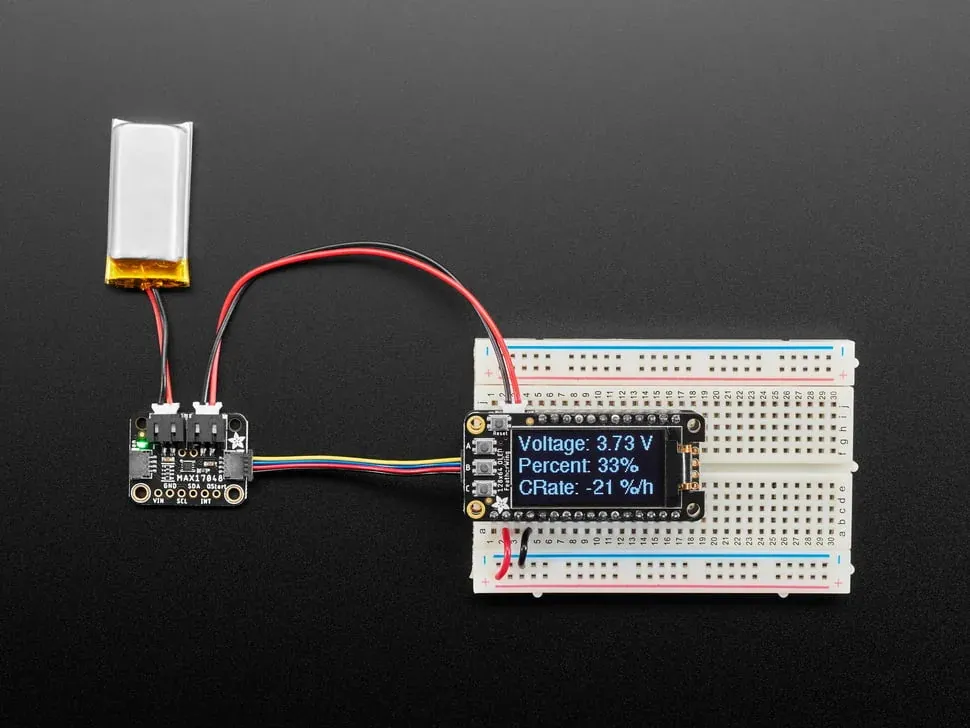
ADI’s MAX17048 uses ModelGauge for a single lithium-ion cell without a current-sense resistor. Its configuration depends on a temperature input and the host update procedure, so confirm who supplies temperature and how often in the datasheet.
The MAX17055 combines coulomb counting with a voltage model and supports current and temperature measurements. Its listed chemistry support includes LiFePO4. The extra capability comes with different sensing, configuration and firmware requirements; MAX17048 and MAX17055 are not footprint-compatible substitutes.
Evaluate the application conditions that change the answer:
- Very low average load: compare gauge consumption with the product’s sleep budget.
- Short high-current bursts: check loaded voltage, current measurement and end-of-discharge prediction.
- Long periods without rest: review model behavior when relaxed open-circuit voltage is rarely observed.
- Replaceable battery: define pack detection, initialization and treatment of stored parameters.
- Cold operation: account for cell resistance rise, temperature input and usable capacity under load.
A small current offset becomes a large capacity error
An uncompensated current offset accumulates with time. Calculate that contribution before deciding that a current-sense implementation is adequate.
| Offset | Error over 24 h | Of a 1,000 mAh cell | Of a 2,000 mAh cell |
|---|---|---|---|
| 0.5 mA | 12 mAh | 1.2% | 0.6% |
| 1 mA | 24 mAh | 2.4% | 1.2% |
| 2 mA | 48 mAh | 4.8% | 2.4% |
The table shows pure integration error. A hybrid gauge may correct it through its model, and the real offset depends on the sensing implementation and conditions.
For a 10 milliohm shunt carrying 2 A, the voltage drop is 20 mV and the dissipation is 40 mW. A smaller shunt reduces loss but also reduces the voltage available for current measurement. Use the gauge’s supported range and layout requirements, including Kelvin sensing where specified, rather than choosing the resistor solely for low resistance.
What must be requalified when the cell changes?
Revisit the gauge configuration and the product’s usable-energy behavior. Matching nominal voltage and label capacity does not establish the same discharge curve, impedance, aging response or low-temperature performance.
Begin with the exact cell identity, chemistry, rated capacity, charge termination and system cutoff requirements. Record the configured model, sense resistance, temperature source, design capacity and any learned-state handling required by the selected gauge.
Then run a representative charge/discharge program using approved test equipment and the cell maker’s operating limits. Include the product’s pulse loads and low-power intervals. Test at the required temperatures, with both new cells and the aged condition relevant to the service target.
Compare reported remaining capacity with the usable charge or energy delivered before the product’s specified cutoff. Log early shutdowns and optimistic remaining-charge reports separately. If the product shuts down with substantial charge displayed, inspect the load-induced voltage drop and cutoff policy as well as the gauge model.
Initialization and production control
Power cycling the host, disconnecting the cell and waking from a long sleep can take different paths through gauge initialization. Verify each path, including recovery after an interrupted configuration write. Confirm that the host detects invalid or uninitialized data instead of presenting it as a valid percentage.
Freeze the released gauge firmware and cell configuration with the approved battery BOM. When a supplier proposes a replacement cell, require the engineering change to identify whether the model or learned state must change. This is a separate task from the battery charger selection review, which determines how energy enters the cell.
For component alternative sourcing, provide cell count and chemistry, the gauge ordering code, sense-resistor arrangement, host interface and required shutdown reserve. Use the BOM review path when the gauge, cell and protection parts change together. Ask for samples early enough to run the intended battery profile; a gauge that reports the right percentage at room temperature but the wrong runtime at cutoff has not passed validation.
Frequently Asked Questions (FAQ)
Does a fuel gauge replace the battery charger or protection circuit?
No. State-of-charge estimation, charge regulation and protective cutoff are different functions. A product must implement each function required by its cell and system design.
Should capacity be entered in mAh or mWh?
Use the units and scaling required by the exact gauge register or API. Capacity and energy are different quantities; a host conversion error can produce plausible-looking but incorrect results.
Can learned gauge parameters be copied to every replacement battery?
Only when the gauge vendor's procedure and pack identity support it. A new chemistry, cell model or materially different aged condition can require reinitialization or a different model.
How is a battery fuel gauge calibrated?
Follow the gauge vendor's procedure for the exact configuration. It usually combines a characterized cell model, the design capacity and a learning cycle. Do not copy learned state between packs unless the vendor's procedure explicitly allows it for that pack identity.