Table of Contents
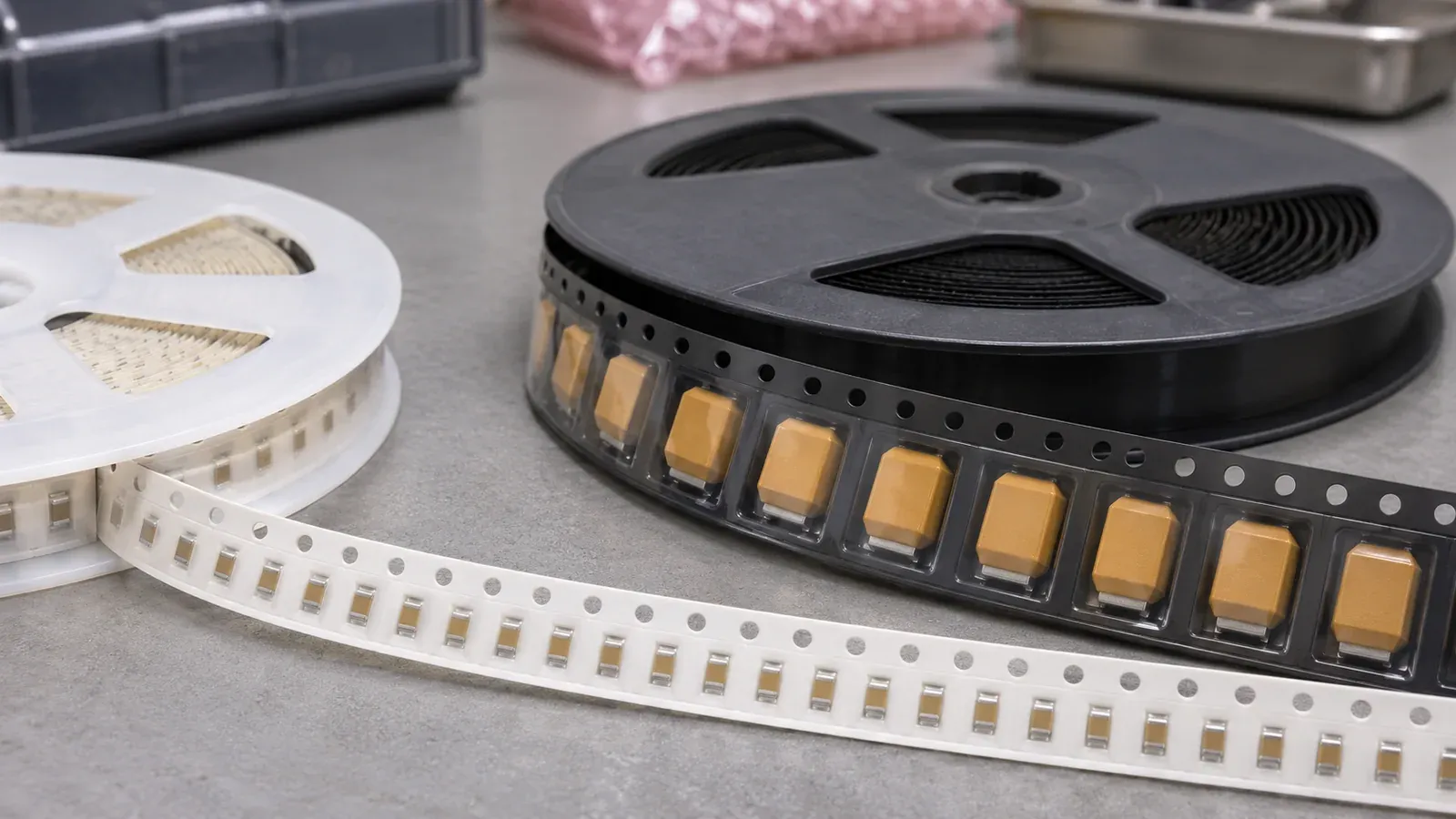
Passive components—long treated as effortless C-class catalog buys—crossed a fourth consecutive lead-time step-up in November 2026. According to TTI and brokerage MLCC trackers published on November 17 and November 25, 2026 alongside Alantys’ November 2026 Electronic Components Market Alert, factory delivery schedules for high-capacitance and automotive multilayer ceramic capacitors (MLCCs) stretched past 40 weeks at Murata, 48 weeks at TDK, and 52 to 61 weeks at Samsung Electro-Mechanics (SEMCO), while TrendForce’s AI server MLCC lead-time index climbed from 35 to 40 weeks (3.3× balanced equilibrium). Simultaneously, representative Vishay low-ESR surface-mount molded tantalum capacitors (such as TR3D227K010C0150 220 µF / 10 V / 2917) are quoting 29-week manufacturer standard lead times in late-November 2026 authorized distribution snapshots.
What makes this cycle dangerous for industrial and automotive OEMs is hidden volume rationing: while SEMCO and Yageo raised distribution pricing five straight months, Murata, TDK, and Taiyo Yuden kept distributor catalog quotes largely flat while quietly letting shelf inventory drain—meaning a line item looks normal in ERP until authorized stock hits zero with no restock date. AI-server prepayment dynamics are analyzed in our 2027 AI server MLCC capacity guide; this report focuses on late-November 2026 multi-vendor lead times and safe engineering dual-sourcing across MLCC and tantalum lines.
What do November 2026 MLCC and tantalum lead-time trackers actually show?
Data compiled across TTI’s early-November step-up, Future Electronics’ sixth consecutive monthly expansion, Digi-Key sample stockout tracking, and Meritz Securities’ November 17 and November 25, 2026 consensus reports confirm that tightness has spilled beyond ultra-high-CV AI server caps into general-purpose medium/large case sizes (0805, 1206) and high-voltage industrial parts.
| Supplier & passive line | Late-Nov 2026 verified lead time | Recent trend & pricing posture (Nov 17–25, 2026) | Key allocation driver |
|---|---|---|---|
Murata (MLCC <1 µF, >1 µF, automotive) |
40+ weeks (up from 30–36w in Oct) |
Catalog quotes steady via volume control; evaluating increases on legacy & expansion-cost lines | Full Japanese fab utilization; high-spec AI server & automotive mix |
TDK (MLCC <1 µF / >1 µF & auto) |
40+ weeks (<1 µF); 48+ weeks (>1 µF & auto, up from 30–48w) |
Quotes flat in distribution; longer factory allocations across large/high-CV parts | Capacity prioritized for automotive and server/network infrastructure |
Taiyo Yuden (MLCC >1 µF & auto) |
30–45 weeks (up from 24–26w; 1 µF/0805 auto jumped 23w → 37w) |
Sample distributor stock fell 87% in one month; selective H2 hikes on raw-material/low-margin SKUs |
Server & optical-transceiver spillover tightening mid-case inventory |
SEMCO (MLCC general, high-CV, auto) |
52–61 weeks (manufacturer lead time 61w) |
5 straight months of price hikes; 10 µF/0402 and 22 µF/0603 flipped back to stockout with no restock ETA |
Heavy allocation into hyperscale server & networking ODM contracts |
Yageo (MLCC & capacitor portfolio) |
30–52 weeks |
5 straight months of price hikes (after reported July 1 ~+50% round per Alantys alert); selective 22 µF/0603 restocks |
Aggressive mix management across commodity and high-CV tiers |
TTI / Market aggregate (MLCC) |
20w general 0805/1206; 24w avg high-CV (+8w YoY); 21+w HV 1206; 40w AI server |
4th step-up since late July; Korea Oct cap exports +37% YoY, China Oct +74% YoY, Japan Sept export ASP +21% YoY |
Demand spreading from Taiwan ODMs into Singapore/Thailand server hubs (+50%+ exports) |
Vishay (Molded SMD Tantalum, e.g., TR3) |
29 weeks standard factory lead time (Nov 2026 Newark benchmark) |
Extended factory queue on high-capacitance, low-ESR D/E case molded MnO2 parts |
Long-cycle aerospace, industrial power, and server bulk-holdup demand |
Notice the export confirmation behind those lead times: Japan’s September capacitor export value hit a monthly record driven primarily by a +21% YoY ASP surge (and +61% YoY shipments to Taiwan with +60%+ ASP growth), while Singapore and Thailand server-assembly hubs jumped over +50%. Even buyers who never build an AI GPU board share 0805/1206 high-CV and 1 µF–47 µF ceramic lines with those hyperscale platforms.
Planning assumptions and triggers for 2027 passive procurement
Model 2027 capacitor sourcing across three clear planning boundaries rather than assuming quick Q1 mean reversion:
- Base case (tight high-CV & automotive through H1 2027): High-capacitance (
≥10 µFin0402/0603/0805), high-voltage (≥100 V1206), and AEC-Q200 MLCCs remain on24–48 weekfactory queues into H2 2027 as LTAs absorb tier-1 Japanese and Korean output, while Vishay/Kyocera AVX low-ESR tantalums hold in the24–32 weekband. - Tightening trigger: Watch whether Murata, TDK, or Taiyo Yuden convert volume rationing into formal Q1 2027 portfolio list-price increases (matching Walsin’s November shift to across-the-board increases). If Japanese OEMs issue formal Q1 hikes alongside sustained
>40 weekserver allocations, distributor buffer stock on standard0603/0805industrial X7R values will clear quickly. - Easing sensitivity: If consumer PC/smartphone volume contracts further in Q1 2027 (mirroring notebook shipment declines), low-CV commodity
0201/0402parts (≤0.1 µF) will ease first—meaning buyers should concentrate safety stock and dual-source engineering effort on high-CV (≥4.7 µF), high-voltage, automotive, and molded tantalum lines rather than padding generic bypass decoupling caps.
Engineering dual-source qualification checklist for MLCCs and tantalums
Never authorize purchasing to cross-reference a Murata, TDK, or Vishay capacitor purely by nominal capacitance, voltage rating, and case size (0603, 0805, 2917). Require engineering sign-off across five quantitative checks—detailed further in our MLCC DC-bias effective capacitance guide and polymer vs MnO2 tantalum replacement guide:
- Effective capacitance under actual DC bias & temperature: A
10 µF / 16 V / 0603 / X5RMLCC from Vendor B can lose70%of its capacitance at12 V DC(3.0 µFeffective), whereas Vendor A’s0805 / X7Rretains6.5 µF. Always compare publishedC(V_DC)curves at operating voltage and peak ambient temperature—especially on buck-converter outputs and precision voltage-reference stability windows. - Dielectric class and voltage/temperature headroom: Never downgrade
C0G/NP0(timing, filters, EMI) toX7R, orX7R(125 °C) toX5R(85 °C) in industrial or automotive enclosures. - Mechanical flex-crack protection (
soft termination): On boards near mounting screws, connectors, or depaneling edges, preserve flex-termination (soft-term) construction (Murata GCJ/GJ,TDK CGA Soft,Yageo CS) rather than swapping to rigid standard terminations. - Tantalum cathode chemistry (
MnO2vs conductive polymer): Maintain50%voltage derating onMnO2solid tantalum (10 Vcap on≤5 Vrail) versus10–20%derating on polymer tantalum, and verify whether swappingMnO2(150 mΩESR) to polymer (25–45 mΩESR) shifts LDO or regulator loop stability. - Catalog and sourcing channel separation: When reviewing Murata components or building a multi-vendor passive AVL (Murata + TDK + Taiyo Yuden + Yageo/KEMET/Vishay), submit a consolidated passive BOM review or targeted RFQ specifying exact allowable tolerances, AEC-Q200 status, and minimum effective capacitance at bias so every cross-qualified reel drops straight onto the SMT feeder without line-stop surprises.
Frequently Asked Questions (FAQ)
Why are Murata and TDK MLCC lead times stretching past 40 weeks even while distributor catalog quotes appear flat?
November 2026 distribution trackers show Japanese MLCC suppliers responding to full utilization through volume allocation and longer factory delivery windows (40+ weeks at Murata, 40–48+ weeks at TDK) rather than frequent spot-price hikes—meaning catalog prices look steady right until distributor stock flips to out-of-stock with no restock ETA.
Can a lower-lead-time commercial X5R MLCC drop in for a constrained automotive X7R part of the same capacitance and case size?
No. Swapping X7R (-55 °C to +125 °C, ±15%) for X5R (-55 °C to +85 °C) loses high-temperature stability, and identical nominal capacitance in a smaller or thinner dielectric stack often loses 50–80% of its effective capacitance under DC bias voltage. Always compare DC-bias curves, temperature rating, and AEC-Q200/soft-termination specs.
Are polymer tantalum capacitors direct drop-in replacements for constrained MnO2 tantalum capacitors?
Not without circuit review. Conductive-polymer tantalum capacitors offer much lower ESR, benign non-ignition failure modes, and smaller voltage derating (typically 20% vs 50% for MnO2), but lower ESR can destabilize older LDO or voltage-reference loops designed around MnO2 ESR, and leakage current is often higher.
How early should buyers place 2027 orders for high-CV MLCCs and molded tantalum capacitors?
With late-November 2026 trackers showing 24-week average high-CV distribution lead times, 29-week factory standard lead times on select Vishay molded tantalums, and 40–61 week manufacturer queues on high-spec Japanese/Korean MLCCs, production BOMs need 26-to-40-week rolling forecast visibility or pre-qualified second sources.