Table of Contents
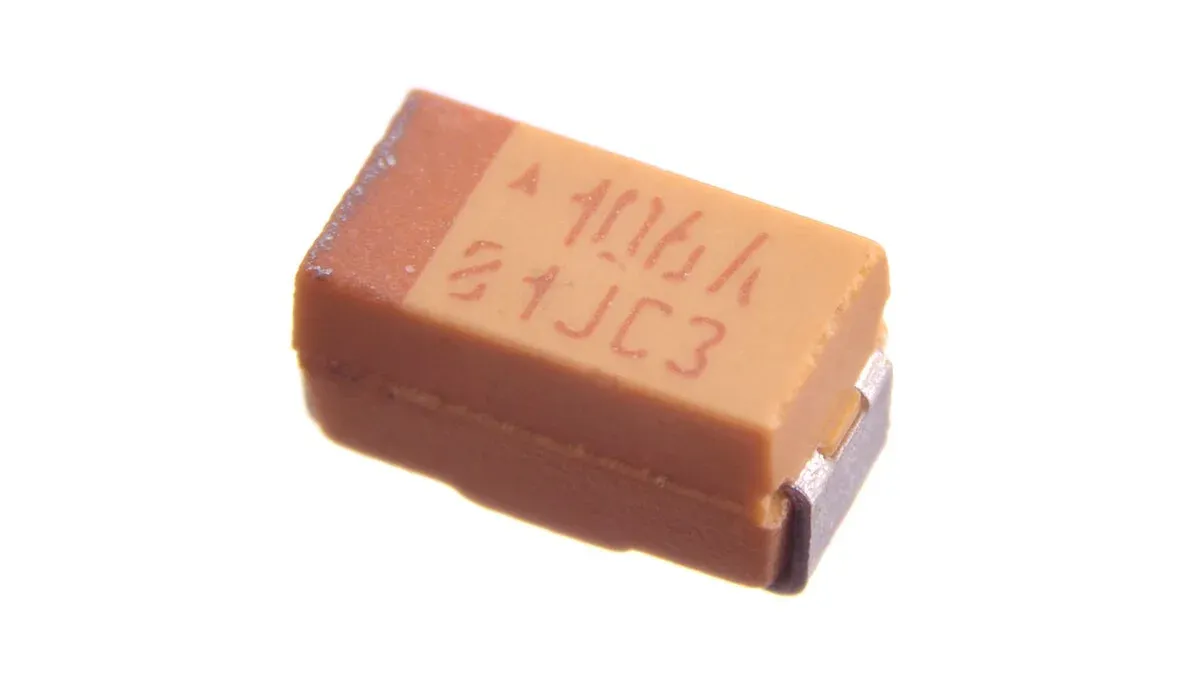
A tantalum capacitor quotation can match capacitance, voltage and case size while changing the cathode technology. For a purchasing team, that is a design change hidden inside an apparently simple alternate offer.
The useful approval question is whether the replacement preserves the circuit’s startup, steady-state and transient behavior. Polymer and manganese-dioxide parts should be compared against the actual supply network and the exact manufacturer series. This guide concerns solid tantalum replacements; wet aluminum capacitors require a different endurance assessment.
Can polymer tantalum replace manganese-dioxide tantalum?
A polymer tantalum part can be a replacement candidate, but matching microfarads and rated voltage does not establish interchangeability. Check cathode technology, equivalent series resistance (ESR), leakage limits, temperature range, surge guidance and mechanical compatibility before approving the change.
Both technologies use tantalum oxide as the dielectric. Their different cathode systems affect the properties that the circuit sees. KYOCERA AVX’s tantalum application guide provides the technical basis for evaluating tantalum construction and application conditions. The correct purchasing record identifies the old and proposed series rather than describing both simply as “solid tantalum.”
Use a comparison that makes unresolved differences visible:
| Approval field | Evidence to request | Reason to hold the alternate |
|---|---|---|
| Technology and full code | Manufacturer series and complete ordering code | Cathode construction remains unidentified |
| Capacitance and impedance | Limits over relevant temperature and frequency | The installed network falls outside its requirement |
| Leakage | Maximum limit under stated voltage, temperature and conditioning | Standby or bias-current budget is exceeded |
| Application voltage | Series guidance and measured rail envelope | Startup or transient conditions are missing |
| Assembly | Drawing, polarity, reflow and handling instructions | Board fit or production handling differs |
How should buyers evaluate voltage derating and startup surge?
Evaluate the maximum voltage and charging conditions against the exact series instructions, including temperature and source impedance. A single derating percentage cannot qualify every tantalum technology, series or application.
As a hypothetical example, a nominal 12 V rail operating a 16 V capacitor uses 75% of the nameplate voltage. That arithmetic says nothing about a startup overshoot, a hot operating corner or the charging current from a low-impedance source. Record those conditions before asking whether the voltage margin is adequate.
The KYOCERA AVX polymer guidelines distinguish polymer application behavior from conventional manganese-dioxide designs. Apply the guidance to the named series; do not turn a recommended condition into a universal assurance about failure behavior.
Engineering should identify the worst charging event, including connection to an already energized rail where relevant. Procurement can then request the supplier’s corresponding documentation and retain the evaluation result with the approved alternate. An unqualified “surge tested” description leaves the test circuit and acceptance limits unknown.
Why can lower ESR create a different circuit response?
Lower ESR changes the impedance of the capacitor network and may change damping or regulator stability. It should be checked against the circuit’s allowed capacitor characteristics, not treated as an automatic improvement.
A replacement may reduce ripple loss while changing a startup waveform or a load-step response. This is especially relevant when the capacitor is part of a regulator’s compensation assumptions. The LDO selection guide explains why the regulator and its output network need to be considered together.
Keep leakage separate from ESR in the review. A low-ESR offer does not establish low leakage, and a typical leakage value cannot stand in for the applicable maximum. Compare the limits at the operating conditions that matter to the product, particularly for backup or standby functions.
Which records belong in a tantalum replacement approval?
Retain the two complete part identities, the parameter comparison, the circuit conditions tested and the resulting acceptance limits. Approval should identify any change to assembly handling or the bill of materials, not just state that the sample fitted the board.
A practical release record also distinguishes what was demonstrated from what remains conditional. Passing a startup check on one board does not establish every production or environmental corner. If the application envelope changes, revisit the alternate instead of carrying its approval into a new design automatically.
For a proposal involving a change to wet aluminum technology, use the separate electrolytic replacement assessment. Its ripple and endurance questions cannot be substituted for the tantalum-specific surge and leakage review.
Frequently Asked Questions (FAQ)
Does a case code define the complete tantalum capacitor footprint?
No. Confirm the manufacturer drawing, terminal dimensions, height and recommended land pattern. A familiar case label is a useful filter, but does not replace the dimensional comparison.
Can a capacitance meter confirm that a tantalum alternate is suitable?
No. A room-temperature capacitance reading does not establish surge behavior, leakage at operating temperature, ripple capability or stability in the installed circuit.
Should the packing suffix remain on the approved purchase line?
Yes. Retain the complete ordering code, including the packing suffix, and verify orientation, reel requirements and any applicable moisture-handling instructions.