Table of Contents
Headlines around Gulf sovereign AI megaprojects focus almost exclusively on GPU allocations and diplomatic chip agreements. Yet late-November 2026 market data shows a much broader physical buildout already consuming industrial electronics across Saudi Arabia, the United Arab Emirates, and neighboring GCC states (Qatar, Oman, Kuwait, and Bahrain). According to Allianz Trade’s GCC Semiconductors Report 2026, installed GCC data center capacity reached ~900 MW in 2025 and is projected to exceed 3 GW by 2030, backed by ~3.5 GW of planned IT load—while Saudi Arabia’s operational footprint stood at 467 MW in Q1 2026 on a path toward a ~1.5 GW 2030 national target.
Between November 1 and November 26, 2026, concrete capital and partnership milestones moved from memoranda toward equipment procurement: HUMAIN closed its 51% PIF / 49% Aramco ownership deal on November 1; Saudi Arabia’s National Infrastructure Fund signed targeted computing and electrical infrastructure financing facilities on November 9; Korea’s KIEP published a detailed November 24, 2026 analysis of Middle East AI value-chain deployments; and UAE’s Stargate UAE (1 GW) anchor inside Abu Dhabi’s 5 GW AI campus vision advanced alongside NEOM DataVolt’s 360 MW first-phase construction (started August 2026). Even where cutting-edge GPU delivery faces shifting export scrutiny (see our November 2026 BIS remote-access IFR analysis), the power substations, cooling plants, UPS rectifiers, and utility-scale BESS arrays behind every Gulf megawatt create durable multi-year demand for non-GPU industrial automation semiconductors.
What separates live Gulf capacity from 2030 megaproject pipelines?
Evaluating Gulf semiconductor demand responsibly requires distinguishing installed, financed construction from long-horizon multi-gigawatt targets reported across November 2026 policy and trade briefs.
| Gulf infrastructure indicator (verified as of Nov 26, 2026) | Live / financed reality | Announced 2030 pipeline & target | Non-GPU hardware pull-through |
|---|---|---|---|
| GCC total data center capacity (Allianz Trade 2026) | ~900 MW installed (2025 baseline) |
>3 GW installed by 2030 (~3.5 GW planned IT load) |
Grid protection relays, SCADA gateways, UPS/800 VDC conversion, HVAC/cooling PLCs |
| Saudi Arabia operational & financed builds (Nov 2026 disclosures) | 467 MW operational (Q1 2026); AMD MI355X live (Aug 31); NEOM DataVolt 360 MW Phase 1 broke ground (Aug); HUMAIN 51% PIF / 49% Aramco closed (Nov 1); National Infrastructure Fund electrical/compute financing (Nov 9) |
~1.5 GW national 2030 target; HUMAIN frameworks up to ~6 GW long-term ambition (NVIDIA/AMD/Cisco/Qualcomm/xAI/center3) |
High-temp (-40 °C to +100/125 °C) substation FPGAs, sulfur-hardened control boards, BESS stacks |
| UAE hyperscale & AI cloud buildout (Allianz Trade / KIEP Nov 24 / The National Nov 26) | Active UAE cloud & G42/Pax Silica infrastructure rollouts; regional re-export & consolidation hub | ~1 GW Stargate UAE compute cluster anchoring Abu Dhabi’s 5 GW joint AI campus vision |
High-density optical/network switchgear, multi-line OEM BOM consolidation via UAE free zones |
| Wider GCC industrial & fab-input footprint | Qatar supplies ~1/3 of global high-purity helium for semiconductor fabs; GCC oil/LNG powers Asian foundries; Oman, Kuwait & Bahrain expanding solar/grid telemetry |
Cross-border GCC grid interconnection & renewable-storage firming for continuous data-center power | Industrial control spares & BESS electronics routed via GCC regional logistics hubs |
Look closely at the financing signal on November 9, 2026: Saudi Arabia’s National Infrastructure Fund explicitly linked financing facilities across both computing infrastructure and electrical power infrastructure. Because desert AI facilities require continuous firm power and aggressive thermal management (geothermal, liquid, and hybrid chilled-water loops operating in 45–55 °C summer ambients), electrical grid, cooling, and battery-storage contractors place orders for control electronics months or years before GPU racks arrive on site.
Which non-GPU industrial semiconductors see direct pull-through across Gulf builds?
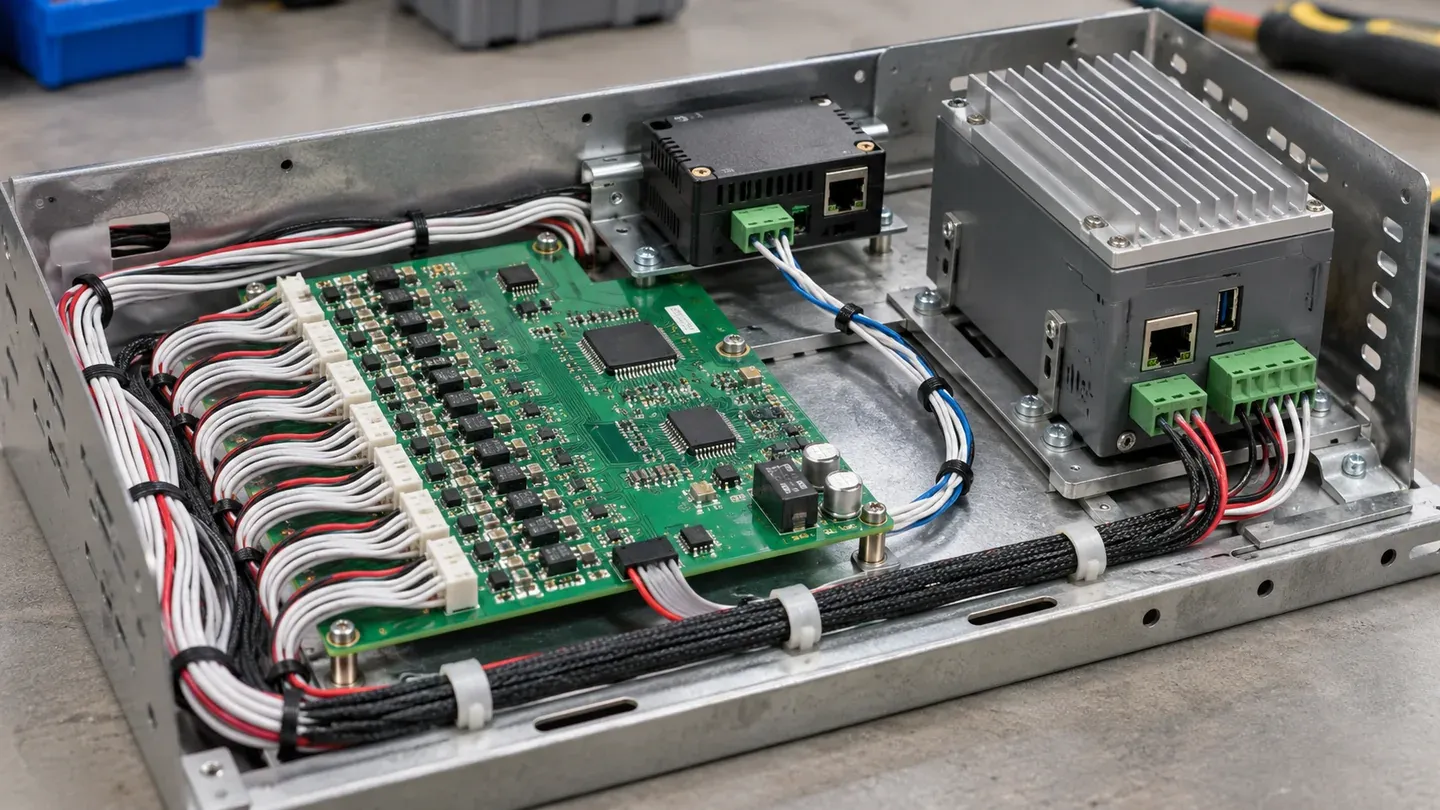
Three non-GPU device families sit directly on the critical path of Gulf data-center electrical rooms, substation feeders, and solar-plus-storage microgrids—matching the exact industrial catalog segments where extended temperature and reliability grades matter most:
- Substation protection, inverter control, and telemetry FPGAs (Kintex-7 XC7K325T & industrial 28 nm lines): Grid-forming inverters, solid-state transfer switches, and high-speed power-quality analyzers rely on industrial-grade (
-40 °C to +100 °Cjunction) 28 nm FPGAs for deterministic microsecond protection loops, synchronized phasor measurement, and optical fiber telemetry. Both AMD (7 Series supported through 2040) and Altera (Cyclone V supported through 2045) anchor 15-to-20-year utility maintenance cycles across the region. - High-voltage galvanic isolation (ADuM1401 & wide-body isolators): Switchgear controllers,
400–800 VDCUPS power shelves, and liquid-cooling telemetry buses require2,500 Vrms–5,000 Vrmsreinforced galvanic isolation (−40 °C to +125 °C, wide-bodyRW-16creepage) capable of surviving continuous cabinet heat and switching ground transients without LED-optocoupler CTR degradation over 10-year service windows. - Utility-scale BESS battery stack monitors (LTC6811): Pairing desert solar generation with
24/7AI data-center base load requires gigawatt-hour stationary battery storage (BESS) racks. High-voltage1,000–1,500 Vcontainerized BESS strings depend on daisy-chainedisoSPI12-cell monitors (HG125 °Cgrade,≤1.2 mVaccuracy,26 Hzfiltered ADC mode for inverter-ripple immunity) paired with sulfur-resistant conformal protection (see our Gulf industrial electronics conformal coating and sulfur-corrosion guide).
Planning scenarios and regional procurement triggers for 2027
Because late-November 2026 reporting (including The National on November 26 and Fortune on November 18, 2026) highlights ongoing U.S. export-policy uncertainty alongside rapid sovereign capital deployment, Gulf contractors should plan 2027 industrial electronics sourcing around three triggers:
- Base case (steady electrical/BESS pull even if GPU cluster timing staggers): Power substations, switchgear, cooling controls, and BESS deployments proceed on multi-year civil/utility schedules across Saudi Arabia, the UAE, Qatar, Oman, Kuwait, and Bahrain, sustaining firm demand for industrial-grade
-IFPGAs,125 °Cisolators, and BMS ICs through 2027–2028. - Upside acceleration trigger: If sovereign AI deployments (HUMAIN Phase 1/2, NEOM DataVolt
360 MW, Stargate UAE) clear bilateral compute-access milestones rapidly in H1 2027, local system integrators will pull forward 800 VDC power-shelf, optical-telemetry, and cooling-controller BOMs simultaneously—colliding with already-extended global analog (16+ week) and MLCC (24–48 week) factory queues. - Policy/delay sensitivity: If tighter U.S. export licensing slows compute-hall commissioning, GPU-rack accessories pause first while utility grid and renewable-BESS maintenance spares stay active; contractors should lock rolling 20-to-26-week inventory on shared utility-grade industrial silicon while keeping compute-specific optical/board lines tied to confirmed project release milestones.
Aligning Gulf project BOMs with customs and environmental readiness
Converting Gulf infrastructure contracts into trouble-free field commissioning requires connecting technical part selection directly to regional logistics: specify industrial (-40 °C to +100/125 °C) grades, ASTM B809 anti-sulfur passives, and MSL 3 dry-pack controls upfront on every BOM, and map destination clearance early—whether shipping directly into Saudi industrial cities via ZATCA, SABER, and SPL National Address workflows or consolidating multi-vendor GCC project kits through UAE free zones.
Frequently Asked Questions (FAQ)
How large is operational vs planned GCC AI data center capacity as of late November 2026?
Per Allianz Trade's 2026 GCC Semiconductors Report and Saudi communications ministry figures reported in November 2026, GCC installed data center capacity reached roughly 900 MW in 2025 (including 467 MW operational in Saudi Arabia in Q1 2026), with over 3.5 GW of planned IT load and projections exceeding 3 GW installed by 2030.
Why do Gulf AI data center projects pull heavy demand for non-GPU industrial semiconductors?
Every megawatt of desert AI compute requires substations, switchgear, cooling plants, UPS/rectifier racks, and utility-scale battery energy storage systems (BESS)—all of which depend on industrial FPGAs (Artix-7, Kintex-7, Cyclone V), reinforced digital isolators (ADuM1401), precision signal chains, and high-voltage BMS monitors (LTC6811).
How do November 2026 U.S. export-control updates affect Gulf infrastructure hardware sourcing?
While the November 16/19, 2026 BIS remote-access interim final rule (91 FR 74970) and ongoing U.S. policy scrutiny create licensing and governance checks for cutting-edge AI compute clusters, supporting power-grid, substation, cooling, and BESS buildouts continue progressing under standard industrial trade compliance.
Are Gulf industrial electronics projects limited to Saudi Arabia and the UAE?
Saudi Arabia and the UAE anchor the largest hyperscale pipelines, but regional electrical, petrochemical, and cloud infrastructure activity spans the wider GCC—including Qatar, Oman, Kuwait, and Bahrain—with many project BOMs consolidated via Dubai/Abu Dhabi or Riyadh/Dammam logistics hubs.