Table of Contents
Industrial control boards deployed across petrochemical complexes, sour-gas fields, desalination plants, and utility-scale solar/BESS substations in Saudi Arabia, the United Arab Emirates, and neighboring GCC industrial corridors (Qatar, Oman, Kuwait, and Bahrain) rarely fail from silicon wear-out. Instead, premature field outages cluster around three interacting stressors: sulfur-driven corrosion of silver-bearing terminations (ANSI/ISA-71.04 G2/G3), cyclic condensation under 45–55 °C outdoor ambient swings, and moisture-damaged spare ICs pulled from inadequately controlled coastal stores.
Specifying the right board-level protection starts at the component BOM and incoming storage workflow—long before a repair kit reaches a cabinet. General moisture-baking rules appear in our moisture-sensitive component floor-life guide, while metal-finish whisker mechanisms are covered in our tin-whisker finish procurement review.
Why do Gulf industrial atmospheres trigger rapid silver-sulfide failures on standard BOMs?
Airborne corrosion surveys documented by Peters (White Paper LP 191309 E-0) and Siemens SIPROTEC 5 conformal-coating profiles show that trace hydrogen sulfide (H2S, 0.01–0.1 ppm in general industrial air and ≥10 ppm in localized petrochemical zones), sulfur dioxide (SO2, 0.1–1 ppm), and chlorides (Cl2/HCl, 0.01–0.1 ppm) attack exposed silver and copper aggressively whenever relative humidity exceeds 50–60%. Under ANSI/ISA-71.04-2013, site air quality is classified by 30-day copper and silver coupon corrosion thickness into G1 (Mild), G2 (Moderate), G3 (Harsh), and GX (Severe).
Two specific component-level failure modes account for the majority of Gulf G2/G3 field returns:
- Thick-film chip resistor open-circuits (
Ag2Screeping corrosion): Conventional thick-film SMD resistors (0402/0603/0805) use a silver-palladium (Ag-Pd) inner electrode beneath the outer nickel/tin plating. TraceH2Spenetrates microscopic porosity at the overcoat-to-termination junction, converting conductive silver into non-conductive black silver sulfide (Ag2S)—which expands, fractures the protective overcoat, and drives the resistor open-circuit. Simultaneously, silver sulfide whiskers (“creeping corrosion”) can grow across adjacent pads, creating intermittent shorts on high-impedance analog and ADuM1401 isolation barriers. - Board-finish tarnish and dendrite growth: Boards built with bare Immersion Silver (
ImAg) suffer direct sulfur attack across exposed vias and test pads, whereas ENIG (electroless nickel immersion gold) or ENEPIG blocks direct silver exposure when paired with solder-mask tented vias.
Procurement rule: For any industrial automation BOM bound for GCC refineries, wastewater plants, or coastal substations, specify ASTM B809 (“Flowers of Sulfur”) qualified anti-sulfur thick-film resistors (featuring high-gold-content inner electrodes or reverse-geometry barrier plating) alongside ENIG PCB finishes—never allow contract manufacturers to auto-substitute generic commercial chip resistors during kitting.
How do IPC-CC-830 conformal coating chemistries compare for Gulf harsh environments?
IPC-CC-830 (successor to MIL-I-46058C) qualifies liquid and vapor-deposited electrical insulating coatings across insulation resistance, thermal shock, moisture resistance, and fungus resistance. Selecting the wrong chemistry—or coating indiscriminately over sensitive packages—creates new reliability defects under Gulf operating temperatures.
| IPC-CC-830 type | Thermal & chemical profile | Sulfur (H2S) / moisture barrier |
Field reworkability | Primary Gulf deployment notes |
|---|---|---|---|---|
Acrylic (AR) |
Up to ~125 °C; weak against hydrocarbon solvents/vapors |
Moderate humidity barrier; permeable to harsh petrochemical vapors | Very easy (solvent removal) | Suitable for mild indoor G1 cabinets; insufficient alone for G3 refinery environments |
Urethane / Polyurethane (UR) |
Up to ~125–130 °C; strong chemical, solvent & abrasion resistance |
Strong moisture and gas barrier (G2/G3 workhorse) |
Difficult (requires thermal/mechanical strip) | Preferred liquid coating for petrochemical/coastal control boards when paired with anti-sulfur passives |
Silicone (SR) |
Wide −55 °C to +200 °C range; flexible under thermal cycling |
Good liquid-water shedding, but higher gas permeability to H2S |
Moderate (specialized stripper) | Best for high-power/high-temp inverter boards (>125 °C hotspots); pair strictly with ASTM B809 passives |
Parylene (XY) |
Vapor-deposited, uniform pinhole-free 10–25 µm film |
Highest gas & moisture barrier across sharp lead edges | Very difficult (abrasive/plasma) | Used on mission-critical G3/GX sensor modules where budget supports vacuum deposition |
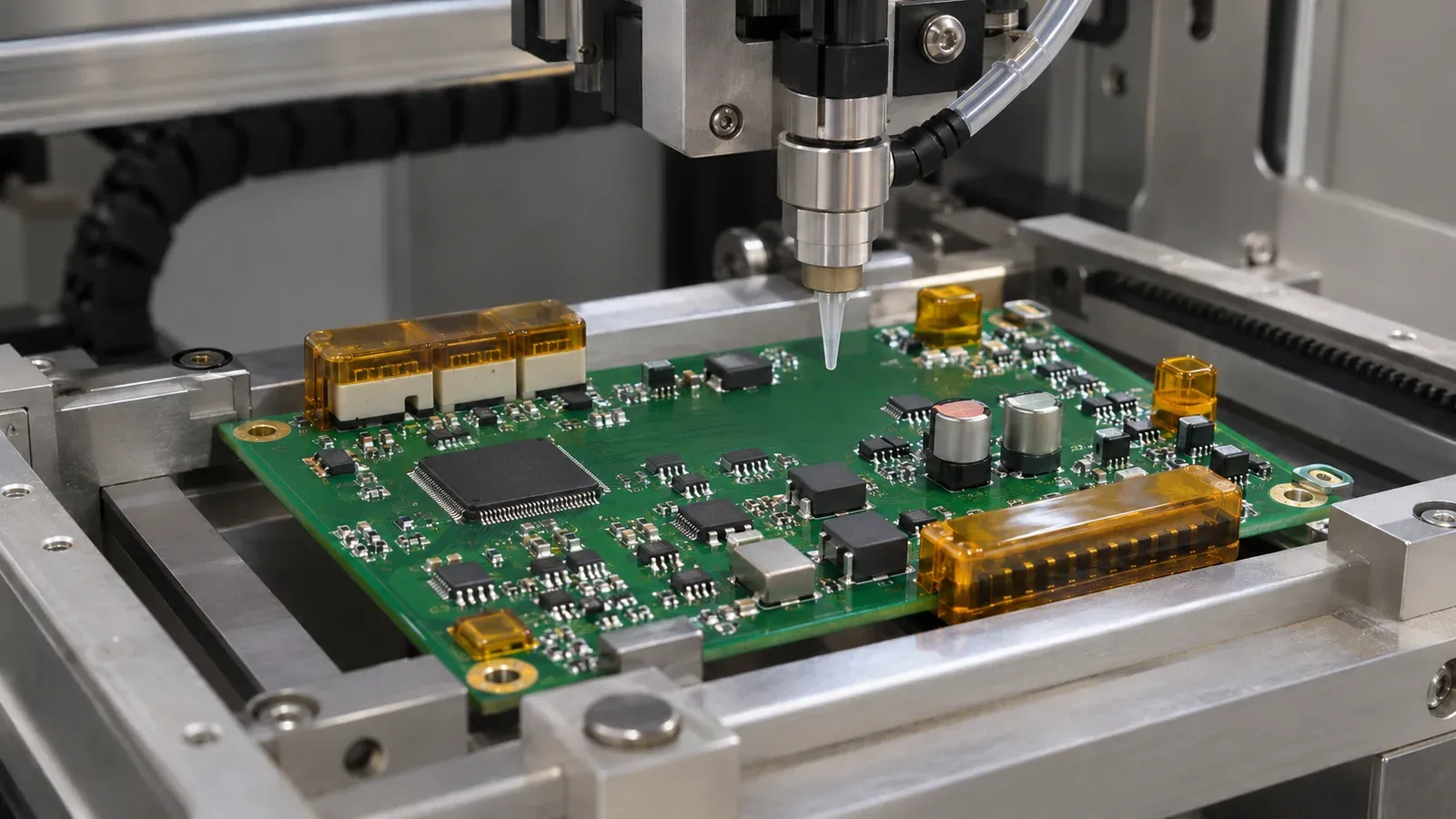
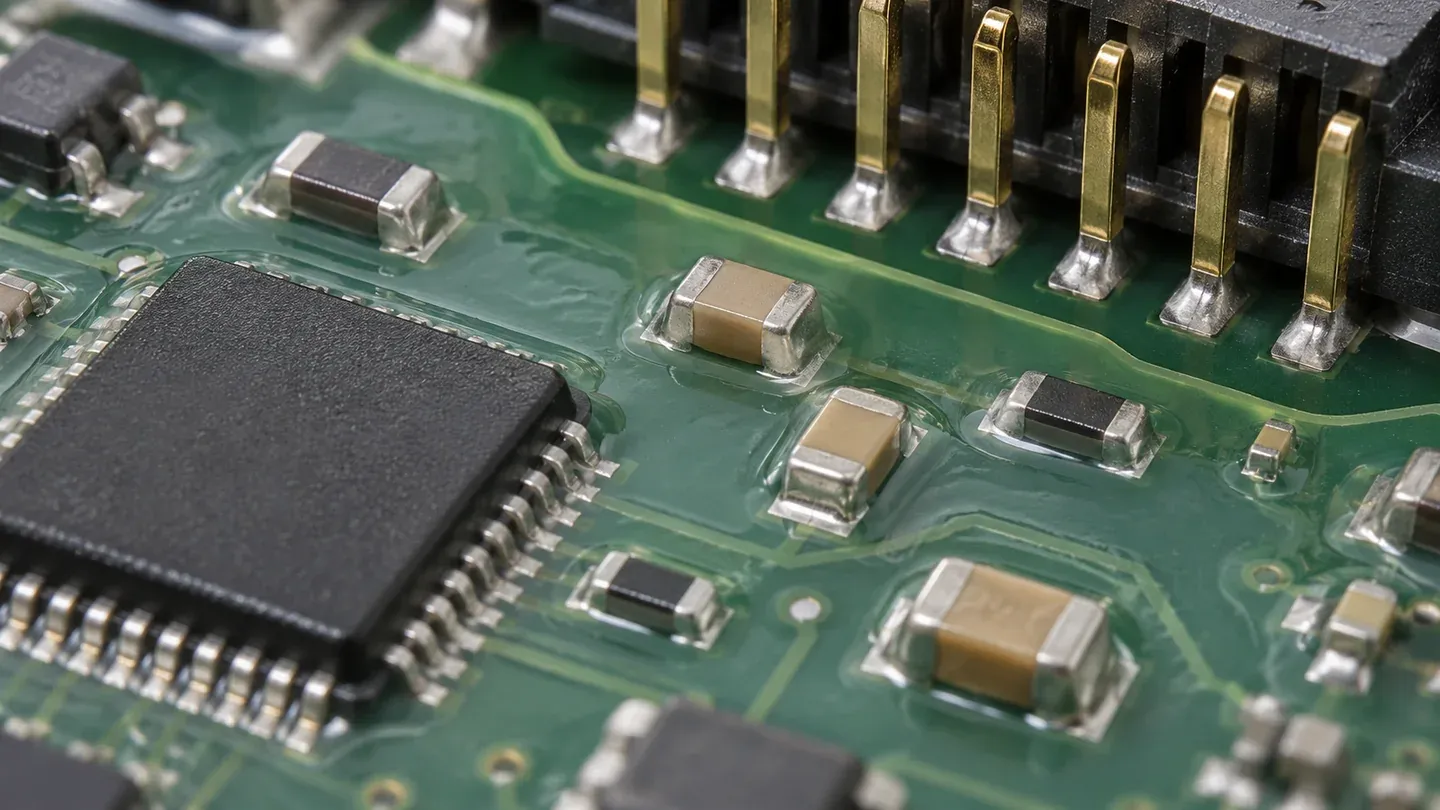
Enforce explicit conformal-coating keep-out drawings on every assembly package: mask electrical connectors, DIP switches, barometric/humidity sensor ports, optical transceivers, heat-sink thermal-interface pads, and—critically—fine-pitch BGA perimeters (such as XC7A100T FPGAs) unless capillary underfill or dam-and-fill compatibility has been formally thermal-cycled. Thick liquid resin wicking partially underneath a BGA causes severe CTE-mismatch solder-ball fatigue across desert day-night thermal cycles.
Controlling MSL 3 spares in 45–55 °C coastal GCC warehouses
Board reliability starts before SMT rework even begins. Maintenance teams supporting plants across Gulf regional logistics hubs (routing through Riyadh, Dammam, Jeddah, Dubai, and Abu Dhabi into wider GCC sites) routinely hold spare FPGAs, isolators, and precision references on-site for emergency repair. Opening a sealed MSL 3 dry pack (168-hour rating at ≤30 °C / 60% RH) inside a humid coastal workshop accelerates moisture diffusion dramatically, turning emergency hot-air BGA rework into immediate package delamination.
Establish four receiving and spares-room controls aligned with JEDEC J-STD-033D and SupplyICs quality verification guidelines:
- Order maintenance spares in individual factory-sealed or re-baked dry packs: Request small-quantity maintenance kits sealed with fresh desiccant and readable Humidity Indicator Cards (
HIC) rather than loose ESD tubes for MSL 2A–4 devices. - Maintain active
<5% RHdry cabinets at plant stores: Store opened reels, partial trays, and unmounted repair BGAs inside monitored desiccant or nitrogen dry cabinets (≤5% RHat controlled20–25 °C) rather than general air-conditioned shelving where door openings spike humidity. - Require pre-rework baking logs on unsealed spares: Whenever an HIC reads
≥10%pink or floor-life logs are missing on a coastal site spare, run a controlledJ-STD-033Dbake (in high-temp trays at125 °Cor40 °C / ≤5% RHlow-temp dry bake) before soldering. - Separate sulfur-hardened BOM lines from generic MRO orders: Keep ASTM B809 anti-sulfur resistor part numbers, ENIG board revisions, and IPC-CC-830 coating specifications locked inside the spare-parts master so urgent replacements match the original harsh-environment qualification.
Frequently Asked Questions (FAQ)
Does applying silicone conformal coating automatically prevent hydrogen sulfide (H2S) resistor failure?
Not by itself. Silicone conformal coatings exhibit relatively high gas permeability compared with polyurethane or Parylene, allowing H2S vapor to diffuse slowly to unprotected silver-palladium resistor terminations. In ISA-71.04 G2/G3 oil, gas, and wastewater sites, pair qualified IPC-CC-830 coating with ASTM B809 anti-sulfur chip resistors.
Why should conformal coating keep-out zones exclude fine-pitch BGA perimeters unless validated?
Liquid conformal coating can wick unevenly beneath low-standoff BGA packages via capillary action. During high-amplitude Gulf thermal cycling (for example, 25 °C air-conditioned nighttime to 75 °C daytime cabinet peaks), trapped resin with a higher coefficient of thermal expansion than solder exerts vertical tensile stress that cracks corner BGA solder joints.
Which PCB surface finish resists sulfur-bearing Gulf industrial atmospheres better: ENIG or Immersion Silver?
ENIG (Electroless Nickel Immersion Gold) resists H2S tarnishing and silver-sulfide whisker growth far better than bare Immersion Silver (ImAg). Exposed silver reacts directly with atmospheric sulfur compounds to form conductive silver sulfide whiskers that bridge fine-pitch SMT pads.
How quickly does coastal Gulf humidity degrade an opened MSL 3 FPGA bag?
JEDEC J-STD-033 rates MSL 3 for 168 hours only at ≤30 °C and ≤60% RH. Inside an unconditioned 40 °C / 75% RH coastal maintenance workshop in Jubail, Dammam, or Jebel Ali, moisture absorption accelerates sharply—requiring immediate resealing with fresh desiccant or active <5% RH dry-cabinet storage.