Table of Contents
A messy bill of materials slows component quoting more than any single factory shortage. When an engineering spreadsheet leaves an ERP export with truncated ordering suffixes, outdated manufacturer names, ambiguous carrier fields, and unflagged end-of-life (EOL) lines, distributors spend days bouncing clarification emails back and forth—or worse, quote incompatible grades and reel formats that fail incoming inspection.
Running a disciplined 6-step electronic component BOM scrubbing protocol before submitting a BOM upload or component RFQ turns an ambiguous parts list into an award-ready procurement package. Strategic scoring frameworks appear in our BOM risk assessment framework, while commercial bid evaluation is covered in our MOQ, MPQ, and NCNR RFQ comparison guide.
What are the 6 steps of an engineering-grade BOM scrubbing workflow?
Effective BOM scrubbing checks six technical and commercial failure points in sequence—from part-number identity down to supplier-ready RFQ columns—so procurement and engineering resolve discrepancies once instead of re-checking them across five competing distributor bids.
| Scrubbing step | Core verification check | Real-world defect caught before RFQ | Output artifact |
|---|---|---|---|
| 1. Complete MPN & suffix normalization | Preserve exact manufacturer punctuation (., #, -) and trailing tokens (Z, W, -EP, FGG, I7N, #TRPBF) |
Prevents quoting SnPb (FG) instead of Pb-free (FGG), commercial (C) instead of industrial (I), or tubes instead of SMT reels |
Clean canonical MPN + current OCM brand column |
| 2. RoHS, REACH & finish audit | Check current Pb-free compliance and flag Pack 22 EU RoHS exemptions (6(a), 6(b), 7(a), 7(c)-I) expiring 2026–2027 |
Catches thick-film resistors (7(c)-I), power semiconductors (7(a)), and aluminum brackets (6(b)) requiring updated declarations or redesign |
Compliance flag column (Exemption-Free vs action date) |
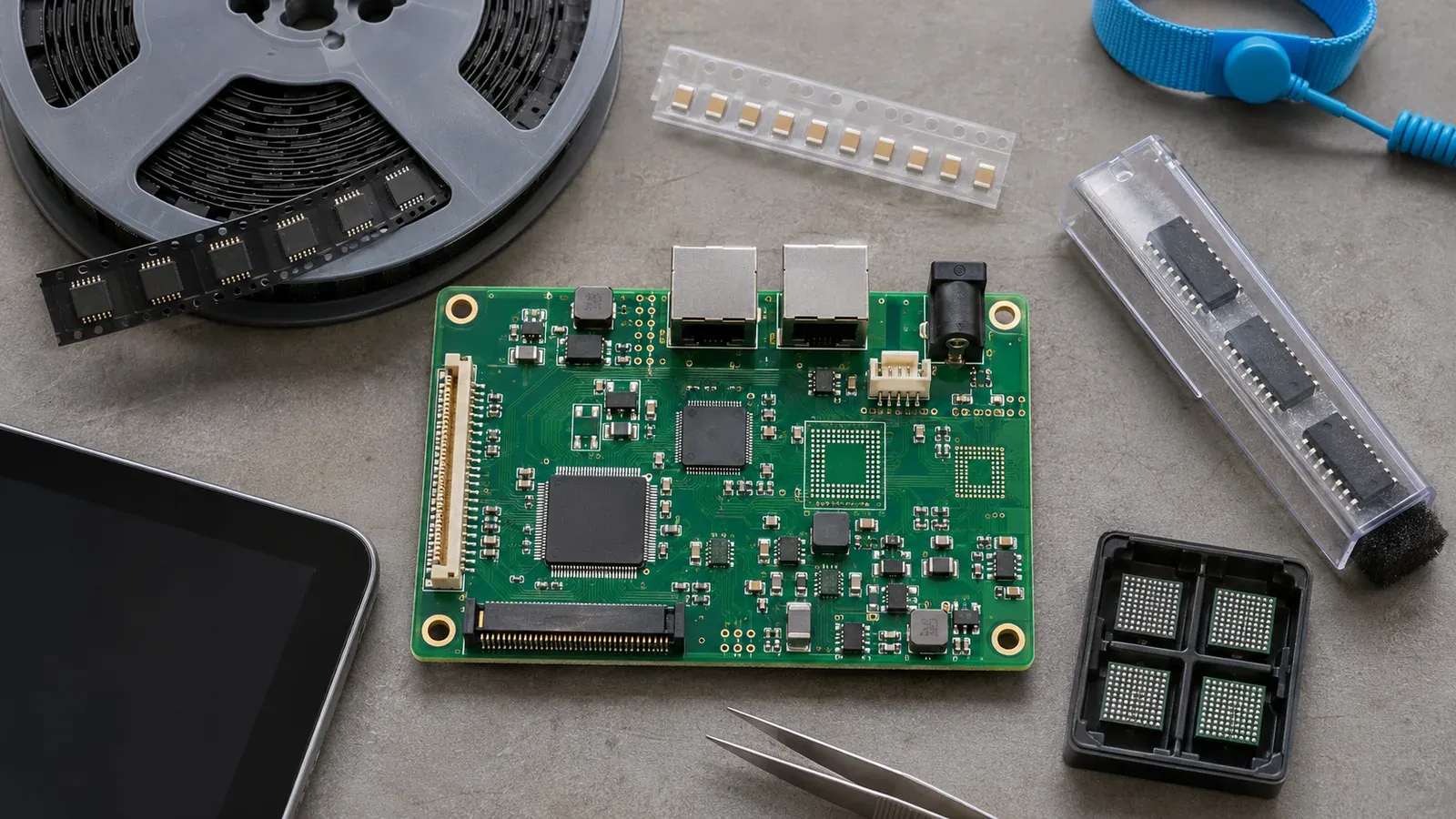
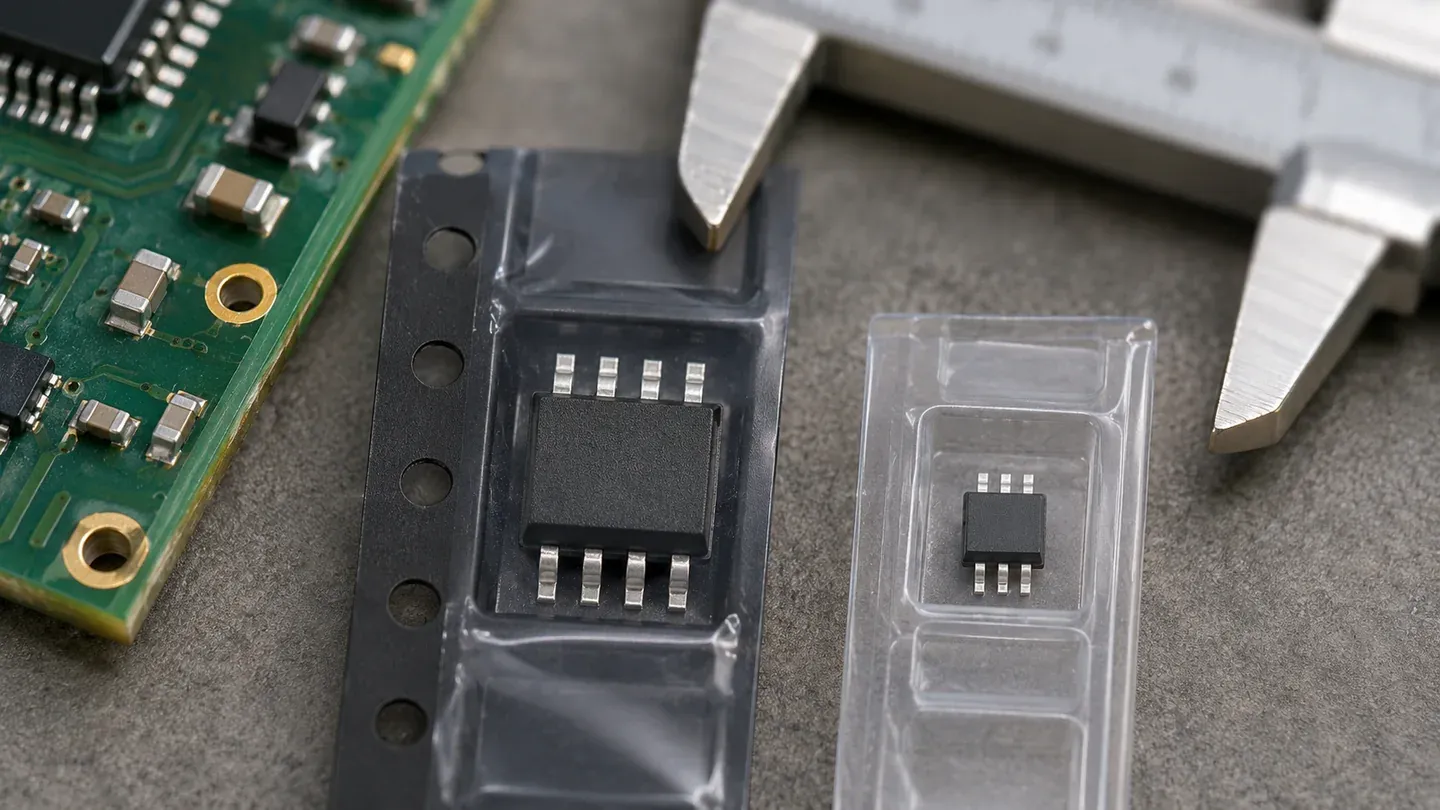
| 3. Carrier, MPQ, MOQ & attrition | Align cut tape, 7-inch/13-inch reels, or JEDEC trays to EMS feeder rules + add 2–5% passive / 0–1% IC attrition |
Eliminates unexpected NCNR full-reel surcharges (5,000 pcs MOQ for a 200-pc pilot build) and feeder-leader shortages |
Explicit Required Carrier & Order Qty (incl. attrition) columns |
| 4. Lifecycle & PCN/PDN risk tiering | Classify every line: Active, Constrained (>20w), NRND, LTB/PDN, or Obsolete |
Separates urgent sole-source LTB items from active multi-source passives; catches packing-only PCNs (e.g., -RL → -R7) |
Risk tier (P0–P3) + documented PCN/PDN reference |
| 5. FFF alternate & AML gating | Map pre-approved Approved Manufacturer List (AML) alternates; lock No-Sub lines |
Stops brokers or distributors from substituting lower-grade dielectrics (X5R for X7R) or mismatched speed grades |
Separate Approved Alternate MPN + Sub Policy columns |
| 6. Standardized RFQ schema | Export a locked 12-column bid sheet with explicit date-code, inspection, destination, and partial-ship terms | Produces apples-to-apples landed quotes across authorized and independent suppliers on the first pass | Locked CSV/XLSX RFQ package |
Look at how Step 1 and Step 2 prevent expensive downstream mistakes in practice: across complex component series guides, stripping . or # turns LTC6655BHMS8-2.5#TRPBF into an unmatchable string, dropping FGG vs FG mixes Pb-free and eutectic tin-lead BGA balls, and overlooking Commission Delegated Directive (EU) 2025/1802 and Texas Instruments’ EU RoHS Exemption Statement Rev. N (detailed in our 2026–2027 EU RoHS exemption deadlines guide) may leave EU-destined builds relying on expired 7(a) or 7(c)-I certificates across the 2027 planning horizon.
Which 12 columns belong in a bid-ready electronic component RFQ?
Eliminate open-ended email threads by standardizing every multi-line BOM export into twelve explicit columns before sending it out for pricing:
Line_ID&Ref_Des: Ties every supplier quote back to schematic designators and PCB build revision.OCM_Brand: Uses current manufacturer identity (for example,Analog DevicesforLTCprefixes,AMD (Xilinx)forXC7*,Alterafor5C*/10CL*).Full_MPN: Complete, untruncated orderable manufacturer part number including voltage, grade, package, finish, and packing tokens.Build_Qty&Order_Qty: Separates net kit quantity from attrition-adjusted purchase quantity (for example,250net +5%SMT feeder attrition =263rounded to300cut-tape or full-reel break).Carrier_Required: ExplicitCut Tape,7-inch Reel,13-inch Reel,JEDEC Tray, orTubeso EMS lines never receive loose bulk bags.Sub_Policy: Strictly one ofExact Only,Approved AML Only, orOpen to Engineering Review(directing unapproved crosses into a formal component alternatives workflow rather than silent substitution).Approved_Alternates: Pre-qualified secondary MPNs already cleared by hardware engineering.Target_Dock_Date: Required warehouse arrival date (separated from target SMT start date to preserve incoming inspection time).Compliance_Req:RoHS 3 Exemption-Free, specific Pack 22 sub-entry,REACH, orSnPb Leaded.Date_Code_&_Lot_Policy: Permitted manufacturing-date window (e.g.,≤24 monthsor≤36 monthswith solderability/dry-pack verification) and whether single-lot traceability is mandatory.Channel_&_QA_Scope:Authorized OnlyvsIndependent Permitted with Inspectionaligned to documented quality controls (visual, X-ray, decapsulation, or electrical blank check on scarce FPGAs).Destination_&_Split_Rule: Exact delivery country/city/free zone, consignee, and whether partial line shipments are accepted for urgent builds.
Separating scrubbing priorities between prototypes and volume production
Do not apply identical scrubbing depth to a 5-board engineering prototype and a 5,000-unit industrial production release:
- Prototype / EVT builds (
1–25 boards): Focus primarily on Steps 1, 3, and 4—verifying exact MPN suffixes, flaggingNRND/Obsoleteparts before the schematic freezes, and avoiding5,000-piece MOQ traps where cut-tape availability protects schedule. - Production / MRO continuity builds (
50+ boardsor multi-year spares): Enforce all 6 steps before issuing annual RFQs—locking Pack 22 RoHS documentation, pre-qualifying dual-source passives and power supervisors (>16–24 weeklead times), and separating urgent line-down repair quantities from planned replenishment buffers.
Pre-release handoff between engineering and purchasing
Establish one formal sign-off gate before any scrubbed BOM enters supplier bidding: engineering owns Full_MPN, Compliance_Req, Sub_Policy, and Approved_Alternates; purchasing owns Order_Qty, Carrier_Required, Target_Dock_Date, Date_Code_&_Lot_Policy, and Destination_&_Split_Rule. Keeping technical identity and commercial terms cleanly separated—but locked in the same file—cuts quote turnaround time and prevents clerical substitutions from reaching the SMT floor.
Frequently Asked Questions (FAQ)
What is the difference between a basic distributor BOM upload and engineering BOM scrubbing?
A basic distributor upload checks price and stock against whatever text string sits in the spreadsheet. Engineering BOM scrubbing first normalizes truncated part numbers, validates suffixes and packing carriers, flags expiring RoHS exemptions and PDN/EOL risks, and gates approved Form-Fit-Function alternates before any RFQ leaves the building.
Why do truncated MPNs cause quoting delays and wrong-part shipments?
Dropping trailing characters—such as #PBF vs #TRPBF on Linear Technology parts, FGG vs FG on Xilinx BGAs, or C8N vs I7N on Altera Cyclone FPGAs—forces distributors either to halt quoting for clarification or to quote an incompatible lead finish, temperature grade, or SMT carrier.
Should unapproved alternative part numbers be mixed into the primary MPN column of an RFQ?
No. Keep the primary MPN column strictly for engineering-released approved parts from the Approved Manufacturer List (AML), and place any candidate alternates in a separate clearly flagged column requiring engineering sign-off prior to purchase.
How often should an active industrial production BOM be scrubbed?
Scrub every new design before prototype-to-production release, every recurring industrial production BOM at least semi-annually (or quarterly during tight allocation cycles), and immediately prior to locking annual blanket POs or EU/export compliance renewals.