Table of Contents
A precision ADC cannot recover absolute accuracy that its reference does not provide. Yet choosing the lowest advertised temperature coefficient is not enough: initial tolerance, noise, calibration, load transients, and the specified temperature interval all affect the result.
Start with an error allocation at the system level. The component shortlist should follow that allocation, so purchasing can distinguish meaningful grade differences from specifications that do not improve the application.
An ADC reference error budget
For an illustrative unipolar 16-bit ADC with a 4.096 V input span, one ideal least significant bit (LSB) is:
4.096 V / 65,536 = 62.5 µV.
A 0.05% reference error equals 500 parts per million (ppm), or 2.048 mV at 4.096 V. That is equivalent to about 32.8 ideal LSBs at full scale. It does not imply that the converter loses 32.8 codes everywhere; reference error acts mainly as a gain error whose effect depends on signal level and converter architecture.
A system may calibrate that initial gain error and still benefit from high resolution. Write the uncalibrated and calibrated accuracy requirements separately. Otherwise, an absolute-accuracy requirement can be confused with a resolution or noise requirement.
Calibrated and uncalibrated terms
Analog Devices’ voltage-reference selection discussion, accessed September 15, 2026, distinguishes initial accuracy, temperature coefficient, long-term drift, and thermal hysteresis. It also explains why temperature coefficient is often a box specification over the stated range rather than a linear slope.
| Error term | Review question | Possible response |
|---|---|---|
| Initial output tolerance | Is it measured out during calibration? | Allocate residual calibration uncertainty |
| Temperature variation | What full interval does the guarantee cover? | Use the applicable limits and temperature characterization |
| Low-frequency and broadband noise | Which bandwidth reaches the measurement? | Match filtering and integration time |
| Load and line regulation | Do supply or reference loads move during conversion? | Evaluate source impedance and operating conditions |
| Hysteresis and aging | How long between calibrations and temperature cycles? | Retain a maintenance and drift allowance |
For a hypothetical 5 ppm/°C box specification over −40°C to +85°C, multiplying by the full 125°C span gives 625 ppm of full-range variation under that specification’s definition. Do not automatically divide it in proportion to a smaller operating interval; the curve may be nonlinear.
Keep worst-case limits separate from typical values. Root-sum-square combination also needs a justified statistical model; it should not replace a worst-case budget simply because it produces a smaller number.
Reference drive and conversion transients
The reference pin may draw conversion-related current pulses. The reference IC, any buffer, bypass capacitance, interconnect, and ADC input together determine settling at the pin.
Use the ADC manufacturer’s recommended reference network as the starting point, then confirm the reference device’s permitted load capacitance and stability conditions. A larger capacitor can reduce some transients while increasing startup time or creating a stability problem.
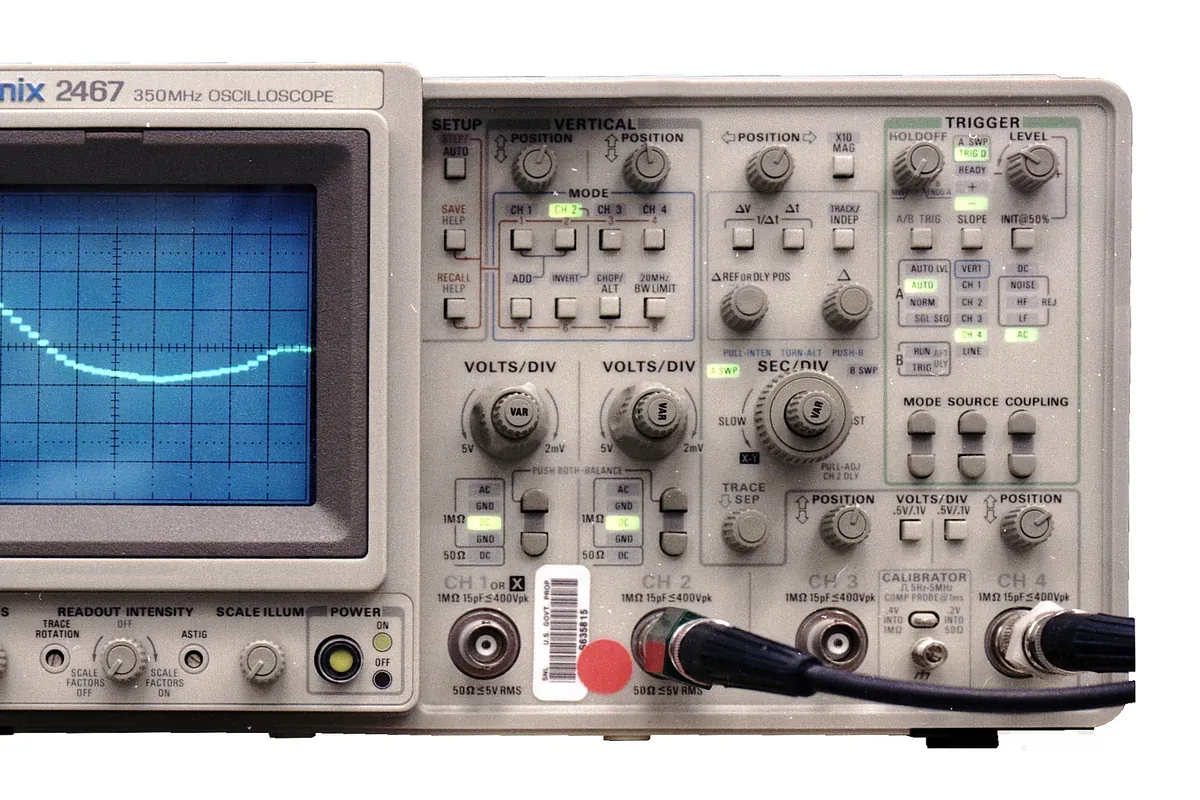
For a multiplexed acquisition system, evaluate the actual channel sequence and sample rate. A measurement that looks quiet at idle can change once conversions begin. Record the reference waveform and conversion results under representative loading, without treating a single oscilloscope trace as a complete accuracy measurement.
The AD7606B acquisition guide addresses a specific converter family; external-reference requirements must be checked for the exact converter and operating mode.
Accuracy grades and substitution constraints
A family name and nominal voltage are incomplete purchase requirements. Capture the output voltage, accuracy grade, temperature grade, package, and ordering suffix from the manufacturer’s table.
Compare candidates against the approved circuit: input headroom, source and sink capability, startup behavior, output capacitor, enable function, and board footprint. A reference with a tighter initial tolerance can still be unsuitable if it cannot drive the implemented load.
For broader signal-chain accuracy, keep this review connected to the instrumentation-amplifier error budget. The sensor front end and reference consume different parts of the same system allowance.
Release the measurement chain, not just the reference
An acceptance plan for industrial measurement hardware should specify calibration conditions, input test points, temperatures, sample rates, and power-cycle behavior. Include a method to distinguish reference drift from source and measurement-instrument uncertainty.
Retain the chosen grade, circuit revision, calibration procedure, and results together. That record allows a later source change to be assessed against a measurable requirement rather than against “same voltage, better ppm.”
Frequently Asked Questions (FAQ)
Does a 16-bit ADC require a reference accurate to one LSB?
It depends on the system's absolute-accuracy and calibration requirements. Resolution defines code spacing; reference error, ADC error, sensor error, and calibration determine measurement accuracy.
Can initial reference error be calibrated out?
A suitable system calibration can remove some initial gain error at the calibration conditions. Temperature changes, noise, hysteresis, aging, and dynamic settling still require separate treatment.
Is a lower-noise LDO a substitute for a voltage reference?
Only if its complete accuracy, drift, noise, loading, and stability behavior meets the reference input requirements. A regulator's power-supply role does not establish precision-reference suitability.